What is allyship? A brief history, present and future
- Written by: Wendy Marie Cumming-Potvin, Associate Professor/ Director of Research (School of Education), Murdoch University
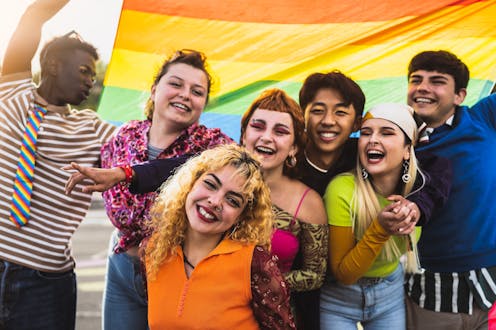
Despite social change, LGBTQI+ people still face discrimination at school[1] and in the community[2].
Language for diverse genders and sexualities is continually changing. LGBTQI+ allyship is part of this change. But what is allyship?
Allyship refers to people outside of a group – say, straight people – who actively support and work with people inside a group – say, LGBTQI+ people.
It can also mean people from different groups working together to support each other’s goals. A key example of this was at the Stonewall riots in 1969[3], when lesbians, gay men and transgender people joined with Black Panthers and civil rights activists in New York City to protest against police brutality.
But defining allyship can be challenging. Some people disagree about who an ally is. Others disagree about what an ally does.
What is an ally?
The term “ally” first appeared in US universities among students in the early 1990s[4]. It was used to describe how majority group members (straight students) helped minorities (gay, lesbian and bisexual students), by advocating to end sexuality-based oppression in higher education.
For many years, scholars have seen straight allyship for lesbian, gay and bisexual people as helpful for activism. Straight allies have played important roles in policy[5] and in combating prejudice[6] on high school and university campuses.
Research has shown university and high school gay–straight alliances have contributed[7] to more positive campus environments and a reduction in gender- and sexuality-based discrimination.

Over many years, gay–straight teacher alliances have successfully used[9] inquiry groups to combat homophobia and explore intersectionality[10] (the way different facets of someone’s identity intersect) within their schools. These groups highlighted LGBTQI-themed literature in English class, and encouraged teachers to be outspoken in their support by attending community events, such as pride parades.
But allyship can be exclusionary. While early perspectives of allyship focused on helping gay or lesbian university students, transgender or non-binary folk were often ignored[11].
There is also contention about how much “work”[12] a straight ally has to do to earn recognition. Some people say that for someone to be called an ally they need to actively work for change, not just say they support others.
As allies, we are continually learning. And sometimes we get it wrong. When we make mistakes, it’s important to apologise and continue supporting those we wish to serve.
Allyship from within the community
Many current definitions of allyship only encompass allies outside of the group they are supporting. But a broadened definition of allyship would be useful.
LGBTQI+ people, especially with leadership roles, can be strong allies in their communities. Laverne Cox uses her stardom to advocate[13] for her community of transgender women of colour and other LGBTQI+ people. Georgie Stone made medical processes easier for transgender children[14] in Australia.
Because identities can shift, identifying who sits inside and outside LGBTQA+ communities can be challenging. Sometimes, there are clear social group insiders. Sometimes, there are clear outsiders. Other times, things are less clear. A person might hover inside and outside minority groups. They may not identify as straight, but they may not live publicly as LGBTQI+. Or a bisexual person may live in a straight relationship for many years.
This means allyship is also dynamic. It shifts[15] depending on power, privilege and life experiences. For example, in one social context, a white, heterosexual woman may have power as a LGBTQI+ ally. But in a professional setting where the majority of attendees are white heterosexual men, this same woman may not be as powerful.
An intersectional process
Allyship needs to understand that many people’s gender and sexuality interact with language fluency, class, geography, race, age and disability.
This means that despite victories such as marriage equality, LGBTQI+ people who are homeless, transgender or people of colour may face significant barriers[16] in society. For example, as of May 2024, 550 anti-trans bills[17] have been introduced in US legislatures.
Because of[18] discrimination, racism and a silencing around Black queer history, LGBTQA+ Aboriginal and Torres Strait Islander people can receive inappropriate services, for example, in healthcare and education[19].
Understanding the multiple identities of LGBTQI+ people will support strong allyship to reduce negative health outcomes[20] for Aboriginal communities.
What’s next for allyship?
Recent Canadian work has grouped researchers, school boards and teacher federations to make ally resources[21] for supporting trans and gender-diverse students in Ontario.
This tool kit includes modules for having conversations about gender identity and teaching about transgender policy. The final module introduces action plans for supporting transgender students through whole school approaches.
History has shown coming together can lead to social transformation and better outcomes for marginalised groups. In 2016, US President Barack Obama designated the Stonewall Inn a national US monument[22] to celebrate gay history.
 The Stonewall Inn has become an important landmark in celebrating queer history.
AP Photo/Seth Wenig
The Stonewall Inn has become an important landmark in celebrating queer history.
AP Photo/Seth Wenig
Apart from acknowledging evolving ideas about gender and sexuality, future LGBTQI+ allyship needs to be intersectional. This means that factors like age, social class, geography, race, language and disability count. And when barriers are broken down across sectors, like healthcare, education and housing, allies become stronger.
References
- ^ at school (www.ohchr.org)
- ^ in the community (www.tandfonline.com)
- ^ Stonewall riots in 1969 (www.tandfonline.com)
- ^ in the early 1990s (files.eric.ed.gov)
- ^ policy (www.jstor.org)
- ^ combating prejudice (www.tandfonline.com)
- ^ have contributed (www.tandfonline.com)
- ^ Shutterstock (www.shutterstock.com)
- ^ successfully used (go.gale.com)
- ^ intersectionality (theconversation.com)
- ^ were often ignored (www.routledge.com)
- ^ how much “work” (www.queensjournal.ca)
- ^ to advocate (ccrjustice.org)
- ^ easier for transgender children (www.theguardian.com)
- ^ shifts (www.suu.edu)
- ^ significant barriers (theconversation.com)
- ^ 550 anti-trans bills (translegislation.com)
- ^ Because of (www.creativespirits.info)
- ^ in healthcare and education (journals.sagepub.com)
- ^ negative health outcomes (www.murdoch.edu.au)
- ^ ally resources (trans-affirm.edu.uwo.ca)
- ^ a national US monument (www.theguardian.com)
Read more https://theconversation.com/what-is-allyship-a-brief-history-present-and-future-220668