

Stop killing brown snakes – they could be a farmer’s best friend
- Written by: Rick Shine, Professor in Evolutionary Biology, Macquarie University
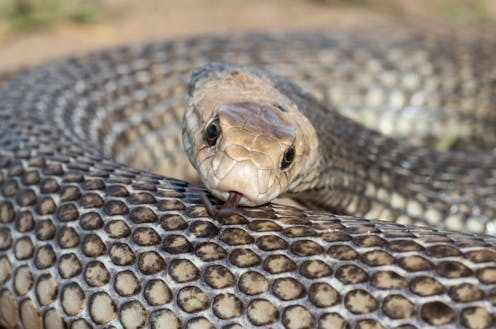
Many Australians who work outdoors – especially farmers and graziers – attempt to kill every snake they encounter, especially those thought to be venomous. In fact, research[1] in one part of rural Australia found 38% of respondents tried to kill snakes wherever possible.
This attitude is misguided and dangerous. Despite their fearsome reputation, venomous Australian snakes pose little risk to human health. And snakes are hugely beneficial on farms by consuming pests such as rodents.
New research[2] by myself and colleagues estimated the magnitude of that benefit. We found adult eastern brown snakes can collectively remove thousands of mice per square kilometre of farmland each year, which substantially increases farm productivity.
Our study suggests the benefits of snake populations on agricultural land far outweigh the potential costs, and farmers should tolerate rather than kill them.
A persecuted serpent
Brown snakes are the most common deadly snake species found in disturbed agricultural habitats in the southern half of Australia.
The snakes are fast-moving and active during the day. Brown snakes are generally persecuted in rural areas because the danger of fatal snake bites is seen to outweigh their benefits as pest controllers.
It’s true that brown snakes are the most common[3] cause[4] of fatal snake bite in Australia. But the bites are rarely fatal. Statistics show snakes of any species kill fewer than three[5] people per year in Australia, on average.
Around 3,000[6] snake bite cases are reported annually – a high proportion of which occur when a snake retaliates[7] to being attacked by a person.
Australian snakes, including brown snakes, generally retreat[8] rather than attack, even when provoked. Eastern brown snakes, in particular, tend to dwell in places where they are unlikely to be encountered by people.
Read more: 'Good luck fella, stay safe': a snake catcher explains why our fear of brown snakes is misplaced[9]
An upside to venomous snakes
The most obvious benefit of maintaining brown snake populations is to reduce rodent numbers. Introduced species of rats and mice are a major cost[10] to Australian agriculture. In extreme cases, mice can destroy most or all of a crop.
We wanted to calculate the number of rodents removed from Australian farmland by brown snakes.
First, we drew on work[11] I had done in the 1980s, which involved dissecting museum specimens to find out what proportion of brown snake diets consisted of rodents.
We then estimated the number of prey consumed each year by brown snakes. This was based on the feeding rates of captive snakes, data from commercially farmed pythons in farms in Thailand and Vietnam, and studies on a species of North American snake which is similar to brown snakes.
To estimate the abundance of brown snakes on farms, we consulted previous research on brown snake abundance, and rates of capture from fieldwork involving red-bellied black snakes. We also obtained data from the Atlas of Living Australia, an online compendium of information about the continent’s plants and animals.
Based on the combined data, we found a square kilometre of farmland can contain 100 adult eastern brown snakes, even where rates of encounters between people and those snakes are low. If each adult brown snake consumes around 100 wild mice each year – which is likely an underestimate – together this must equate to about 1,000 mice per square kilometre. Each mouse removed by a brown snake may eat several kilograms of grain crops over its life.
Give snakes a chance
Agricultural productivity gains are not the only benefits of tolerating brown snakes on farmland.
It would also allow a reduction in the use of chemical methods for rodent control, which can be expensive and ineffective. The chemicals can also threaten the health[12] of humans[13], livestock, scavenging wildlife and pets.
Tolerating brown snakes might also reduce the incidence of snake bite. Most snake bites[14] are inflicted when people are trying to catch or kill the reptile.
What’s more, one study suggests[15] snakes that are long-term residents of an area are less agitated by close encounters with people and know the location of nearby safe havens, and so pose relatively little threat. Culling snakes may create an influx of new animals unfamiliar with the location and not used to humans.
The obvious rebuttal is that killing snakes reduces the incidence of future snake bite, by reducing overall snake numbers. However, data suggests this is not necessarily the case. For example, one study[16] in Indonesia showed reticulated pythons remained abundant despite millions of individuals being removed over decades.
Maintaining viable populations of snakes has an ecological benefit. Removing high-level predators destabilises food webs and disrupts the way ecosystems function.
Finally, conserving snakes has merit in its own right. Many species of snakes are in decline[17], including in Australia, and should be protected.
Our findings suggest the need for a more balanced view of the costs and benefits of snakes, including brown snakes. Tolerating them may bring benefits that outweigh the already low chance of life-threatening snake bite.
The author would like to acknowledge the contribution of Peter Mirtschin, Nathan Dunstan and Jeff Abraham to the research underpinning this article.
Read more: New research reveals these 20 Australian reptiles are set to disappear by 2040[18]
References
- ^ research (www.jstor.org)
- ^ New research (zslpublications.onlinelibrary.wiley.com)
- ^ most common (www.researchgate.net)
- ^ cause (www.9news.com.au)
- ^ fewer than three (www.museum.qld.gov.au)
- ^ Around 3,000 (www.flyingdoctor.org.au)
- ^ retaliates (www.mja.com.au)
- ^ generally retreat (researchers.mq.edu.au)
- ^ 'Good luck fella, stay safe': a snake catcher explains why our fear of brown snakes is misplaced (theconversation.com)
- ^ major cost (digitalcommons.unl.edu)
- ^ work (www.jstor.org)
- ^ health (escholarship.org)
- ^ humans (pubmed.ncbi.nlm.nih.gov)
- ^ Most snake bites (www.qld.gov.au)
- ^ suggests (www.researchgate.net)
- ^ one study (journals.plos.org)
- ^ in decline (www.ncbi.nlm.nih.gov)
- ^ New research reveals these 20 Australian reptiles are set to disappear by 2040 (theconversation.com)
Read more https://theconversation.com/stop-killing-brown-snakes-they-could-be-a-farmers-best-friend-222142










