


In 5 years, this Australian astrophysics lab reached 50% women. Here’s how they did it
- Written by: Emma Ryan-Weber, Director, ARC Centre of Excellence for All Sky Astrophysics in 3D (ASTRO 3D), Swinburne University of Technology
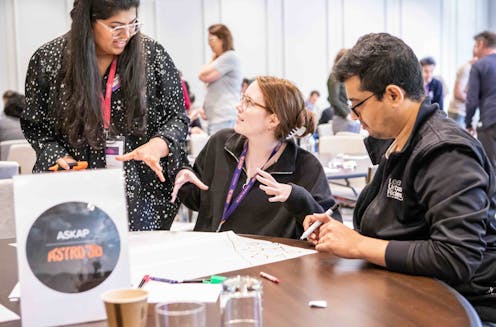
Many organisations, from community sporting groups[1] to the United Nations[2], have set themselves a target of gender parity: ensuring half of staff or members are women. Gender parity is desirable because training and retaining equal halves of a population’s available talent influences an organisation’s growth, problem-solving capacity and future-readiness.
However, actually achieving gender parity is not always an easy feat. In the astronomy sector[3], somewhere between 25% and 35% of people identify as women.
At our research centre in Australia (the ARC Centre of Excellence for All-Sky Astrophysics in 3 Dimensions[4], or ASTRO 3D), we set out in 2017 to reach gender parity.
As some of my colleagues write in a new paper in Nature Astronomy[5], the centre adopted a strategy based on evidence from the social sciences, and by 2022 we had increased women’s membership from 38% to 50%. This result shows it can be done – and offers some tips other organisations can use.
How we did it
The change was brought about by a broad range of diversity initiatives across recruitment, retention, leadership and workplace culture. The increase in women was at all levels from students to chief investigators, and – in case you were worried – did not come at the expense of men, as the centre’s membership grew over this period.
The centre took a “top-down” approach to gender parity, with five key elements:
- setting a diversity target with regular monitoring of progress
- selecting a diverse set of team leaders
- in-person diversity training for all organisation members
- ensuring 50% women on selection committees for hiring postdoctoral researchers
- ensuring 50% women on shortlists for postdoctoral positions.
Read more: Science needs true diversity to succeed -- and Australian astronomy shows how we can get it[6]
We found that when a “tipping point” of 40% women was reached, we saw more women students choosing to join ASTRO 3D – particularly within research teams led or co-led by women.
One of the most powerful messages to take away from the paper is the importance of monitoring and evaluation. That’s how we know the strategies applied by ASTRO 3D, built from evidence in the social sciences, were effective. Evaluating programs is crucial, and can be done using platforms like the Women in STEM evaluation portal[7].
Everybody wins
The results underscore the continued need for women role models and leaders in science, technology, engineering and mathematics.
We know gender parity improves research quality[8] because it reduces the risk of bias and groupthink, which can affect the validity and reliability of scientific findings. Furthermore, diversity can lead to more innovative and creative solutions to scientific problems, as people from different backgrounds bring unique insights to the table.
Read more: We must include more women in physics — it would help the whole of humanity[9]
ASTRO 3D has shown that a multifaceted approach can be used to create a diverse workplace, which is better for everyone.
While astronomy may seem far removed from day-to-day concerns, everyone benefits from fundamental science[10].
Astronomy is a gateway science and a training ground for our brightest minds. From schoolchildren to the general public, people are fascinated by questions of what’s out there in space, and how the elements fused inside stars end up in the air we inhale with every breath.
When astronomy comes down to Earth
While solving the mysteries of the universe, astronomy students and researchers develop skills in data analysis and problem-solving. Astronomy graduates and researchers are now highly sought in private industry[11].
Their problem-solving skills are easily transferred from astronomy to sectors from biomedical and climate science, to mining and satellite technology, to energy and finance. Curating and analysing data from stars and galaxies is remarkably similar to predicting bushfires, decoding genomic data and making financial decisions.
Read more: Looking at the stars, or falling by the wayside? How astronomy is failing female scientists[12]
Research and development teams in both academia and industry benefit from gender parity. It fosters an environment where everyone can thrive and contribute their best work.
The many astronomy graduates and postdocs who go on to work in industry take both problem-solving skills and lived experience of a positive research culture built on gender-parity goals. ASTRO 3D has shown how it can be done.
References
- ^ community sporting groups (bicyclenetwork.com.au)
- ^ United Nations (www.ipu.org)
- ^ In the astronomy sector (www.nature.com)
- ^ ARC Centre of Excellence for All-Sky Astrophysics in 3 Dimensions (astro3d.org.au)
- ^ a new paper in Nature Astronomy (doi.org)
- ^ Science needs true diversity to succeed -- and Australian astronomy shows how we can get it (theconversation.com)
- ^ Women in STEM evaluation portal (evaluation.womeninstem.org.au)
- ^ improves research quality (theconversation.com)
- ^ We must include more women in physics — it would help the whole of humanity (theconversation.com)
- ^ everyone benefits from fundamental science (theconversation.com)
- ^ in private industry (wheretowithphysics.org.au)
- ^ Looking at the stars, or falling by the wayside? How astronomy is failing female scientists (theconversation.com)










