Facing protests and new threats from Trump, is the Iranian regime on its last legs?
- Written by: Amin Saikal, Emeritus Professor of Middle Eastern Studies, Australian National University; The University of Western Australia; Victoria University
Iran’s Islamic regime is once again faced with nationwide popular protests and a potential confrontation with Israel and the United States.
Protesters have flooded Tehran[1] and many other major cities in recent days, calling for the downfall of the regime. The US and Israel have also voiced strong support[2] for the protesters[3].
At least 20 people have reportedly been killed[4], with around 1,000 arrested.
Despite the regime’s increasing vulnerability, though, it might be too early to write its obituary.
Why Iranians are so angry
Public discontent with the Islamic regime has been building for years.
The current wave of protests was triggered[5] in late December by the collapse of the Iranian currency and the rising cost of living. However, the public’s fury is rooted in wider societal grievances. These include:
- the regime’s theocratic impositions, such as the mandatory headscarf (hijab)[6] rule that women are increasingly flouting in public
- widespread corruption and mismanagement of the economy under severe US-led sanctions
- the costly support for a network of proxy militant groups in Lebanon, Gaza, Iraq and Yemen, and
- the regime’s top-down approach to water governance[7] that has left the country increasingly vulnerable to drought.
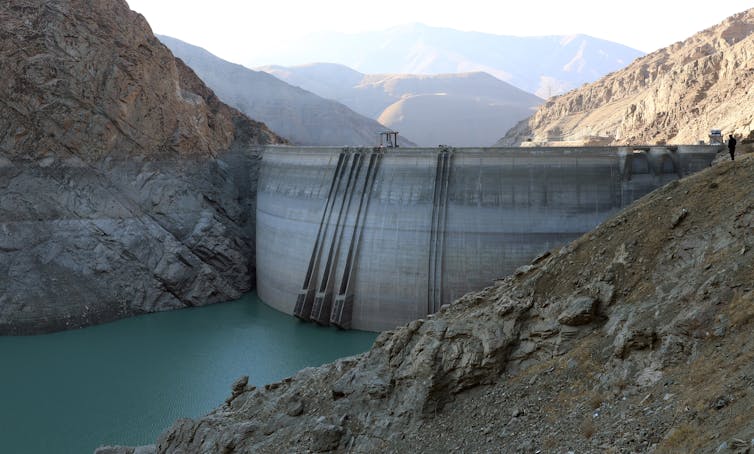
The current wave of protests was initially sparked by bazaaris (traditional business owners and shopkeepers). However, in the last week, it has swelled to include university students and those from the “Women, Life and Freedom[8]” movement that took to the streets following the death of a young woman, Mahsa Amini, in the custody of the morality police in 2022.
The regime severely cracked down on those protests, but they have continued in other forms[9] over the past few years.
More threats from Trump
The regime is also facing external pressure from the US and Israel.
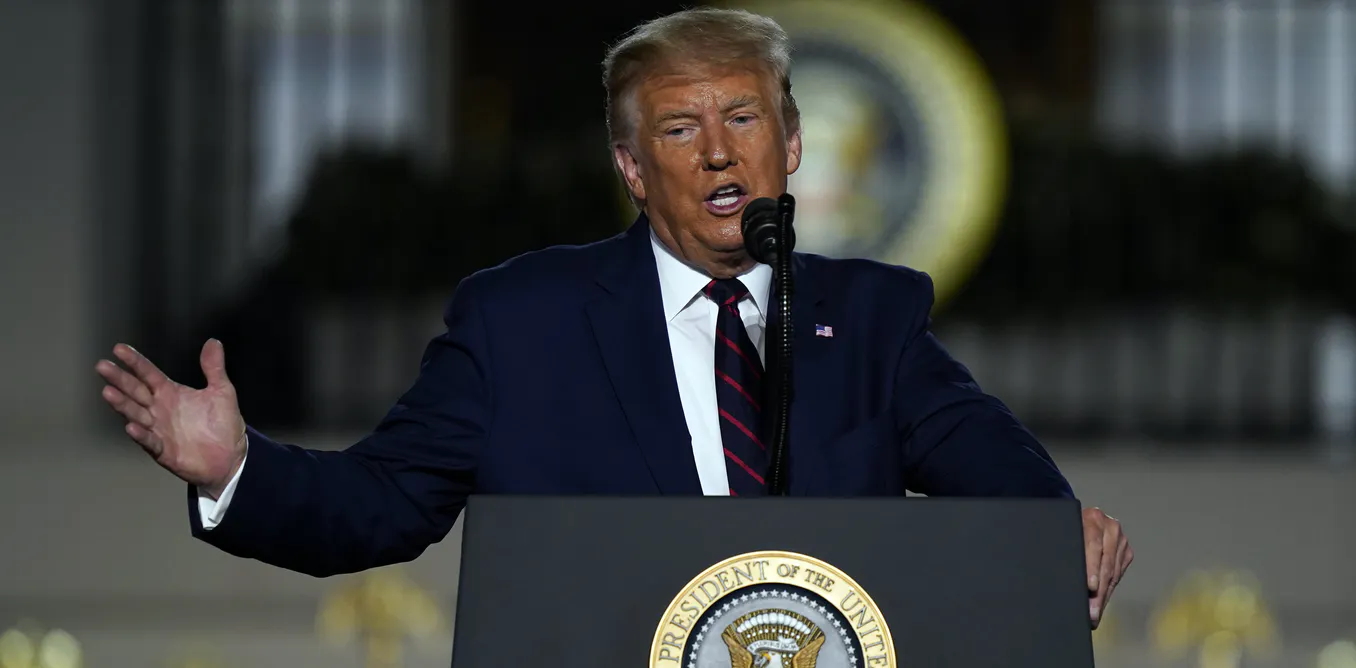
US President Donald Trump has warned[10] the Iranian government not to kill protesters, saying the US was “locked and loaded” to act.
In recent days, both Trump and Israeli Prime Minister Benjamin Netanyahu have also threatened[11] another round of military action if Tehran rebuilds its nuclear capability and refuses to curtail its missile industry.
Netanyahu, who has relentlessly castigated the regime as an existential threat, initiated a 12-day war[12] with Iran last June. The US briefly entered the war by bombing Iran’s three main nuclear sites, after which Trump claimed to have “obliterated[13]” Iran’s nuclear program.
Many experts and the UN’s nuclear watchdog, the International Atomic Energy Agency (IAEA), have since cast doubt[14] on this claim.
The foundations of the Iranian program reportedly survived the US and Israeli bombings. Some 400 kilograms of highly enriched uranium, still missing, could potentially enable[15] Tehran to assemble a few nuclear bombs in moments of desperation. There also haven’t been new talks[16] between Iran and Western powers to negotiate a new nuclear deal, either.
In recent days, Trump has accused[17] Tehran of seeking new nuclear sites and attempting to replenish its missile stocks, threatening to “eradicate that build-up”.
Prepared to defend itself
While unpopular, the Iranian regime can still rely on many repressive instruments of state power[18].
These include the powerful Islamic Revolutionary Guard Corps (IRGC) and the well-equipped and well-trained Basij paramilitary force[19] used to crack down on dissent. The regime also has intelligence services, revolutionary committees and a network of clerical circles.
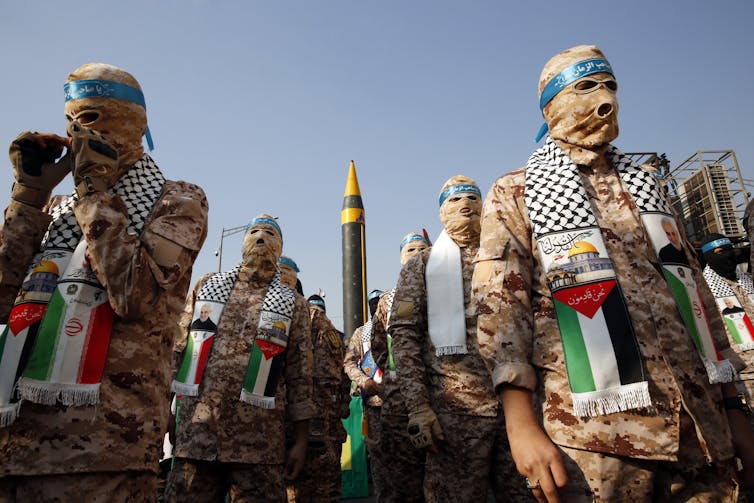
The fortunes of these forces are closely tied to the survival of the regime. Many of them are headed by figures who were involved in setting them up following the toppling of Shah Mohammad Reza Pahlavi’s pro-Western monarchy in the revolution of 1978–79. They are fully cognisant of the fact that if the regime goes down, they will, too.
The regime has also prepared to defend itself long-term against any foreign threats. It has invested heavily in an asymmetrical warfare strategy and developed a potent defence industry. Since the end of the war with Israel, it has reportedly focused on rebuilding[20] its missile capabilities and acquiring fresh supplies of arms and air defence systems from Russia and China.
Yet, the Islamic government still faces a critical situation, especially following the Trump administration’s toppling of Venezuela’s leader in recent days.
Many Iranians both inside and outside the country want to see the fall of the clerical regime and Reza Pahlavi, the son of the last shah[21], to return from exile to head a transitional government to democratise Iran.
However, Trump has reportedly not favoured regime change[22] in Iran, possibly fearing the political transition may not be orderly and could be as bloody and disruptive as the one that followed the shah’s fall in 1979. He has also made clear his focus[23] is on the Western hemisphere.
Iran is a very complex[24] country with a diverse population of 93 million people. It is also strategically placed, with the longest coastline on the oil-rich Persian Gulf in a traditional zone of major power rivalry. These considerations should be on Trump’s mind when deciding how to handle Iran.
References
- ^ flooded Tehran (www.bbc.com)
- ^ voiced strong support (www.bbc.com)
- ^ protesters (www.timesofisrael.com)
- ^ have reportedly been killed (abcnews.go.com)
- ^ triggered (www.theguardian.com)
- ^ mandatory headscarf (hijab) (apnews.com)
- ^ water governance (theconversation.com)
- ^ Women, Life and Freedom (www.nonviolent-conflict.org)
- ^ continued in other forms (theconversation.com)
- ^ warned (www.bbc.com)
- ^ threatened (www.euronews.com)
- ^ initiated a 12-day war (theconversation.com)
- ^ obliterated (www.aljazeera.com)
- ^ cast doubt (www.aljazeera.com)
- ^ potentially enable (thebulletin.org)
- ^ haven’t been new talks (www.pbs.org)
- ^ accused (www.euronews.com)
- ^ repressive instruments of state power (www.longwarjournal.org)
- ^ Basij paramilitary force (www.abc.net.au)
- ^ rebuilding (caspianpost.com)
- ^ the son of the last shah (www.politico.com)
- ^ not favoured regime change (www.iranintl.com)
- ^ clear his focus (theconversation.com)
- ^ complex (theconversation.com)