


New play The Exact Dimensions of Hell explores the chaos and contradiction of teenage girlhood – and witchcraft
- Written by: Sarah Austin, Lecturer in Theatre, The University of Melbourne
The relationship between witchcraft and teenage girls[1] has been the subject of many books, films and television shows.
Over time, the traditional image of witch as crone has been replaced and reclaimed by a glamourous symbol of rebellion and feminine empowerment[2], notions that are deeply appealing to teenagers.
During the grunge era of the 1990s, these ideas reached their peak with Buffy[3] (a film in 1992, and on television from 1997–2001) and Charmed[4] (1998–2006). In 1998, Australian musician and television personality Fiona Horne wrote her infamous book[5] situating witchcraft as an alternative form of spirituality and knowledge.
Director Alice Darling and playwright Bridget Mackey situate The Exact Dimensions of Hell in this 1990s suburban Australia. It is a theatrical exploration that unflinchingly examines themes of teenage girls, desire and power.
The story revolves around 14-year-old The Girl (Matilda Gibbs), who begins seeking information in online chat groups about witchcraft and magic(k) rituals. We understand this girl is isolated, struggling to belong and perceives herself as hideous.
Conversely, she believes she is special and worthy, claiming she has always been able to perceive “the unseen”. She wants to learn witchcraft to destroy her enemies and obtain her desires – which largely include being able to dance front row in the Rock Eisteddfod and make boys notice her.
Read more: How witches went on to become modern feminist icons[6]
A pact with the devil
Through these chat groups, she encounters The Witch (Daniel Schlusser), a lonely, ageing and terminally ill occultist who has already written one book, and desperately wants to make his mark writing another before cancer prematurely ends his life.
The Witch convinces The Girl he can teach her how to practise witchcraft and bend the universe to her will.
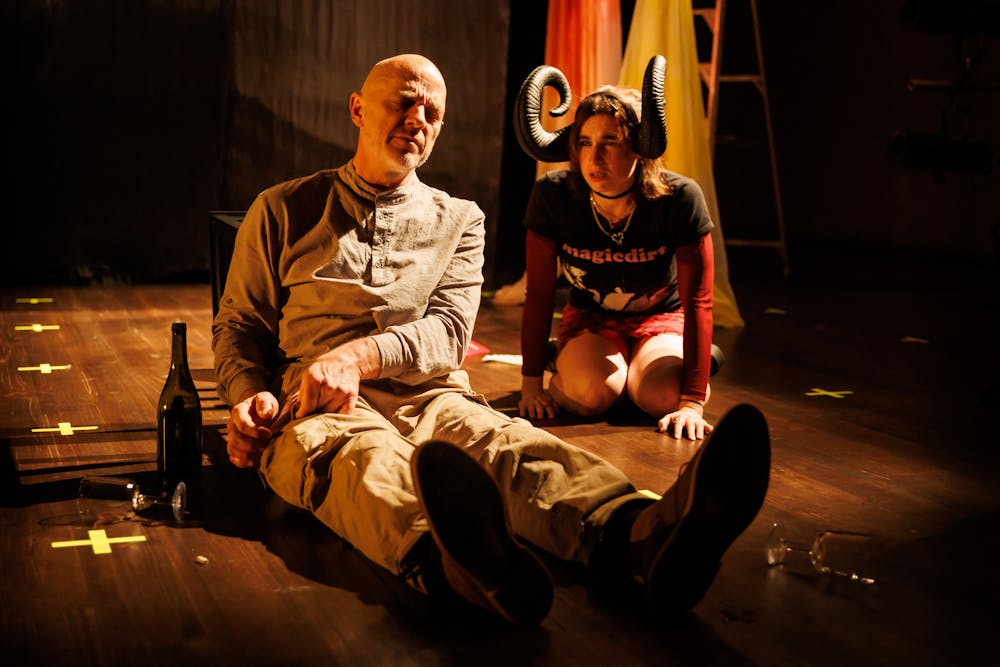
Traditional ideas of witches suggest that a witch is usually a woman who makes a pact with the devil[7] in exchange for powers to undertake evil acts. In this way, Schlusser’s The Witch is situated as wholly unreliable and deeply problematic, a corrupt and evil force.
What unfolds in this relationship between The Girl and The Witch is a predictable, uncomfortable and disturbing manipulation. The Girl’s desire to encounter and submit to the possibilities of the forbidden become entangled in The Witch’s capacity to propel and groom The Girl into being part of his own fantasies of infamy and control.
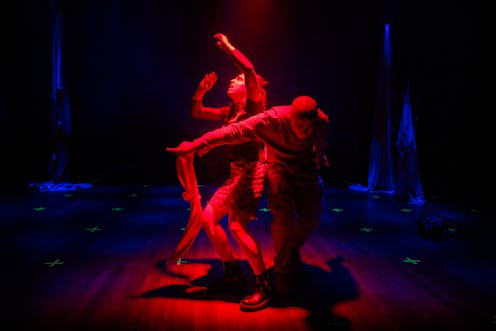
Taking place on a stripped back set with minimal props (visual design by Meg Wilson), the performance oscillates between realistic dialogue and sequences of abstracted and stylised choreography.
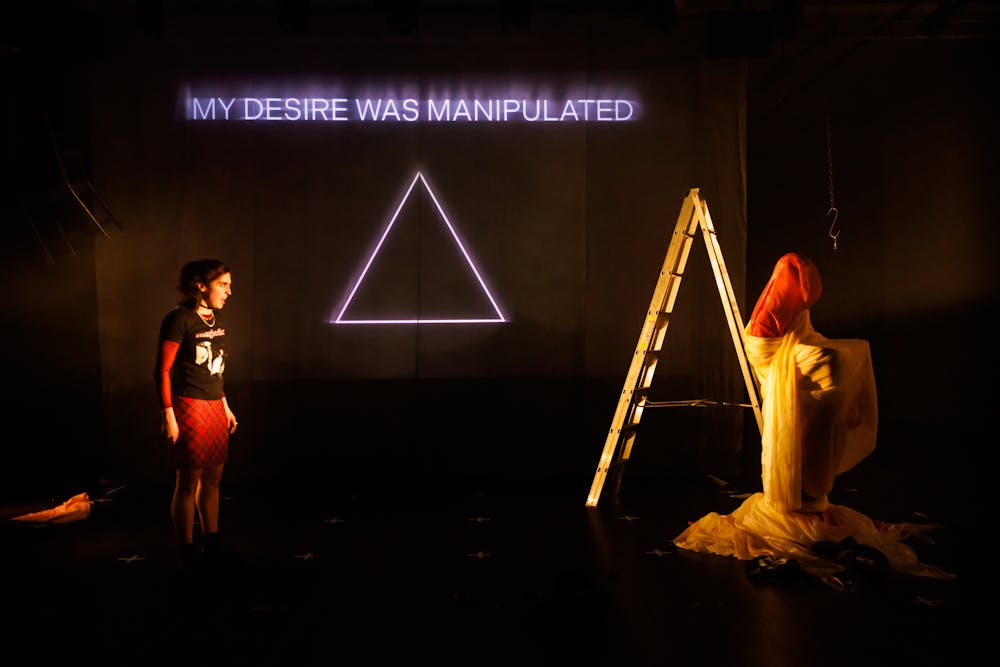 The performance makes great use of projected text.
Darren Gill/Mackey, Darling & Collaborators
The performance makes great use of projected text.
Darren Gill/Mackey, Darling & Collaborators
Rituals and invisible forces are represented through movement sequences and hanging fabric demarcating the space. The performance makes great use of projected text which visually depict the occult practice of sigils[8] and uses the symbol of a triangle[9], understood in some witchcraft practices as representative of the feminine.
The projected text also reflects the exact dimensions of power playing out throughout the story.
Witchcraft and ‘hysteria’
Throughout, the intentions of The Girl are placed at the forefront of the story, and the audience are given a clear depiction of the chaos and contradiction of this character.
There are moments in the play when the force of The Girl’s desire for power over her own life are physically inhabited and realised, and she shakes palpably with the intensity of her beliefs and her desire. Unfortunately, this theatrical attempt to centre her perspective and empower The Girl does little to provide her with narrative agency.
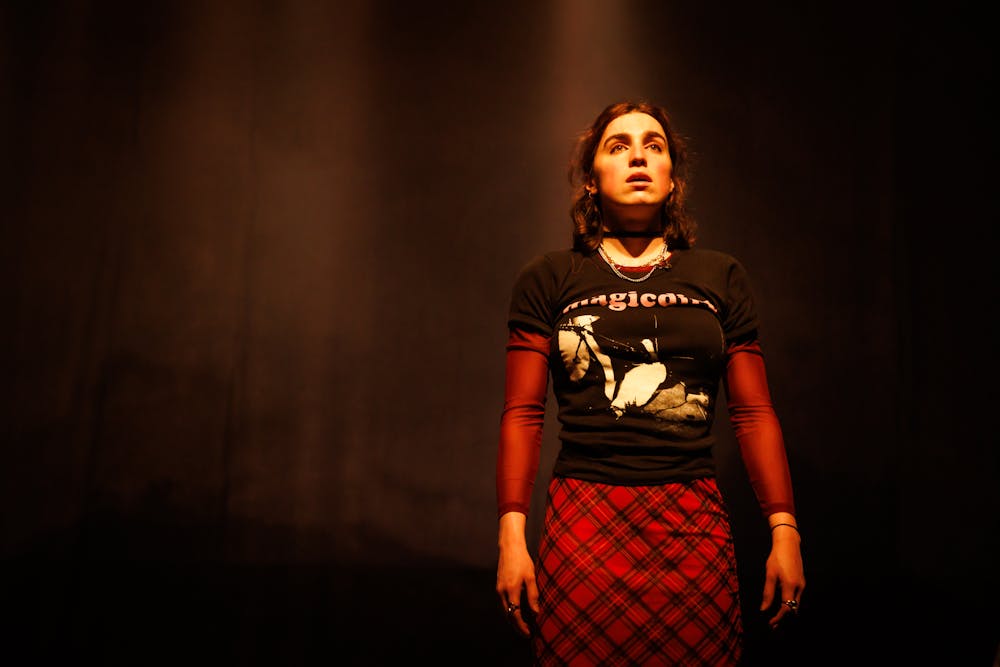 The Girl is both wild and trapped, playful and serious, certain and unsure.
Darren Gill/Mackey, Darling & Collaborators
The Girl is both wild and trapped, playful and serious, certain and unsure.
Darren Gill/Mackey, Darling & Collaborators
As we watch the horror of an abusive situation unfold on stage between The Witch and The Girl, her vulnerability is emphasised – despite her gaining confidence in her own power.
The Exact Dimensions of Hell does not focus on the complexities of occult practices, but rather works to depict the fearlessness and vulnerability of adolescence. The Girl is a romanticised embodiment of the multiple realities and truths of this particular age; she is both wild and trapped, playful and serious, certain and unsure.
Historically, the depictions of witches in popular culture have intersected with social anxieties[10] over young girls as they enter into womanhood. These young women have often been positioned as dangerous and “hysterical[11]”.
The Exact Dimensions of Hell works to reinforce this idea of the dangerous and hysterical teenage girl, and so misses an opportunity to critique how this notion has been constructed in social discourse. The choice to theatrically fragment the depictions of the catalogue of abuse The Girl has suffered at the hands of men make her an unreliable narrator for the audience.
We have often seen how women have been depicted as unreliable with the truth in arenas of public judgement or the halls of justice. Attributing these ideas of the dangerous, unreliable and hysterical to young women can define how they are seen, and how they are believed in these and other contexts.
It is not too big a jump to imagine the persistent interest young women show in witchcraft practices is related to a desire to control what is around them – and in so doing protect themselves from the very real danger they face as teenage girls in a patriarchal society.
The Exact Dimensions of Hell is at fortyfivedownstairs, Melbourne, until April 28.
Read more: Most witches are women, because witch hunts were all about persecuting the powerless[12]
References
- ^ witchcraft and teenage girls (www.vice.com)
- ^ rebellion and feminine empowerment (www.wmagazine.com)
- ^ Buffy (en.wikipedia.org)
- ^ Charmed (en.wikipedia.org)
- ^ infamous book (www.goodreads.com)
- ^ How witches went on to become modern feminist icons (theconversation.com)
- ^ pact with the devil (stories.uq.edu.au)
- ^ sigils (en.wikipedia.org)
- ^ triangle (thoughtcatalog.com)
- ^ intersected with social anxieties (digitalcommons.library.umaine.edu)
- ^ hysterical (lithub.com)
- ^ Most witches are women, because witch hunts were all about persecuting the powerless (theconversation.com)










