Everyone is talking about the NDIS – we spoke to participants and asked them how to fix it
- Written by: Mark Brown, Research Fellow, La Trobe University

Last week’s budget revealed the rapidly escalating costs of the National Disability Insurance Scheme[1] (NDIS) and rekindled fears among people with disability about its sustainability.
The Albanese government is unequivocal in its support for the NDIS, but has also warned[2] more needs to be done to bring down costs.
As part of this effort, it has brought forward an independent review of the NDIS[3] to be co-chaired by former senior public servant Lisa Paul and former chair of the National Disability Insurance Agency (NDIA) Bruce Bonyhady. It will hand down findings and recommendations by October 2023.
The next year will be crucial for setting out the future path of the NDIS and participants in the scheme. Our new survey[4] shows Australians with disability are keen to see real change.
Read more: The budget sounded warnings of an NDIS 'blow out' – but also set aside funds to curb costs and boost productivity[5]
Voices that matter
The Summer Foundation – supported by People with Disability Australia – recently conducted a national survey of NDIS participants[6]. We asked people with disability or their families what works well with the scheme and what needs to be changed.
The 477 survey respondents included those with a wide range of disabilities, ages and locations around Australia.
Previous research drew on in-depth interviews[7] and found that despite gratitude for the NDIS, participants have lost trust and confidence in the NDIA, which administers the scheme.
The new survey provides hundreds of examples of how the NDIS has enabled a wide range of participants to achieve important and transformative outcomes. The survey also provides rich data that illustrates the stress and unpredictability of navigating the NDIS. There are insights into how the scheme could be much more efficient and simpler for users to navigate. As one told us:
The concept of NDIS is great. The implementation and delivery needs to be improved.
Jumping through hoops
Survey responses indicate the range of issues participants want addressed.
Participants take issue with the reports and assessments they are asked to obtain as part of funding plan reviews. The NDIA asks participants to submit evidence from health professionals about their disability and needs. But participants believe NDIA staff often do not read, understand or factor in this evidence. This feels like a waste of time, effort and money.
The national survey asked three main questions.The recommendations of long-term experts involved with a person [shouldn’t be] second-guessed or discarded by an inexperienced and unfamiliar NDIA officer (no matter their good intentions).
Not everyone can be an advocate
Participants report NDIA staff lack expertise and experience in disability issues. This puts a burden on the participant or their family to educate the agency.
Those with the skills, knowledge, time and ability to self-advocate may eventually succeed in getting a suitable funding plan, but others with less capacity give up.
Participants say NDIA staff should receive more training, or have their expertise better matched to who they are working with; hiring more people with disability experience was also suggested. Here are some of things participants shared:
Planners, interviewers [should] know and understand the disabilities they are writing about fully – no one understands deaf. They keep trying to ring me – ughhh I am deaf.
I am very grateful for the NDIS and what it does. Although it is working well for me personally, I am appalled at how complex, time-consuming and sophisticated I had to be to get what I have.
The funding has been difficult to continue to fight for each year, having to prove lifelong disability that will never improve. However the funds received and the flexibility of using the funds has been so important.
Read more: 'They treat you like a person, they ask you what you want': what NDIS participants value in support workers[8]
Wanting better
Participants say the NDIA lacks the fundamental elements of contemporary customer service, let alone an agency designed to engage with people who may have severe cognitive and communication limitations.
Participants’ frustration with the NDIS stems in part from knowing how well the scheme can work, and that it does work well for some people some of the time.
The current design of the NDIS is unnecessarily bureaucratic[9] in a way that demonstrates a lack of trust[10] in the competency of participants to make decisions about their lives.
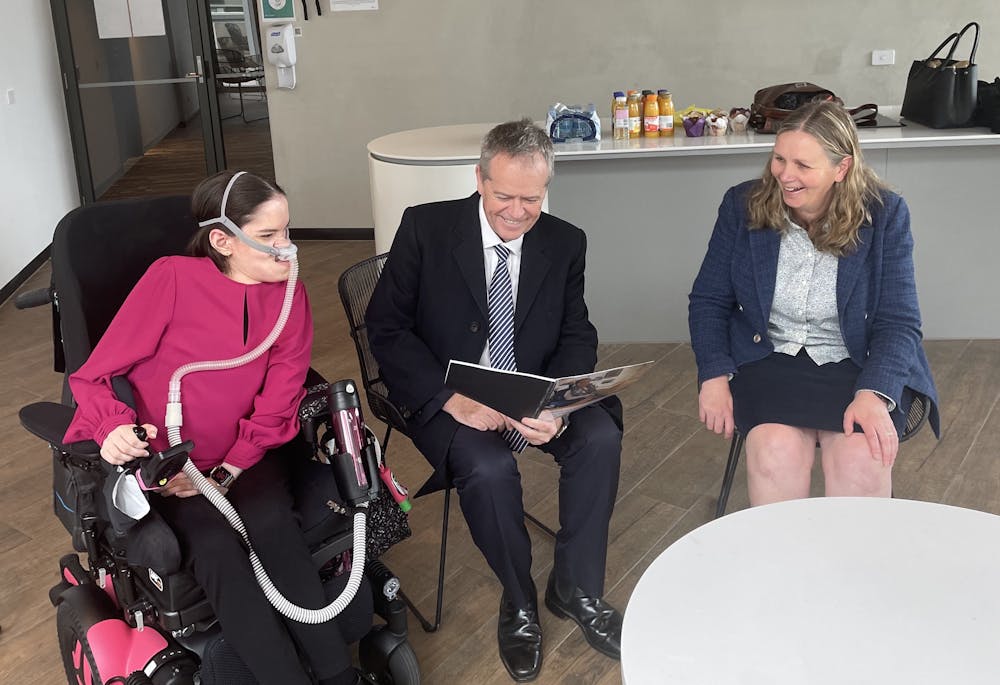
Participants described many ways in which the NDIS allows them to participate socially and economically and make the most of life despite their disability.
When it does work, it’s the people who listen, the people who treat people with disability as humans, not as a burden. The people who recognise they are handling a person’s life, rather than managing an account.
My NDIS supports allow me to work for the first time in full-time ongoing employment in the open employment market. Prior to the NDIS supports that I receive, this would not have been possible.
Our daughter volunteers at three local organisations with the help of support workers. She is supported to go shopping for herself. She attends a centre-based program for socialising and fun. She is receiving regular overnight support to help increase her independence from us, her parents.
Getting to work
Many NDIS participants have untapped potential to work and make other valuable contributions to society. A new NDIS 2.0[11] needs to see the agency working in partnership with people with disability to enable economic and social participation and deliver real jobs for people with disability. Better connecting NDIS participants to job opportunities and reforming disability employment services may be part of the solution to increasing work participation.
The government’s pilot scheme announced this week[12] has this focus. However, our survey suggests many participants cannot even begin to explore employment because their basic daily supports and housing are not secure in today’s NDIS.
Redesigning the NDIA to be an efficient and cost-effective administrator that consistently delivers great outcomes for NDIS participants will be a major challenge.
Giving a voice to a broad range of participants and their families – who have a wealth of expert knowledge on what works well and what needs to be changed – is crucial to transforming the scheme. The NDIS review is a once-in-a-generation opportunity to get the scheme right, stem the current waste of public resources, and transform the lives of half a million Australians.
Read more: NDIS plans rely on algorithms to judge need – the upcoming review should change that[13]
References
- ^ costs of the National Disability Insurance Scheme (www.afr.com)
- ^ warned (www.abc.net.au)
- ^ independent review of the NDIS (www.ndisreview.gov.au)
- ^ new survey (assets.summerfoundation.org.au)
- ^ The budget sounded warnings of an NDIS 'blow out' – but also set aside funds to curb costs and boost productivity (theconversation.com)
- ^ survey of NDIS participants (assets.summerfoundation.org.au)
- ^ drew on in-depth interviews (theconversation.com)
- ^ 'They treat you like a person, they ask you what you want': what NDIS participants value in support workers (theconversation.com)
- ^ bureaucratic (www.smh.com.au)
- ^ demonstrates a lack of trust (www.scribd.com)
- ^ NDIS 2.0 (ministers.dss.gov.au)
- ^ pilot scheme announced this week (www.theguardian.com)
- ^ NDIS plans rely on algorithms to judge need – the upcoming review should change that (theconversation.com)