


4.3 trillion readers can’t be wrong – why The Onion’s defence of satire should be heard by the US Supreme Court
- Written by: Stephen Skalicky, Senior Lecturer in the School of Linguistics and Applied Language Studies, Te Herenga Waka — Victoria University of Wellington
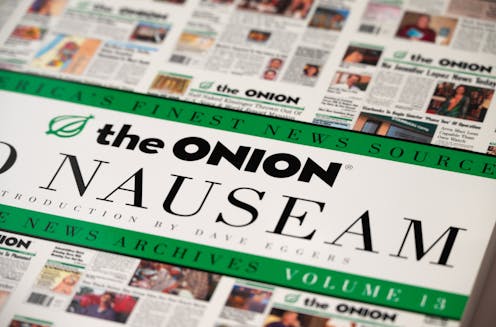
If you’ve read, watched and enjoyed the work of America’s best-known satirical publication The Onion[1], you might be surprised by how serious it suddenly became earlier this month. So serious, in fact, that it might end up before the US Supreme Court.
Each year approximately 7,000 appellants peition to have their cases heard before the Supreme Court, but only 100 to 150[2] of these petitions are reviewed. What are known as amicus curiae briefs[3] can be filed by interested third parties to strengthen the need for a petition to be seen by the court.
Little wonder, then, that it caught the eye of the media when such a brief was filed by The Onion[4]. Despite the publication’s typically absurd claim to a daily readership of 4.3 trillion, the intent of the brief is far from ridiculous. Because The Onion believes the right to use satire is under threat.
The brief was filed to support an appellant named Anthony Novak, who in 2015 was arrested and charged with using a computer to disrupt police operations[5]. The disruption was said to arise from Novak’s decision to create a satirical Facebook page identical in appearance to that of the police department in the city of Parma, Ohio.
At trial, Novak was found not guilty and then sued the city for violation of his civil rights. The city sought qualified immunity for its officers, which shields them from civil litigation unless they had been shown to violate someone’s civil rights – exactly the claim raised by Novak.
A state judge agreed with Novak and rejected the city’s qualified immunity, indicating Novak could sue. The city appealed and the case moved to the Sixth Circuit Court of Appeals. The Sixth Circuit reversed the lower court’s rejection and ruled the officers should be granted qualified immunity because Novak’s actions were not protected speech.
This barred Novak from seeking any damages for his arrest. His last chance for appeal is now in the hands of the Supreme Court.
Satire and protected speech
The purpose of The Onion’s brief is to provide additional information about the nature of satire, and to urge the Supreme Court to hear Novak’s case and reconsider the decision handed down by the Sixth Circuit.
It’s written with humorous and satirical flair, and is indeed a very good read. True to form, though, the playful aspects of The Onion’s brief contain a serious message: if the Supreme Court were not to hear Novak’s case, future satirists (including the writers at The Onion) may face legal prosecution for creating satire.
Therefore, it argues, the Supreme Court must hear Novak’s case to ensure the preservation of satire as a legitimate means of free speech.
Read more: Ninety years on, what can we learn from reading Evelyn Waugh's troubling satire Black Mischief?[6]
Yet more than 30 years ago, the Supreme Court decided in Hustler v. Falwell[7] that satire and parody are protected speech under the First Amendment[8] of the US Constitution. Why then did the Sixth Circuit rule in favour of the city if Novak’s page was a form of protected speech?
The reason is simple: the Sixth Circuit limited the boundaries of what it considered to be satire. In its decision[9], the Sixth Circuit noted that while the Facebook site was satire and thus protected, Novak also deleted spoiler comments from his page and copied a warning from the real page to his own.
The Sixth ruled the police officers could not be expected to extend first amendment protection to these actions and thus granted them qualified immunity, squashing Novak’s civil suit.
The court’s decision presents a quandary: how can the creation of a satirical work be protected speech when the maintenance of the work is not? The seemingly contradictory logic behind the Sixth Circuit’s decision is why The Onion’s brief is so important – it provides a definition of satire from a position of experience and expertise.
Defining how satire works
So, what is satire and how does it work? While there is a tradition of defining it as a literary genre, satire is much more than a category on a bookshelf. Satire can occur in any medium, such as Novak’s Facebook page.
This is because satire is “parasitic” – a satirist appropriates formal features of an existing genre, person or event to create a pretence of authenticity and sincerity. By pretending to be something it is not – such as a news story or a police Facebook page – a satirical work arouses expectations and stereotypes associated with that genre.
At the same time, the satirist provides indirect and subtle clues which, when interpreted correctly, belie the satirical pretence and pull back the curtain to expose the ruse, which distinguishes the satire from the real thing.
Read more: What makes a good literary hoax? A political point, for starters[10]
The second step must be indirect for satire to work, and it cannot work if the satirical object is labelled “satire” in advance. This point is strongly emphasised in The Onion’s brief: killing the satirical pretence kills the satire. If Novak’s efforts to maintain a satirical pretence are an arrestable offense, then satire is no longer protected speech.
Whether Novak’s case goes to the Supreme Court is still uncertain, and the details of his case are more nuanced than asking whether someone can be jailed for making satire. Instead, the Supreme Court would need to draw new lines defining what satire is and how it works. Agreeing on a universal definition of satire is far from easy.
Fortunately, “America’s Finest News Source[11]” has provided the court with an excellent explanation, demonstrating just how serious satire can be.
References
- ^ The Onion (www.theonion.com)
- ^ only 100 to 150 (www.uscourts.gov)
- ^ amicus curiae briefs (www.law.cornell.edu)
- ^ filed by The Onion (www.supremecourt.gov)
- ^ using a computer to disrupt police operations (codes.findlaw.com)
- ^ Ninety years on, what can we learn from reading Evelyn Waugh's troubling satire Black Mischief? (theconversation.com)
- ^ Hustler v. Falwell (www.loc.gov)
- ^ First Amendment (constitution.congress.gov)
- ^ In its decision (www.opn.ca6.uscourts.gov)
- ^ What makes a good literary hoax? A political point, for starters (theconversation.com)
- ^ America’s Finest News Source (www.theonion.com)










