Will the US Supreme Court consider a request to overturn same-sex marriage?
- Written by: Justin Ellis, Senior Lecturer in Criminology, University of Newcastle
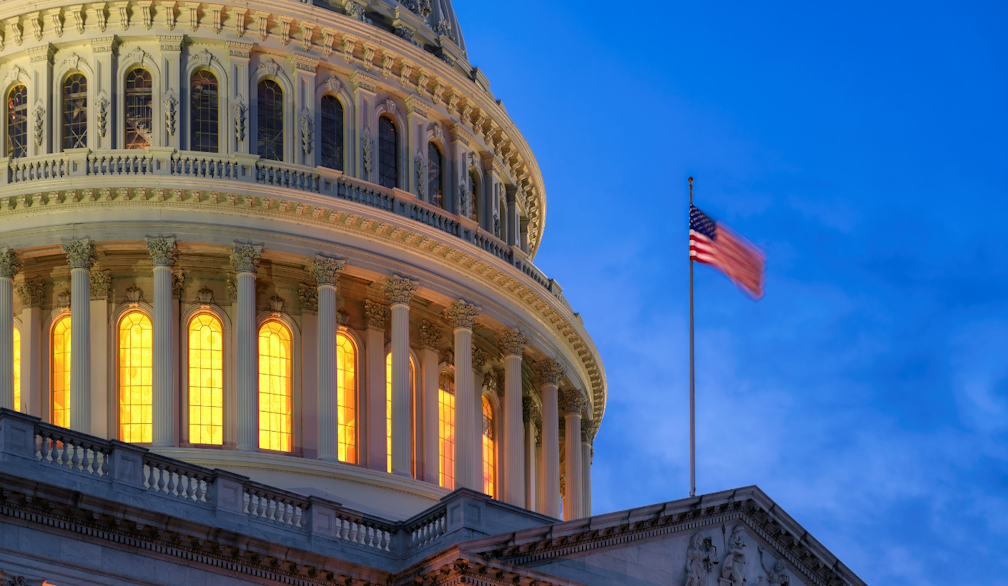
It’s been a decade since the US Supreme Court recognised a constitutional right to same-sex marriage in the landmark case, Obergefell v Hodges[1]. The US Supreme Court will meet today to consider a request to overturn that 2015 decision.
In 2015, Kim Davis, a former Kentucky county clerk, made global headlines when she refused to grant a marriage license to a gay couple based on her religious beliefs. The couple, David Moore and David Ermold, filed a lawsuit against her, alleging she had violated their constitutional right to marry.
In a separate case, a US District judge ordered[2] Davis to issue marriage licences to both gay and straight couples. When she refused, she was briefly jailed[3].
Then, in 2016, the Kentucky legislature passed a law[4] that sought to accommodate clerks opposed to same-sex marriage by removing their names and signatures from licensing forms.
In the meantime, Moore and Ermold’s case continued. In 2023, a jury awarded them damages[5] of US$50,000 (A$77,000) each.
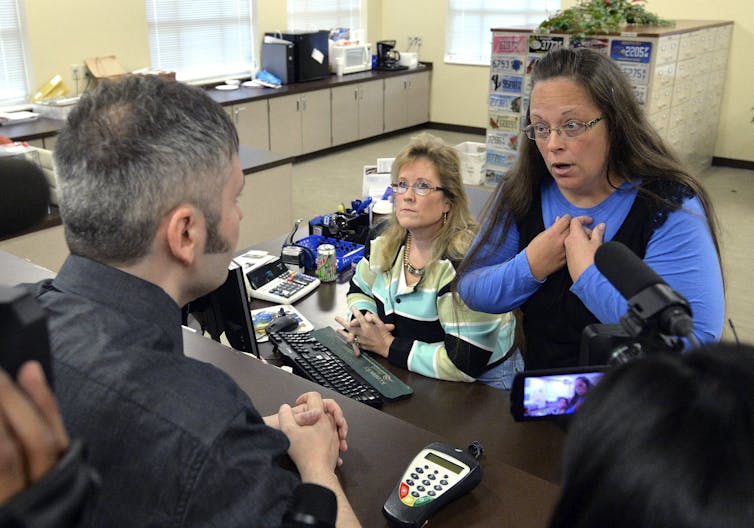
Davis appealed that decision, arguing she could not be held liable because issuing Moore and Ermold a marriage license would have violated her right to freely exercise her religion. Davis’ appeal was rejected by the 6th Circuit Court on the grounds the First Amendment protects her as a private citizen, but not in her role as a government clerk.
This is when the US Supreme Court became involved. Davis is now asking the highest court in the country to review the 6th Circuit Court’s decision. She is arguing that she appeared before that court as an individual, not as a representative of the state.
There’s something bigger at stake, though. Davis is also asking the Supreme Court to overrule their 2015 decision in the Obergefell case that legalised same-sex marriages federally.
Today, at its private conference, the Supreme Court will decide whether to review Davis’ request.
What are the chances same-sex marriage could be overturned?
The chances of the US Supreme Court reviewing the case are unlikely – the court receives[6] more than 7,000 such petitions each year and only chooses to hear 1% of them.
If it was to grant a review, the court would also likely consider Davis’ petition at two consecutive conferences[7].
However, given the more conservative configuration of justices on the Supreme Court, Obergefell v Hodges cannot be taken for granted.
It would take the votes of just four justices to take up the question and grant a review. It would then require a fifth justice to overturn Obergefell. The current court is dominated by conservative appointees by six to three.
Three of the conservative justices also wrote their own dissents to Obergefell[8]. As Justice Samuel Alito wrote at the time, “the Constitution says nothing about a right to same-sex marriage.”
One argument the conservative justices could use to overturn Obergefell is the view same-sex marriage does not pass the “history and tradition[9]” test.
This happened in the Dobbs v. Jackson Women’s Health Organization[10] decision in 2022 that overturned Roe v Wade and ended the US constitutional right to abortion, handing jurisdiction back to the states.
Alito reasoned at the time abortion did not meet the test because it was not “deeply rooted in the nation’s history and tradition”.
The Dobbs decision also showed the court’s willingness to overturn precedent[11].
Another reason the court might choose to overturn Obergefell is that the conservative majority has prioritised First Amendment free speech protections over other constitutional and legal rights.
On the other hand, Moore and Ermold argue in their response[12] to Davis’ petition[13] that the case is a “relatively easy” one that “does not merit” the justices’ intervention.
They argue, for instance, that Davis’ didn’t develop her current First Amendment argument until very late in the process, in her reply to the 6th Circuit Court, filed nine years into the case.
By waiting so long to raise this argument, they argue, Davis has deprived them and the lower courts of “a fair opportunity to address it”.
State legislatures and LGBTQ+ rights
Davis’ petition for a review may seem like a longshot. But it illuminates a worrying trend in the US of conservative lawmakers trying to curtail LGBTQ+ rights in the states.
The American Civil Liberties Union[14] counts 616 such bills in state legislatures so far in 2025. These include:
- 32 free speech and expression bans
- 109 bills that would weaken civil rights laws (including 61 based on religious exemptions); and
- 277 bills that would restrict student and educator rights.
Seventy-one of the bills have been passed into law, including nine based on religious exemptions.
A tactic in this strategy is to introduce resolutions in state legislatures[15] calling on the US Supreme Court to overturn its ruling in Obergefell. These resolutions are considered symbolic, as state law does not have control over what the Supreme Court does. But they outline a persistent, anti-same-sex marriage narrative.
Anti-LGBTQ+ misinformation and disinformation
There is also a broader assault on sexual and gender diversity happening in the US, much of which was foregrounded in The Heritage Foundation’s Project 2025 manifesto[16] for a 2025 Republican presidency.
This includes anti-LGBTQ+ misinformation and disinformation[17] that seeks to portray same-sex-attracted men, drag queens and transgender women as sexualised threats to children.
The LGBTQ+ community finds itself under constant threat from an onslaught of coordinated online campaigns, in addition to constant legal and legislative action. And this directly impacts the capacity for safe LGBTQ+ participation in public life.
As a result, LGBTQ+ individuals and organisations are already reconsidering their relationship with visibility, and how they can continue to advocate for progress.
References
- ^ Obergefell v Hodges (www.supremecourt.gov)
- ^ ordered (www.sbs.com.au)
- ^ briefly jailed (www.wsj.com)
- ^ passed a law (www.reuters.com)
- ^ awarded them damages (www.theguardian.com)
- ^ receives (thehill.com)
- ^ two consecutive conferences (www.scotusblog.com)
- ^ own dissents to Obergefell (www.politico.com)
- ^ history and tradition (www.nytimes.com)
- ^ Dobbs v. Jackson Women’s Health Organization (www.supremecourt.gov)
- ^ willingness to overturn precedent (theconversation.com)
- ^ Moore and Ermold argue in their response (www.supremecourt.gov)
- ^ Davis’ petition (www.supremecourt.gov)
- ^ American Civil Liberties Union (www.aclu.org)
- ^ introduce resolutions in state legislatures (www.unclosetedmedia.com)
- ^ Project 2025 manifesto (theconversation.com)
- ^ anti-LGBTQ+ misinformation and disinformation (journals.sagepub.com)