The Democrats are riding a blue wave, but major questions remain for a divided party
- Written by: Liam Byrne, Honorary Fellow, School of Historical and Philosophical Studies, The University of Melbourne
All of a sudden, the Democrats seem to be on a roll.
Last week’s elections in the United States gave the party the boost it has been desperately seeking since Donald Trump recaptured the White House in 2024 and sent the party into a tailspin.
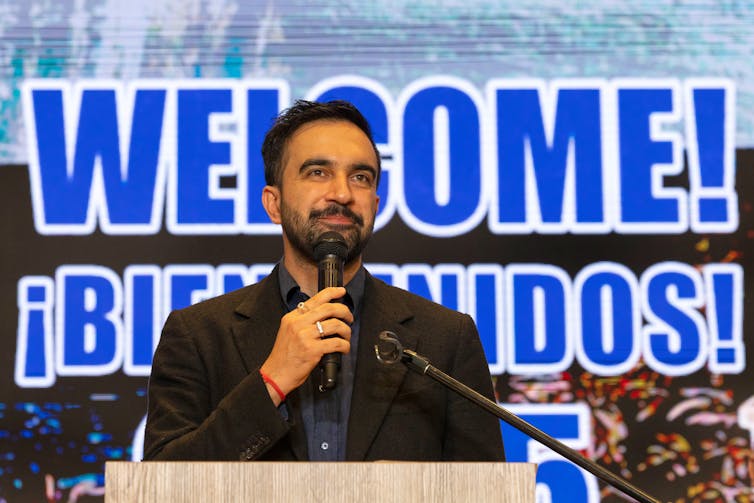
Democrats won governorships in Virginia and New Jersey, and Zohran Mamdani stormed to victory in the New York City mayor’s race in open defiance of Trump.
Perhaps most significant for the Democrats’ chances in the 2026 midterm elections, California Governor Gavin Newsom’s Proposition 50 passed by a wide margin[1]. This measure is intended to reconfigure the state’s electorates[2] counterbalance Republican gerrymandering in Texas and other states.
Meanwhile, Trump’s approval ratings continue to slump in national polls[3] amid a prolonged government shutdown.
But if a week is a long time in politics, the next US elections (due in November 2026) are an eternity away.
And there are still serious challenges ahead for the Democratic Party as it seeks not just to win back control of the House of Representatives, but to resist Trump’s attempts to recast the country in his own authoritarian and reactionary image.
What went right for the Democrats?
Before looking at the challenges, though, it is important to understand what led to last week’s Democratic successes.
Trump governs through crisis and chaos. His pitch to supporters is an existential one, explicitly cultivating white grievance[4] among those voters who feel they have been left behind. He argues that the US political system is so broken, only he can resolve it through extraordinary measures.
Yet, there is a significant gap between Trump’s vision of the United States, and the reality of life for Americans (including many Trump voters).
On the campaign trail in 2024, Trump promised his administration would down bring prices “starting on day one[5]”.
But early evidence[6] from Trump’s tariffs indicates US companies and consumers are bearing the costs. Prices have continued to rise[7] on certain goods[8], such as apparel, furniture, food items and cars. A recent survey[9] found 74% of respondents had experienced an average increase of monthly household costs by at least US$100 (A$150).
Disappointed expectations are a potent political force that has spelled doom for politicians well before Trump.
The optics couldn’t be worse at the moment, either. Hosting a Great Gatsby-themed party[10], a brash and boastful display of wealth, at a time when federal food aid is about to end for 42 million citizens is not exactly a public relations coup.
The Democrats that won last week came from different ends of the party’s political spectrum, but there was one thing that united them: a focus on affordability and the cost of living. And they all had a clear message[11]: Trump’s policies are to blame.
This is adept and effective politics. Democrats are identifying the ways that Trump is failing to carry through on his promises, and have been increasingly ruthless in exposing them.
But there are limits to this strategy. To build sustainable electoral coalitions capable of not just winning office but of turning back the larger MAGA tide that swept to victory in 2024, the Democrats need to be able to construct a coherent and compelling vision of the future they want to create.
Can the Democrats unify on a national scale?
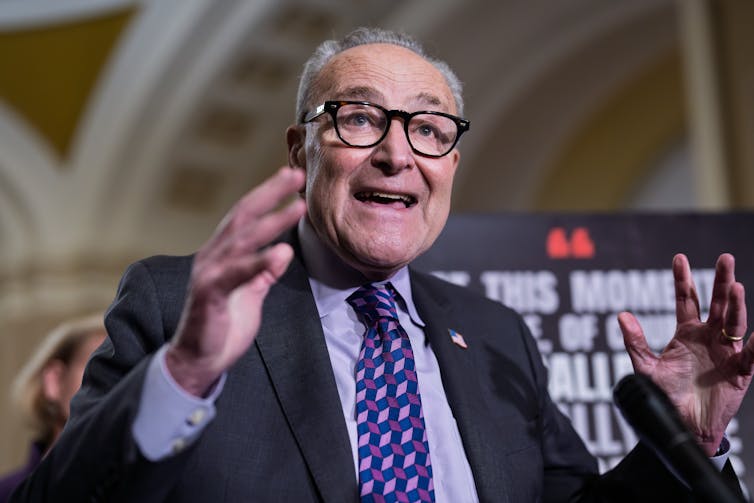
The Democrats remain deeply divided over how to respond to Trump – and more broadly, divided over what the party stands for[12].
The split among Senate Democrats[13] on whether to allow a vote to reopen the government without getting the assurances on health insurance subsidies they’ve been holding out for exemplifies this.
Are the Democrats going to lean into being a moderate and centrist party? Or will they move further left and embrace more progressive positions – those championed by the likes of Bernie Sanders[14] and Mamdani – even if these are to the left of the electorate?
It is not a problem the party is having these debates. Political parties in the US have always been organisationally looser and ideologically broader than those elsewhere.
It is, however, unclear if the party has the institutional mechanisms to synthesise these strongly polarised perspectives into a consistent agenda and program that Democrats can present to a national electorate.
As some commentators have noted[15], it is relatively easy for Democrats to win low-turnout state and city-based elections without clarifying these matters. But winning a national election, or recapturing the US Senate, is a more difficult task.
Can the Democrats find a way to not just articulate opposition to Trump, but put forth of a common vision of America’s future embraced by these disparate wings of the party?
And how do they turn words into action?
When a political system is in crisis, it is not enough for progressives to repeat over and over what has gone wrong. They also need solutions – a positive case for what they want to achieve and a policy agenda to enact it. Then, they can build a new social coalition around a common sense of purpose.
It is all well and good to denounce Trump’s poor economic management, but will Democrats be able to implement strategies[16] that deliver on their affordability promises?
For this to happen, the party has to agree on concrete plans to reinvigorate economic growth beyond the tech sector and ensure a fairer redistribution of the benefits of this growth. In addition, they’ll need to come together on the right balance of investment in the American people and infrastructure through government spending, and the need to reduce the US’ extraordinary debt levels.
To make things even more difficult, they’ll need to articulate how to achieve this with a Congress prone to partisan gridlock like never before in modern history. So far, the Democrats have no clear answers to these fundamental questions.
The Democrats’ challenge, therefore, is not just to repudiate Trump’s dark vision of America, but to put forward their own positive vision of what the future can be. Recent victories are encouraging, but a lack of this broader imaginative work so far is striking.
The Democrats have come closer to working out how to win – but still need an answer for an even more defining question: what do they want to win for?
References
- ^ passed by a wide margin (apps.npr.org)
- ^ reconfigure the state’s electorates (www.bbc.com)
- ^ slump in national polls (theconversation.com)
- ^ white grievance (time.com)
- ^ starting on day one (www.bbc.com)
- ^ early evidence (www.reuters.com)
- ^ continued to rise (www.npr.org)
- ^ certain goods (www.bbc.com)
- ^ recent survey (www.theguardian.com)
- ^ Great Gatsby-themed party (www.latimes.com)
- ^ clear message (www.theatlantic.com)
- ^ what the party stands for (www.theguardian.com)
- ^ split among Senate Democrats (www.politico.com)
- ^ Bernie Sanders (www.thenation.com)
- ^ some commentators have noted (www.theatlantic.com)
- ^ implement strategies (www.theatlantic.com)