China’s ban on fuel exports is deeply worrying for Australian air travellers
- Written by: Samantha Hepburn, Professor of Law, Deakin University

Australia’s vulnerability to liquid fuel shortages and price hikes has intensified amid reports China has told oil refiners to halt all fuel exports. This adds to continued global uncertainty about the duration of the Iran conflict and its impact upon oil supplies.
On Friday, the Australian Financial Review reported[1] China had notified oil refiners to halt all exports, casting doubt over at least two cargoes due to be shipped to Australia.
Two transport ships in the Strait of Hormuz, the world’s most important transport route, have also been blown up[2] making it likely future ships will not make this journey while the conflict continues.
This means Asian refineries like those in China are receiving significantly less oil. This reduction in supply mean these refining countries must, in turn, assess their own strategic requirements[3] for petrol, diesel and jet fuel.
China asks refineries to stop all fuel cargoes
Asia countries gets up to 90% of their oil from the Middle East[4]. As a net importer of liquid fuels, Australia is heavily reliant upon exports from Asian refineries. This is particularly true for jet fuel.
Aviation experts have long warned of the susceptibility of Australia to jet fuel disruption. For example, the Sydney Airport’s chief executive officer, Scott Charlton, has indicated Sydney is completely reliant on jet fuel imports[5] and has no refinery capacity.
This makes any decision by China to stop exports of jet fuel to Australia extremely concerning. Depending upon how long this continues, it is likely to cause significant disruptions to flight scheduling. In 2025 Australia imported about 32% of its jet fuel from China[6].
Without these exports, Australia must turn to other countries such as South Korea, Taiwan, Singapore, Malaysia and India. However, they are also experiencing the impact of the Middle Eastern conflict, and it is possible further export [7]restrictions from these countries may follow.
When stockpiles really matter
If this happens, Australia will need to rely upon its strategic stockpile of jet fuel because it has very little domestic refinery capability. Unfortunately, these stockpiles are not significant.
As of mid-March 2026, the Department of Industry, Science and Resources confirmed Australia[9] has approximately 29 to 32 days of jet fuel in reserve, which amounts to to approximately 802 million litres. These stocks are held either onshore at storage facilities or on ships located within Australia’s exclusive economic zone[10], which extends extends from 22 to 370 kilometres from the coastline of Australia and its external territories,.
This stockpile is consistent with the minimum domestic stockpile obligations imposed by the Australian government. However, Australia has not complied with the 90-day stockpiling obligation for members of the International Energy Agency (IEA), and cannot provide international assistance[11].
In recent days, the IEA has ordered its member states release the biggest oil stockpile reserves in history. Four hundred million barrels of emergency oil, representing a third of the total stockpiles of all member states, were released. This is far more than the 2022 release of 182 million barrels of oil[12] by IEA countries following Russia’s full-scale invasion of Ukraine.
What will happen to Australian flights?
Australia’s jet fuel supply chain is designed around continuous tanker deliveries, rather than long term storage. Large airports store jet fuel in tank farms, with mutiple storage tanks, connected to pipelines and hydrant systems. These facilities can only hold a few weeks of jet fuel at a time[13].
This means airports will run out quickly if new supplies do not arrive.
There are many reasons[14] why Australia has not increased its security stockpile of liquid fuel. These include a decline in domestic refining capacity, reliance upon cheaper global supplies and costs and space associated with fuel storage. However, the lack of a significant stockpile has now put Australia in a precarious situation.
If jet fuel deliveries to airports completely stop, airports will need to rely upon their reserves. Jet fuel reserves would run low within a few weeks, or less. Authorities are likely to prioritise emergency and military flights, reduce commercial aviation and impose fuel rations[15].
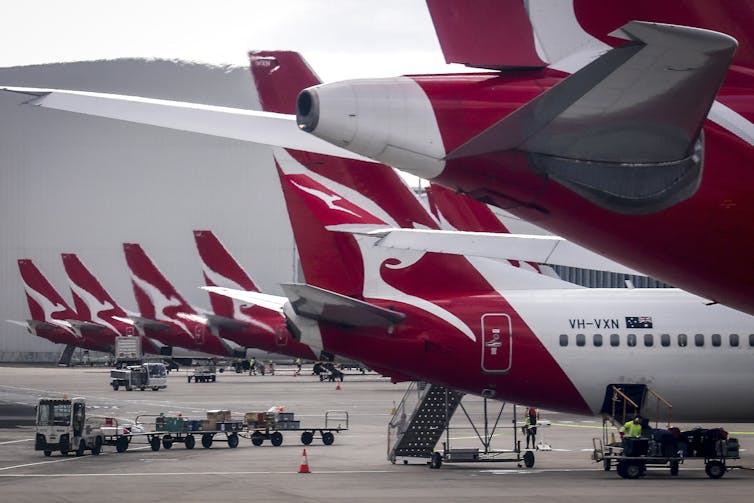
It is unclear what the current impact of fuel export restrictions upon flight scheduling will be. Qantas, the biggest user of jet fuel in Australia, has indicated it will need to increase its fares, however at this stage flights have not been cancelled[16]. But this is on the cards if supplies do not arrive beyond March, and there is a need to impose fuel rationing.
Air New Zealand has already cut 1,100 flights[17] from its service due to fuel pricing and supply issues. There are concerns this will lead to increased airfares, fuel surcharges, flight reductions and cancellations in the immediate future. In the longer term, we might also see the prospect of flight rationing.
References
- ^ reported (www.afr.com)
- ^ been blown up (www.abc.net.au)
- ^ own strategic requirements (www.reuters.com)
- ^ the Middle East (www.reuters.com)
- ^ on jet fuel imports (www.afr.com)
- ^ jet fuel from China (crudeoilpeak.info)
- ^ possible further export (www.reuters.com)
- ^ David Gray/Getty (www.gettyimages.com.au)
- ^ confirmed Australia (www.minister.industry.gov.au)
- ^ Australia’s exclusive economic zone (en.wikipedia.org)
- ^ provide international assistance (www.theguardian.com)
- ^ 182 million barrels of oil (www.theguardian.com)
- ^ at a time (www.festanks.com.au)
- ^ many reasons (www.aspistrategist.org.au)
- ^ impose fuel rations (www.mua.org.au)
- ^ not been cancelled (www.sbs.com.au)
- ^ already cut 1,100 flights (www.1news.co.nz)