We looked at all the recent evidence on mobile phone bans in schools – this is what we found
- Written by: Marilyn Campbell, Professor, School of Early Childhood & Inclusive Education, Queensland University of Technology
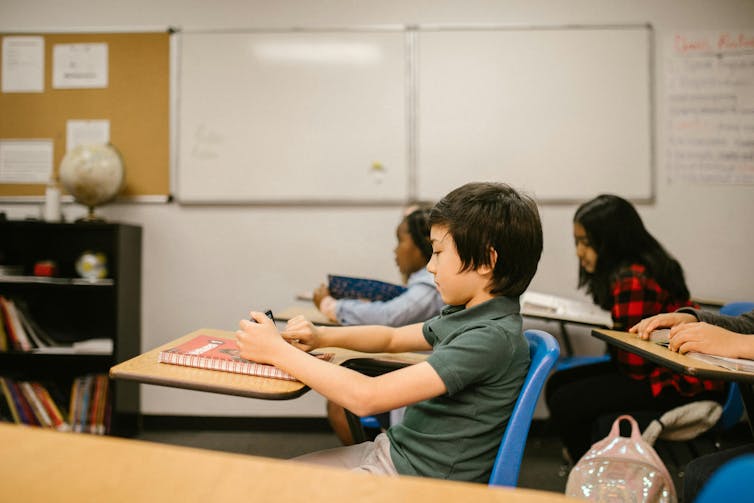
Mobile phones are currently banned in all Australian state schools and many Catholic and independent schools around the country. This is part of a global trend[1] over more than a decade[2] to restrict phone use in schools.
Australian governments say banning mobile phones will reduce distractions in class[3], allow students to focus on learning[4], improve student wellbeing[5] and reduce cyberbullying[6].
But previous research has shown there is little evidence[7] on whether the bans actually achieve these aims.
Many places that restricted phones in schools before Australia did have now reversed their decisions. For example, several school districts in Canada[8] implemented outright bans then revoked them as they were too hard to maintain. They now allow teachers to make decisions that suit their own classrooms.
A ban was similarly revoked in New York City[9], partly because bans made it harder for parents to stay in contact with their children.
What does recent research say about phone bans in schools?
Our study
We conducted a “scoping review” of all published and unpublished global evidence for and against banning mobile phones in schools.
Our review, which is pending publication, aims to shed light on whether mobile phones in schools impact academic achievement (including paying attention and distraction), students’ mental health and wellbeing, and the incidence of cyberbullying.
A scoping review is done when researchers know there aren’t many studies on a particular topic. This means researchers cast a very inclusive net, to gather as much evidence as possible.
Read more: Why a ban on cellphones in schools might be more of a distraction than the problem it’s trying to fix[10]
Our team screened 1,317 articles and reports as well as dissertations from masters and PhD students. We identified 22 studies that examined schools before and after phone bans. There was a mix of study types. Some looked at multiple schools and jurisdictions, some looked at a small number of schools, some collected quantitative data, others sought qualitative views.
In a sign of just how little research there is on this topic, 12 of the studies we identified were done by masters and doctoral students. This means they are not peer-reviewed but done by research students under supervision by an academic in the field.
But in a sign of how fresh this evidence is, almost half the studies we identified were published or completed since 2020.
The studies looked at schools in Bermuda, China, the Czech Republic, Ghana, Malawi, Norway, South Africa, Spain, Sweden, Thailand, the United Kingdom and the United States. None of them looked at schools in Australia.
Academic achievement
Our research found four studies that identified a slight improvement in academic achievement when phones were banned in schools. However, two of these studies[13] found this improvement only applied to disadvantaged or low-achieving students.
Some studies[14] compared schools where there were partial bans against schools with complete bans. This is a problem because it confuses the issue.
But three studies found no differences in academic achievement, whether there were mobile phone bans or not. Two of these studies used very large samples. This masters thesis[15] looked at 30% of all schools in Norway. Another study used a nationwide cohort in Sweden[16]. This means we can be reasonably confident in these results.
Mental health and wellbeing
Two studies in our review, including this doctoral thesis[17], reported mobile phone bans had positive effects on students’ mental health. However, both studies used teachers’ and parents’ perceptions of students’ wellbeing (the students were not asked themselves).
Two other studies[18] showed no differences in psychological wellbeing following mobile phone bans. However, three studies[19] reported more harm to students’ mental health and wellbeing when they were subjected to phone bans.
The students reported they felt more anxious without being able to use their phone. This was especially evident in one doctoral thesis[20] carried out when students were returning to school after the pandemic, having been very reliant on their devices during lockdown.
So the evidence for banning mobile phones for the mental health and wellbeing of student is inconclusive and based only on anecdotes or perceptions, rather than the recorded incidence of mental illness.
Bullying and cyberbullying
Four studies[23] reported a small reduction in bullying in schools following phone bans, especially among older students. However, the studies did not specify whether or not they were talking about cyberbullying.
Teachers in two other studies, including this doctoral thesis[24], reported they believed having mobile phones in schools increased cyberbullying.
But two other studies[25] showed the number of incidents of online victimisation and harassment was greater in schools with mobile phone bans compared with those without bans. The study didn’t collect data on whether the online harassment was happening inside or outside school hours.
The authors suggested this might be because students saw the phone bans as punitive, which made the school climate less egalitarian and less positive. Other research has linked[26] a positive school climate with fewer incidents of bullying.
There is no research evidence that students do or don’t use other devices to bully each other if there are phone bans. But it is of course possible for students to use laptops, tablets, smartwatches or library computers to conduct cyberbullying.
Even if phone bans were effective, they would not address the bulk of school bullying. A 2019 Australian study[27] found 99% of students who were cyberbullied were also bullied face-to-face.
Read more: Banning mobile phones in schools: beneficial or risky? Here's what the evidence says[28]
What does this tell us?
Overall, our study suggests the evidence for banning mobile phones in schools is weak and inconclusive.
As Australian education academic Neil Selwyn argued in 2021[29], the impetus for mobile phone bans says more about MPs responding to community concerns rather than research evidence.
Politicians should leave this decision to individual schools, which have direct experience of the pros or cons of a ban in their particular community. For example, a community in remote Queensland could have different needs and priorities from a school in central Brisbane.
Mobile phones are an integral part of our lives. We need to be teaching children about appropriate use of phones, rather than simply banning them. This will help students learn how to use their phones safely and responsibly at school, at home and beyond.
Read more: School phone bans seem obvious but could make it harder for kids to use tech in healthy ways[30]
References
- ^ global trend (www.weforum.org)
- ^ more than a decade (www.cbc.ca)
- ^ reduce distractions in class (www.education.wa.edu.au)
- ^ focus on learning (education.nsw.gov.au)
- ^ student wellbeing (www.education.sa.gov.au)
- ^ reduce cyberbullying (statements.qld.gov.au)
- ^ little evidence (theconversation.com)
- ^ several school districts in Canada (www.cbc.ca)
- ^ New York City (www.nyc.gov)
- ^ Why a ban on cellphones in schools might be more of a distraction than the problem it’s trying to fix (theconversation.com)
- ^ RDNE Stock Project/ Pexels (www.pexels.com)
- ^ CC BY (creativecommons.org)
- ^ studies (www.sciencedirect.com)
- ^ studies (www.emerald.com)
- ^ masters thesis (openaccess.nhh.no)
- ^ in Sweden (www.sciencedirect.com)
- ^ doctoral thesis (www.proquest.com)
- ^ studies (openaccess.nhh.no)
- ^ studies (openaccess.nhh.no)
- ^ doctoral thesis (www.proquest.com)
- ^ Priscilla Du Preez/Unsplash (unsplash.com)
- ^ CC BY (creativecommons.org)
- ^ studies (www.emerald.com)
- ^ doctoral thesis (www.proquest.com)
- ^ studies (www.tandfonline.com)
- ^ linked (theconversation.com)
- ^ study (journals.sagepub.com)
- ^ Banning mobile phones in schools: beneficial or risky? Here's what the evidence says (theconversation.com)
- ^ argued in 2021 (bera-journals.onlinelibrary.wiley.com)
- ^ School phone bans seem obvious but could make it harder for kids to use tech in healthy ways (theconversation.com)