J.M. Coetzee’s provocative first book turns 50 this year – and his most controversial turns 25
- Written by: Andrew van der Vlies, Professor, School of Humanities, University of Adelaide
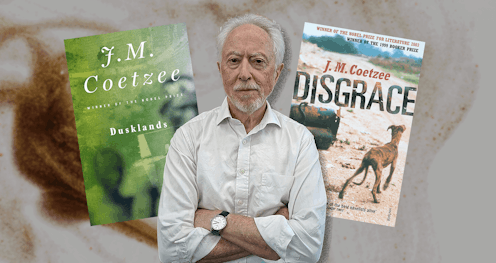
J.M. Coetzee, one of the leading novelists of our age, turns 84 this year. Last year, he published The Pole and Other Stories[1], his 18th book (excluding volumes of criticism, commentary, letters and translations). Its flowering of mature style confirms that this writer remains at the top of his game.
Coetzee celebrates another milestone this year: 50 years of publishing serious, provocative fiction. His work is always formally daring, brave in its social critique and its refusal to play by the rules.
Dusklands
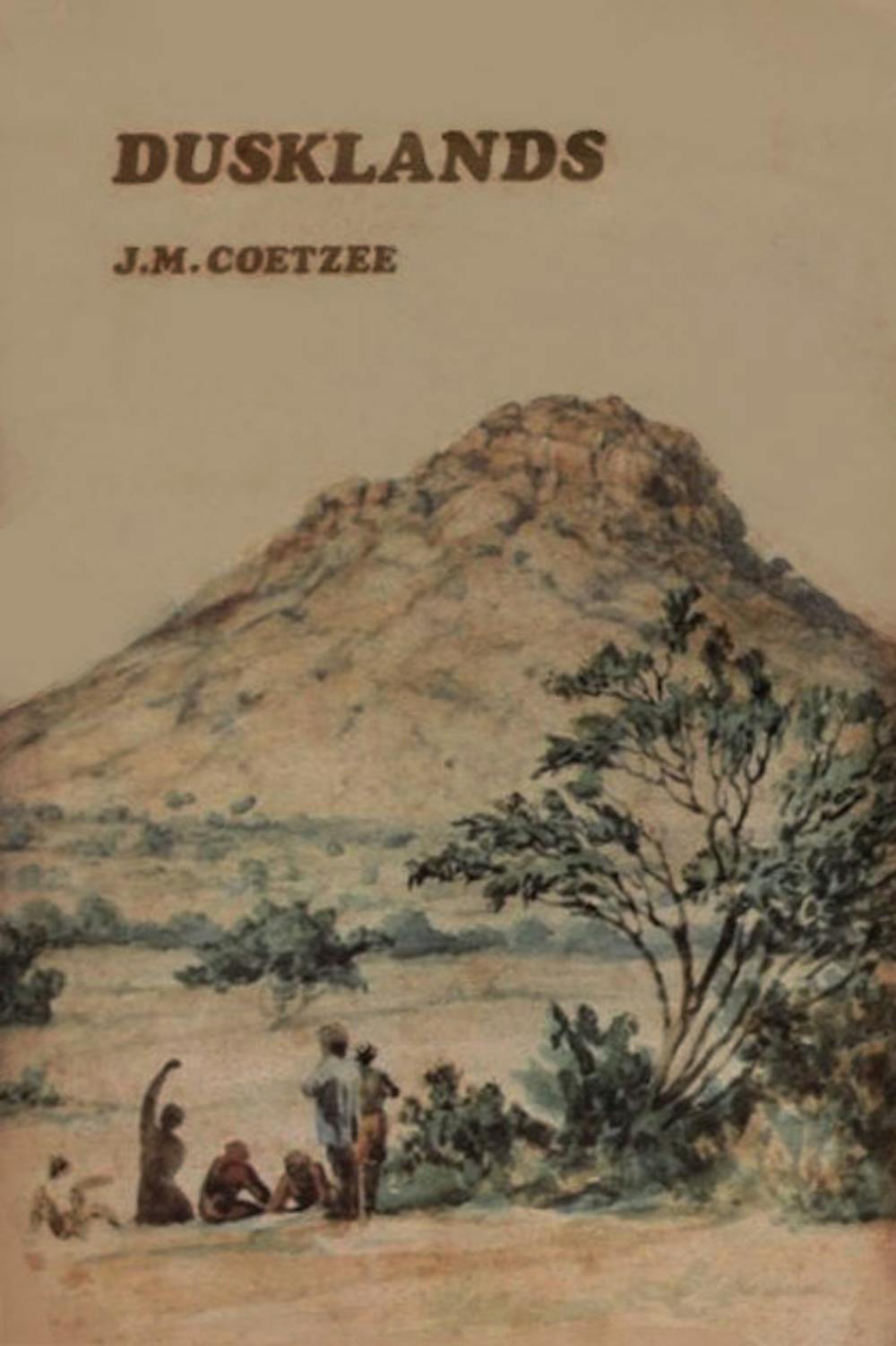
Coetzee’s first book, Dusklands[2], appeared in April 1974. It was published by a small press in Johannesburg called Ravan, which had built a modest reputation for oppositional writing under apartheid. Coetzee’s debut was a slim volume with an unassuming – even deliberately dull – cover that belied the incendiary force of the two stories it contained.
Its first part, The Vietnam Project, is set in the United States during the early 1970s. Its narrator, Eugene Dawn, meditates on his work as propaganda-warfare analyst for the US military’s operations in Vietnam.
“I have an exploring temperament,” he declares. “Had I lived two hundred years ago I would have had a continent to […] open to colonization.”
Eugene Dawn’s dreams of “total air-war” precipitate his decline. He holes up in a motel with Patrick White’s Voss[3] and Saul Bellow’s Herzog[4] – novels concerned with the decline of overreaching rational minds.
The drive to explore and dominate also compels the protagonist of the book’s second part, The Narrative of Jacobus Coetzee. The story is presented as as a translation, with parodic scholarly apparatus, of a record by a (real) 18th-century explorer. Jacobus Coetzee describes expeditions into the interior of what is now the Western and Northern Cape provinces of South Africa.
“I am a hunter,” he states, “a domesticator of the wilderness, a hero of enumeration.”
He recounts how, in 1760-61, he encounters the indigenous Khoisan people in the hinterlands of the Dutch settlement. He regards them as “completely disposable” and treats them like animals, seeing them as “game”. Their murder by the increasingly unhinged frontiersman is narrated with stomach-turning glee, as Jacobus Coetzee appears to descend into a madness born of megalomania.
“I am a tool in the hands of history,” he declares. “I have other things to think about.”
Each part of this bracing debut, then, offered an implicitly satirical engagement with the excesses of colonial adventuring. The book was formally daring, too. Was this a novel or two novellas, its first readers wondered. How was one to interpret the 18th-century “narrative” that presented itself as a historical document?
The juxtaposition of two widely divergent settings drew attention to what the narratives shared. It connected the narrators’ self-satisfied posturings as missionaries of “civilization” in a bravura indictment of Western Enlightenment discourses.
The boldness and novelty of approach led Jonathan Crewe – the book’s first South African reviewer – to herald of the arrival of the modern novel in the country. Some of the more avant-garde and oppositional Afrikaans writers of the previous decade would no doubt have demurred. But Crewe’s comparison of Dusklands with Joseph Conrad’s Heart of Darkness[5] remains apt.
Both books feature the “journey of the Western consciousness out of the polity and into the void,” Crewe wrote. Both cast that journey as critique rather than celebration of Western attitudes.
Read more: How Conrad’s imperial horror story Heart of Darkness resonates with our globalised times[6]
A revolutionary text
Rita Barnard, a South African-born academic at the University of Pennsylvania who has taught Dusklands for many years, has observed that her students increasingly baulk at the book’s violence. They resent that they are being asked to occupy the subject position of the white perpetrator.
Barnard has some sympathy with this response. “After all,” she muses,
revelations about colonial discourse that Dusklands stunned us with in the 1970s are no longer new; my students were already trained to look for silences, racist misrepresentations, and epistemic violence in a text.
Yet Dusklands was undoubtedly revolutionary for its moment. Nelson Mandela was eight years into his life sentence. The Soweto Rising and the death of Steve Biko in police custody had not yet galvanised internal opposition. Overtly anti-apartheid works were routinely repressed. The formal end of apartheid was still 20 years away.
In this context, it is difficult to conceive of a bolder attack on the ideas of apartheid’s ideologues. No other work had dared to link apartheid’s originary narratives (as the explorer accounts undoubtedly are) to Kissinger-era realpolitik.
For all our laudable attention to trigger warnings, we should welcome fiction that unsettles our complacent sense that philosophical opposition to colonial violence and its legacies might be sufficient absolution. Dusklands forces the reader into uncomfortable cohabitation with characters who are implicated in genocide, but convinced of their moral rectitude.
One hardly need elaborate the ongoing lesson this holds for readers in the present.
 J.M. Coetzee receiving an honorary doctorate from Wits University, Johannesburg, South Africa, December 10, 2012.
Mary-Anne Palmer/Getty Images
J.M. Coetzee receiving an honorary doctorate from Wits University, Johannesburg, South Africa, December 10, 2012.
Mary-Anne Palmer/Getty Images
Read more: In J.M. Coetzee's latest story collection, questions of the soul become urgent as the body becomes frail[7]
Disgrace
As arbitrarily neat temporal markers would have it, this year is also a significant anniversary for another of Coetzee’s most provocative works.
Disgrace[8] was published in August 1999, five years into the “new” South Africa, and against the backdrop of the Truth and Reconciliation Commission, the country’s great experiment in truth-telling. It won Coetzee his second Booker Prize, making him the first author so celebrated.
Set in a recognisable present, Disgrace is Coetzee’s most deceptively straightforward realist narrative. Its university setting, similar to the University of Cape Town, generated all manner of misguided speculations about whether it was a roman à clef.
 Disgrace is a novel that interrogates the transparency of language, more specifically English. Its protagonist, David Lurie, is an academic whose research interest is the poetry of the Romantics. He wonders at one point whether English is a fit medium for communication in post-apartheid South Africa. It appears “tired”, he reflects.
Early in the novel, Lurie goes to see a play called Sunset at the Globe Salon, a farce that offers ironic commentary on his intellectual identifications. The play is set neither in Shakespeare’s Globe Theatre, nor in an 18th-century salon, but in a hairdressers’ parlour, where the melodrama unfolds in gloriously creolising English. The sun is going down on an “old” South Africa – and Lurie appears stranded.
Like Dusklands, Disgrace does not shy away from violence – in this case, a violent gang rape of Lurie’s daughter Lucy by three black men.
Lucy is a model “new” South African. She is a lesbian who runs a boarding kennel in the rural heartland, having turned her back on self-satisfied metropolitan social circles. She is attempting to live ethically, with a social conscience.
The country’s ruling party, the African National Congress, took umbrage. In a submission to the country’s Human Rights Commission, they condemned Disgrace as an instance of white racism lingering in media and the arts. Specifically, they objected to the novel’s key moment of crisis – the rape – and Lucy’s suggestion that such sexual violence might be the “the price one has to pay for staying on”.
Coetzee, they averred, “represents as brutally as he can the white people’s perception of the post-apartheid black man”.
What the ANC failed to note was that the rape is not represented. Disgrace might appear to be a realist novel with an omniscient narrator, but it is, in fact, entirely focalised through its white male protagonist, who is in denial about his complicity with prejudice and violence.
Indeed, David Lurie is himself a rapist. Lucy’s rape is mirrored by Lurie’s rape of one of his students, Melanie Isaacs, who is coded as mixed race (a detail readers often miss). He justifies his exploitation of a student as “not rape, not quite that, but undesired … to the core”.
David’s punishment is a retreat into forms of self-abnegation and “service” that the novel invites us to read as ultimately narcissistic.
Read more:
Patrick White was the first Australian writer to win the Nobel Prize in Literature – 50 years later, is he still being read?[9]
Problems with language
One of the striking aspects of Dusklands – and part of its boldness – is its insistence on the global connections between oppression and injustice. It insists, too, on addressing a global audience, in a style that refuses to be marked as parochial or nationalist. Its form refuses to endorse any single speaking position.
Barnard puts this eloquently. Dusklands, she writes, “opens up a speaking place that is global, rather than national, or even strictly monolingual or monogeneric”.
These moves have characterised Coetzee’s subsequent work. His novels incorporate apparent contradictions, undermine occasions of narration, and frame narratives as the speech acts of characters who are obviously compromised and unreliable. They undermine the premises of canonical texts and stage outrageous metafictional interventions – as when the writer-protagonist of one Coetzee novel, Elizabeth Costello[10] (2003), shows up part-way through the next, Slow Man[11] (2005), and proceeds to direct the plot.
Language makes worlds, and Coetzee’s work has from the outset interrogated the presumption that this is a straightforward operation without ideological implications. Language is never transparent, never innocent of the designs of those who claim to police forms of expression.
Coetzee was regarded by some of his peers as insufficiently engaged with the emergency in South Africa – notably Nadine Gordimer in a famously puzzled review[12] of his Booker Prize-winning novel Life & Times of Michael K[13] (1983). But the difficulty of taking positions, when those positions are already taken by people determined to force compliance with one view of historical events or another, is a recurring dilemma for Coetzee.
Only fiction, his 50-year career continues to insist, offers a writer the means to intervene in the world in ways that have relevance beyond immediate contexts. It places the author at a remove from the political demand that we speak, for such speaking is inevitably only ventriloquism.
In Summertime[14] (2009), the final instalment in a trilogy of memoirs that challenge readers’ presumptions about the genre (it features a biographer interviewing significant figures in the life of the deceased author John Coetzee), a former lover of the author speculates that Dusklands was not only “a book about cruelty, an exposé of the cruelty involved in various forms of conquest”, but also “a project in self-administered therapy”.
This is a joke of sorts. But it is also insightful, in that it acknowledges the part-autobiographical nature of any writer’s work.
Coetzee has been ahead of his readers from the outset. He is implicated in the “translation” of The Narrative of Jacobus Coetzee (a distant relative, if not a direct antecedent). And Eugene Dawn’s demanding supervisor at the sinister RAND-like corporation he serves is named “Coetzee”.
All of Coetzee’s works are a self-recriminating interrogations. They address the complicity of writers in events that are too easily dismissed as beyond their capacity to influence. They examine privileges inherited at the expense of others in ways that remain profoundly important. Their honesty and power to discomfort makes them as necessary today as when they first appeared.
References^ The Pole and Other Stories (www.textpublishing.com.au)^ Dusklands (www.textpublishing.com.au)^ Voss (www.penguin.com.au)^ Herzog (www.penguin.com.au)^ Heart of Darkness (www.britannica.com)^ How Conrad’s imperial horror story Heart of Darkness resonates with our globalised times (theconversation.com)^ In J.M. Coetzee's latest story collection, questions of the soul become urgent as the body becomes frail (theconversation.com)^ Disgrace (www.textpublishing.com.au)^ Patrick White was the first Australian writer to win the Nobel Prize in Literature – 50 years later, is he still being read? (theconversation.com)^ Elizabeth Costello (www.textpublishing.com.au)^ Slow Man (www.textpublishing.com.au)^ famously puzzled review (www.nybooks.com)^ Life & Times of Michael K (www.textpublishing.com.au)^ Summertime (www.textpublishing.com.au)
Disgrace is a novel that interrogates the transparency of language, more specifically English. Its protagonist, David Lurie, is an academic whose research interest is the poetry of the Romantics. He wonders at one point whether English is a fit medium for communication in post-apartheid South Africa. It appears “tired”, he reflects.
Early in the novel, Lurie goes to see a play called Sunset at the Globe Salon, a farce that offers ironic commentary on his intellectual identifications. The play is set neither in Shakespeare’s Globe Theatre, nor in an 18th-century salon, but in a hairdressers’ parlour, where the melodrama unfolds in gloriously creolising English. The sun is going down on an “old” South Africa – and Lurie appears stranded.
Like Dusklands, Disgrace does not shy away from violence – in this case, a violent gang rape of Lurie’s daughter Lucy by three black men.
Lucy is a model “new” South African. She is a lesbian who runs a boarding kennel in the rural heartland, having turned her back on self-satisfied metropolitan social circles. She is attempting to live ethically, with a social conscience.
The country’s ruling party, the African National Congress, took umbrage. In a submission to the country’s Human Rights Commission, they condemned Disgrace as an instance of white racism lingering in media and the arts. Specifically, they objected to the novel’s key moment of crisis – the rape – and Lucy’s suggestion that such sexual violence might be the “the price one has to pay for staying on”.
Coetzee, they averred, “represents as brutally as he can the white people’s perception of the post-apartheid black man”.
What the ANC failed to note was that the rape is not represented. Disgrace might appear to be a realist novel with an omniscient narrator, but it is, in fact, entirely focalised through its white male protagonist, who is in denial about his complicity with prejudice and violence.
Indeed, David Lurie is himself a rapist. Lucy’s rape is mirrored by Lurie’s rape of one of his students, Melanie Isaacs, who is coded as mixed race (a detail readers often miss). He justifies his exploitation of a student as “not rape, not quite that, but undesired … to the core”.
David’s punishment is a retreat into forms of self-abnegation and “service” that the novel invites us to read as ultimately narcissistic.
Read more:
Patrick White was the first Australian writer to win the Nobel Prize in Literature – 50 years later, is he still being read?[9]
Problems with language
One of the striking aspects of Dusklands – and part of its boldness – is its insistence on the global connections between oppression and injustice. It insists, too, on addressing a global audience, in a style that refuses to be marked as parochial or nationalist. Its form refuses to endorse any single speaking position.
Barnard puts this eloquently. Dusklands, she writes, “opens up a speaking place that is global, rather than national, or even strictly monolingual or monogeneric”.
These moves have characterised Coetzee’s subsequent work. His novels incorporate apparent contradictions, undermine occasions of narration, and frame narratives as the speech acts of characters who are obviously compromised and unreliable. They undermine the premises of canonical texts and stage outrageous metafictional interventions – as when the writer-protagonist of one Coetzee novel, Elizabeth Costello[10] (2003), shows up part-way through the next, Slow Man[11] (2005), and proceeds to direct the plot.
Language makes worlds, and Coetzee’s work has from the outset interrogated the presumption that this is a straightforward operation without ideological implications. Language is never transparent, never innocent of the designs of those who claim to police forms of expression.
Coetzee was regarded by some of his peers as insufficiently engaged with the emergency in South Africa – notably Nadine Gordimer in a famously puzzled review[12] of his Booker Prize-winning novel Life & Times of Michael K[13] (1983). But the difficulty of taking positions, when those positions are already taken by people determined to force compliance with one view of historical events or another, is a recurring dilemma for Coetzee.
Only fiction, his 50-year career continues to insist, offers a writer the means to intervene in the world in ways that have relevance beyond immediate contexts. It places the author at a remove from the political demand that we speak, for such speaking is inevitably only ventriloquism.
In Summertime[14] (2009), the final instalment in a trilogy of memoirs that challenge readers’ presumptions about the genre (it features a biographer interviewing significant figures in the life of the deceased author John Coetzee), a former lover of the author speculates that Dusklands was not only “a book about cruelty, an exposé of the cruelty involved in various forms of conquest”, but also “a project in self-administered therapy”.
This is a joke of sorts. But it is also insightful, in that it acknowledges the part-autobiographical nature of any writer’s work.
Coetzee has been ahead of his readers from the outset. He is implicated in the “translation” of The Narrative of Jacobus Coetzee (a distant relative, if not a direct antecedent). And Eugene Dawn’s demanding supervisor at the sinister RAND-like corporation he serves is named “Coetzee”.
All of Coetzee’s works are a self-recriminating interrogations. They address the complicity of writers in events that are too easily dismissed as beyond their capacity to influence. They examine privileges inherited at the expense of others in ways that remain profoundly important. Their honesty and power to discomfort makes them as necessary today as when they first appeared.
References^ The Pole and Other Stories (www.textpublishing.com.au)^ Dusklands (www.textpublishing.com.au)^ Voss (www.penguin.com.au)^ Herzog (www.penguin.com.au)^ Heart of Darkness (www.britannica.com)^ How Conrad’s imperial horror story Heart of Darkness resonates with our globalised times (theconversation.com)^ In J.M. Coetzee's latest story collection, questions of the soul become urgent as the body becomes frail (theconversation.com)^ Disgrace (www.textpublishing.com.au)^ Patrick White was the first Australian writer to win the Nobel Prize in Literature – 50 years later, is he still being read? (theconversation.com)^ Elizabeth Costello (www.textpublishing.com.au)^ Slow Man (www.textpublishing.com.au)^ famously puzzled review (www.nybooks.com)^ Life & Times of Michael K (www.textpublishing.com.au)^ Summertime (www.textpublishing.com.au)