Who is Sam Altman, OpenAI's wunderkind ex-CEO – and why does it matter that he got sacked?
- Written by: Toby Walsh, Professor of AI, Research Group Leader, UNSW Sydney
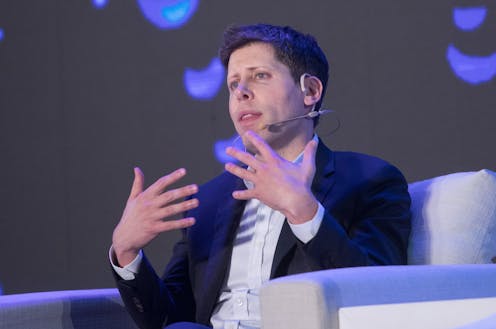
On Friday, OpenAI’s high-flying chief executive Sam Altman was unexpectedly fired by the company’s board. Co-founder and chief technology officer Greg Brockman was also removed as the board president, after which he promptly resigned.
In an unexpected twist, talks began today about potentially reinstating Altman in some capacity following an outpouring of industry and investor support[1] for him and several OpenAI researchers who quit[2] their jobs in solidarity.
Shockingly, however, that too was not to be. As of publication, Bloomberg reporters[3] announced OpenAI’s interim CEO, Mira Murati, had not managed to rehire Altman and Brockman as she had planned.
Instead, the board found a new CEO – Emmett Shear[4] – in record time. Shear, the former CEO of Twitch, will now take over from Murati as interim CEO, as reported by The Information[5].
It has been an epic backstabbing scene worthy of the HBO drama Succession. While many have speculated about why the board may have forced Altman out, details remain scarce.
What we can say is the decision to fire Altman will likely put a dent in OpenAI’s commercial progress.
An unusual company structure
OpenAI is the hottest company in tech today, having released the ChatGPT chatbot and DALL-E image generator onto a largely unsuspecting public.
The company’s mission is simple: to develop artificial general intelligence[6] (AGI) – that is, an AI which is as smart or smarter than a human – and to do so for the public good. Many were starting to believe OpenAI could succeed at this goal.
Read more: Will AI ever reach human-level intelligence? We asked five experts[7]
But developing AGI isn’t just a technical challenge. It’s a major management and economic nightmare. How can you ensure the vast power and wealth generated by AGI doesn’t subvert the company’s goal to seek the public good?
Many individuals within OpenAI and the wider tech community worry AI is progressing too fast. A global race in AI development is underway and the commercial pressure to succeed is immense.
Following its launch, ChatGPT quickly became the fastest-growing app in history, and OpenAI is by many measures one of the world’s fastest-growing companies. Its most recent funding round (which may now be scuppered by the recent drama) was set to value the company[8] at around US$90 billion[9]. Silicon Valley has never seen anything like it.
Given its mission, OpenAI was originally set up as a not-for-profit. But developing AGI requires billions[10] of dollars. To raise these billions, Altman pivoted the company towards a unique dual for-profit and not-for-profit structure.
The outcome was a for-profit subsidiary which is controlled by the not-for-profit. But the for-profit subsidiary is itself unusual, as it limits the return for investors (including Microsoft) to 100 times their stake.
Calls to bring back Altman
On top of OpenAI’s odd dual structure sat a board made up of Altman, Brockman, chief scientist Ilya Sutskever and three outsiders.
Many saw Altman as central to OpenAI’s success. The candid and boyish tech entrepreneur was previously president of Y Combinator, a legendary Silicon Valley startup accelerator that has launched many household names including Airbnb, Dropbox, Reddit, Stripe and Doordash.
Altman, a Stanford dropout, is a geek with immense social and strategic intelligence. He is also, by all accounts, a genius at building companies and someone who can effortlessly play three-dimensional chess in the cut and thrust of the business world.
In fact, Altman was already a billionaire when Elon Musk brought him on as one of the OpenAI founders in 2015. Musk would later go through his own drama, which led to him leaving the board, and to Altman going back on his original plan of having an open not-for-profit initiative to develop AGI.
OpenAI’s former CTO Brockman was a master at coding, and phenomenally hard working. He is what people[11] in the Valley call a “10x engineer” – someone who has as much productivity as 10 normal coders.
That leaves Sutskever, OpenAI’s chief scientist. He was one of the inventors of AlexNet[12], a powerful neural network which started the AI deep learning revolution about a decade ago – and also of the GPT language models that started the generative AI revolution. To be responsible for two of the technical innovations that have fuelled the AI frenzy is without precedent.
Sutskever, in particular, seems to be a major key player in the latest drama. According to inside reports, he was worried OpenAI was moving too fast and that Altman was putting money ahead of safety and the company’s original mission. It was Sutskever who persuaded the three outside board members to fire Altman, reports claim[13].
The shock news of the sacking prompted multiple key staff to either quit or threaten to quit, while investors including Microsoft applied pressure[14] for his return. But it seems this wasn’t enough to bring Altman back.
Microsoft, the largest investor in OpenAI, had promised about US$10 billion towards OpenAI’s goals[15]. But without a seat on OpenAI’s board, Microsoft was only informed of Altman’s departure moments before the news broke.
The word on the street now is Altman and his followers will likely be branching out with their own AI venture.
What’s next?
The OpenAI board justified its original decision to fire Altman on the basis he was “not consistently candid” with them, without further clarification. Some think this may mean the board, which operates as a not-for-profit board, may have felt that under Altman they weren’t able to carry out the board’s duty of ensuring OpenAI was building AGI for the good of humanity.
In the months leading up to his dismissal, Altman had pitched several[16] ideas for new AI projects to investors, including a plan to develop custom chips to train extremely large AI models, which would let it compete with chip company Nvidia.
The board’s decision will likely have a lasting impact. Sutskever’s position in the company is now likely greatly weakened (I wouldn’t be surprised if he leaves or is pushed out). At the same time, his actions may well have addressed his concerns about OpenAI moving too fast.
As OpenAI emerges from this drama, it will be doubled over from the blow that was this weekend – and will struggle to raise funds in the future as it has in the past.
References
- ^ investor support (www.cnbc.com)
- ^ who quit (www.wired.com)
- ^ Bloomberg reporters (www.bloomberg.com)
- ^ Emmett Shear (x.com)
- ^ The Information (www.theinformation.com)
- ^ artificial general intelligence (openai.com)
- ^ Will AI ever reach human-level intelligence? We asked five experts (theconversation.com)
- ^ value the company (economictimes.indiatimes.com)
- ^ US$90 billion (www.wsj.com)
- ^ requires billions (www.theverge.com)
- ^ He is what people (time.com)
- ^ inventors of AlexNet (www.analyticsvidhya.com)
- ^ reports claim (www.wired.com)
- ^ applied pressure (www.theguardian.com)
- ^ OpenAI’s goals (www.semafor.com)
- ^ had pitched several (www.afr.com)