$3 billion for 'targeted and temporary' relief on bills
- Written by: Michelle Grattan, Professorial Fellow, University of Canberra
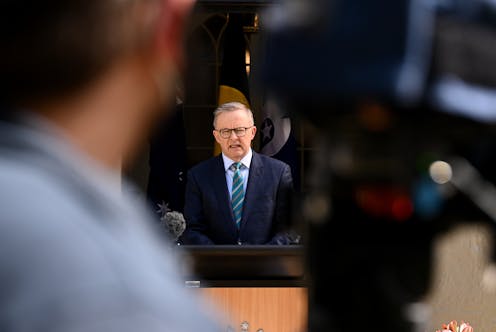
The federal government will provide up to $1.5 billion – to be matched by states and territories – for “targeted and temporary” relief on power bills for low and middle income households and small businesses.
Under a four-part package announced by Prime Minister Anthony Albanese after Friday’s national cabinet, the assistance will be built into households’ bills rather than being a cash handout.
Albanese said this was so it was deflationary, rather than inflationary.
The help, lasting a year, will be delivered by states and territories.
It will go to people receiving Commonwealth income support, pensioners, Commonwealth Seniors Health Card holders, and those receiving Family Tax Benefit A and B. It will also be directed to small-business customers of electricity retailers.
‘Hundreds of dollars’ in bill relief
The government says it will provide hundreds of dollars in bill relief to eligible families and businesses.
Amounts will vary between jurisdictions, with details still to be worked out. “It will not be the same plan in each state and territory, given each of them have different systems,” Albanese told a news conference. Power prices are not as high in some jurisdictions.
After the details are signed off by national cabinet by March, the assistance will start in the second quarter of next year, as winter looms.
In other measures, the federal government will impose a 12-month gas price cap of $12 a gigajoule on new wholesale gas sales by east-coast producers.
Read more: Will price caps on coal and gas bring power prices down? An expert isn't so sure[1]
There will be a mandatory code of conduct for the wholesale gas market that includes a “reasonable pricing” provision.
Federal parliament, which had finished for the year, will be recalled on Thursday to pass the necessary legislation.
NSW and Queensland will introduce a temporary price cap on coal used for electricity generation of $125 a tonne. Where the cost of production is higher, the federal government will provide support.
In a statement, Albanese, Treasurer Jim Chalmers and Energy Minister Chris Bowen said the average family would be $230 worse off next year without the government’s energy price relief plan.
They said that combined, the gas and coal measures were estimated to:
dampen predicted gas price rises by 2 percentage points in 2022-23 and 16 percentage points in 2023-24
reduce the impact of forecast electricity price rises of 36% in 2023-24 by 13 percentage points – preventing the $230 increase an average household would have seen otherwise
reduce expected inflation in 2023-24 by about a half percentage point.
Extraordinary times, and measures
Albanese said these were extraordinary times requiring extraordinary measures.
These are actions that wouldn’t have been contemplated by governments in normal times.
He hailed the agreement as an example of the “Commonwealth working hand in hand with states and territories”.
The deal has involved much wrangling with the NSW and Queensland governments, which stood to lose revenue. The NSW government, facing an election early next year, agreed to forgo royalties provided there was cost of living assistance.
Previously the federal government has resisted giving cost of living relief citing budget pressures as well as high inflation.
Albanese stressed the funding would not be inflationary.
The appropriate way to pay it is through state governments because that is how you take money off people’s bills, rather than provide cash payments. And that is important so that you have a deflationary impact, rather than inflationary.
Asked how much of the budget’s forecast two-year 56% rise in power prices the package would undo, Albanese said:
What it will do is put downward pressure on those increases which were envisaged.
He said there had already been some downward pressure as a result of the Commonwealth flagging it would act.
The final part of the package includes a capacity investment scheme agreed by energy ministers on Thursday, to ensure supply reliability. The federal government has agreed to underwrite investment in dispatchable renewable storage and generation.
Friday’s national cabinet was held virtually, with Albanese isolated at Kirribilli House with COVID.
Industry groups respond
The Business Council of Australia welcomed the help for households and small businesses. But it warned that “without careful management the long-term consequences of dramatic intervention could end up making the problem much worse”.
The Australian Industry Group described the deal as “messy but good for users”.
The Australian Petroleum Production & Exploration Association’s chief executive, Samantha McCulloch, said: “A gas price cap will force prices higher for households and businesses because it will kill investment confidence and reduce future supply.
"This heavy-handed, radical intervention has been conducted with no prior consultation with industry to consider specific measures and warn of potential risks to Australia.”
Chalmers said it “was a pretty remarkable effort by Albanese to line all that up from iso”.
References
- ^ Will price caps on coal and gas bring power prices down? An expert isn't so sure (theconversation.com)