'You can’t speak what you can’t hear' – how Māori and Pacific sports stars are helping revitalise vulnerable languages
- Written by: Dion Enari, Lecturer in Sport and Recreation, Auckland University of Technology
We’re becoming more used to hearing and seeing te reo Māori in everyday use these days. And Pacific languages are becoming increasingly familiar too – especially during the Pacific language weeks[1] now under way.
But if there’s one forum that has seen a genuine surge in the use of Indigenous languages it’s the world of elite sport. It’s a reflection of the increased cultural pride[2] felt by Māori and Pacific athletes – and it’s one more way these vulnerable languages are being kept alive in Aotearoa New Zealand.
Take women’s rugby star Ruby Tui, for example, who broke into her native Samoan during an impromptu interview with a BBC reporter during the Olympic Games in 2021.
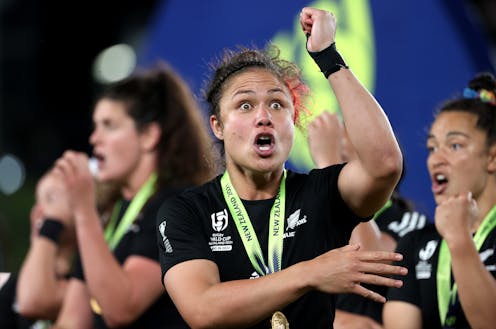
After her Black Ferns team won the 2022 women’s Rugby World Cup, Tui led the crowd in a spontaneous rendition of the classic Māori waiata (song) “Tutira Mai Ngā Iwi” – making international headlines[3] in the process.
Tui joins other high-profile Māori and Pacific players such as All Blacks Ardie Savea[4], TJ Perenara and Patrick Tuipulotu[5], and Black Ferns star Stacy Fluhler[6], who have all used their mother tongues during interviews.
Vulnerable languages
This is more than a feel-good phenomenon. Public figures using their native languages on the big stage support the revitalisation efforts being made by Indigenous people in general.
Despite te reo Māori being an official language of Aotearoa New Zealand, and Samoan being the country’s third-most-spoken language (and second-most-spoken language[7] in Auckland), there are still real concerns for their long-term survival.
Read more: Research on 2,400 languages shows nearly half the world's language diversity is at risk[8]
Te reo Māori is listed as “vulnerable”[9] on the UNESCO endangered languages list, and the number of Samoan speakers among the diaspora populations is decreasing[10].
New Zealand census data show only 3% of the population can speak te reo Māori, and only 2% Samoan. In fact, these numbers may be an overestimation of language capability, with the true percentages even lower[11]. It is thought that, without deliberate effort, language loss can occur within three generations[12].
Collective cultural values
On a positive note, it wasn’t very long ago that Indigenous athletes would only speak English during interviews. So the fact they will now use their star status to raise awareness[13] of their culture and language is a sign of progress.
In the process, these athletes are making inroads into what has largely been a eurocentric sporting arena[14]. In fact, it might be better to think of them not as athletes of Indigenous heritage, but rather as Indigenous people who happen to be athletes.
This is something our research supports[15]. Many of these athletes feel a sense of responsibility[16] to their families, villages, tribes and nations – not only to play well, but to use their profile to benefit their people.
This runs counter in some ways to the often individualistic values and financial priorities of commercial sports. Even in the hyper-competitive world of American football (NFL), Pacific players have managed to bring their cultures and languages[17] to the fore.
Since its inception in 2017, the Polynesian Bowl[18] has celebrated the legacy of Polynesian NFL players, with a Polynesian Hall of Fame, as well as through an ambassador programme and high school all-star game – with a primetime live broadcast spot[19] on the NFL network.
Read more: More Pacific rugby league stars are opting to play for their homelands over Australia or NZ – that's good for the game[20]
‘More than just words’
All these initiatives suggest there is another place where bilingual proficiency could make a difference – the commentary box.
There have already been examples of this – notably various initiatives by Whakaata Māori (Māori Television), including te reo Māori commentary during the 2011 Rugby World Cup[21] and 2022 Men’s Softball World Cup[22].
In 2019, Sky Sport also offered a te reo Māori option for matches broadcast during te wiki o te reo Māori (Māori Language Week). The same year, Sky piloted a Pacific language commentary team[23] for the Pasifika Challenge rugby event. Samoan, Tongan and Fijian commentaries were made available for all matches.
Television New Zealand and Spark Sport also offered te reo Māori commentary at this year’s T20 cricket series[24]. Former Black Cap Peter McGlashan (Ngāti Porou) explained his involvement this way:
My grandma grew up in a time when Māori were prohibited from speaking their language – it was beaten out of us. So this is something very special to me.
Te reo Māori is about so much more than just words. It’s the story of a culture that you can’t articulate accurately in any other language. It’s important we keep using it.
Part of the purpose of the commentary initiative, of course, was to attract more Māori to cricket. With that will come more role models and more opportunities to put the culture on the field. As McGlashan also said:
It’s just like the language. You can’t speak what you can’t hear. And you can’t be what you can’t see.
References
- ^ Pacific language weeks (www.mpp.govt.nz)
- ^ increased cultural pride (www.journal.mai.ac.nz)
- ^ international headlines (wwos.nine.com.au)
- ^ Ardie Savea (www.youtube.com)
- ^ TJ Perenara and Patrick Tuipulotu (www.facebook.com)
- ^ Stacy Fluhler (www.youtube.com)
- ^ second-most-spoken language (www.beehive.govt.nz)
- ^ Research on 2,400 languages shows nearly half the world's language diversity is at risk (theconversation.com)
- ^ listed as “vulnerable” (www.theguardian.com)
- ^ decreasing (journals.sagepub.com)
- ^ true percentages even lower (openrepository.aut.ac.nz)
- ^ can occur within three generations (openrepository.aut.ac.nz)
- ^ raise awareness (ir.canterbury.ac.nz)
- ^ eurocentric sporting arena (link.springer.com)
- ^ research supports (link.springer.com)
- ^ sense of responsibility (ir.canterbury.ac.nz)
- ^ bring their cultures and languages (ir.canterbury.ac.nz)
- ^ Polynesian Bowl (www.polynesianbowl.com)
- ^ primetime live broadcast spot (www.nfl.com)
- ^ More Pacific rugby league stars are opting to play for their homelands over Australia or NZ – that's good for the game (theconversation.com)
- ^ 2011 Rugby World Cup (www.scoop.co.nz)
- ^ 2022 Men’s Softball World Cup (www.instagram.com)
- ^ commentary team (www.rnz.co.nz)
- ^ T20 cricket series (www.1news.co.nz)