Relief at Derek Chauvin conviction a sign of long history of police brutality
- Written by: Clare Corbould, Associate Professor, Contemporary Histories Research Group, Deakin University
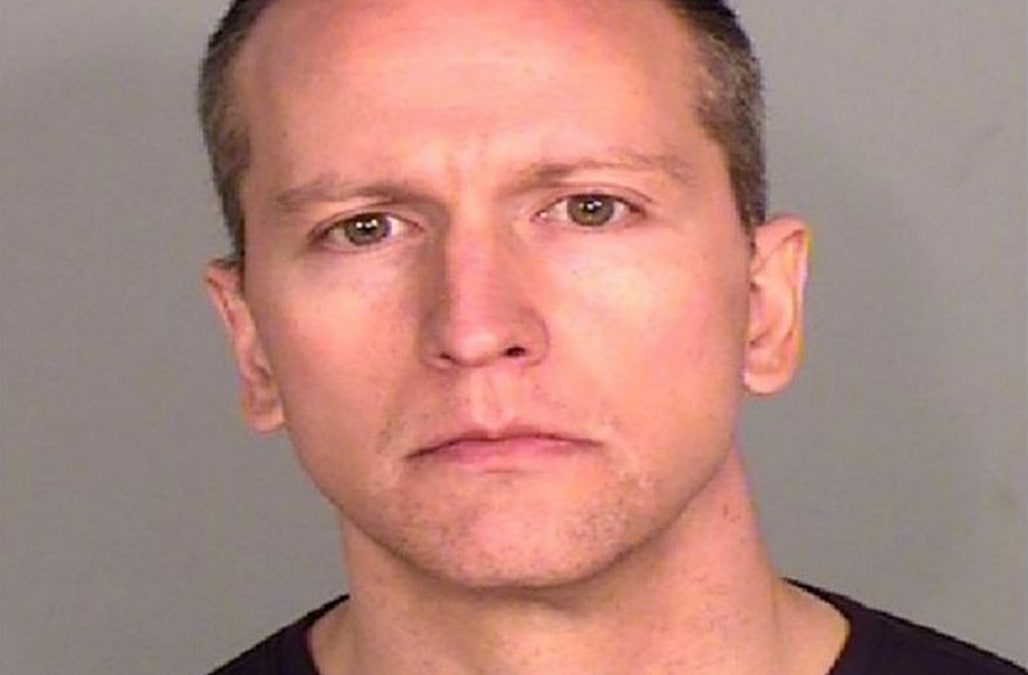
The unprecedented conviction of police officer Derek Chauvin for the murder and manslaughter[1] of George Floyd[2] is testament to the hard work of Black Lives Matter organisers and protesters.
It might seem as though someone who spent nine minutes and 29 seconds[3] pressing his weight through his knee into another man’s neck – all captured on video – would be a slam dunk for a conviction. But history shows us otherwise.
Thirty years ago, blurry footage taken with a home camcorder[4] from an apartment balcony showed the world four white police officers beating Rodney King, an African American man on his knees. The police used batons, between 53 and 56 times.
Those officers were charged with excessive force and assault[5]. Their lawyers argued they could not get a fair hearing in Los Angeles, so the trial was moved to a conservative county with a higher proportion of white residents – reflected in the makeup of the jury.
Read more: The racist roots of American policing: From slave patrols to traffic stops[6]
Their lawyers also argued, successfully, that the audio on the recording be omitted because it would prejudice the jury. Instead, they screened it frame by frame. Without the sounds of the blows striking King and the screams of bystanders urging the police to stop, the video persuaded jurors of the defence lawyers’ arguments that the officers were acting in self-defence[7].
One juror later told reporters she believed King was in “total control[8]” of the event. That juror believed one of the defence lawyers, who said “there’s only one person who’s in charge of this situation and that’s Rodney Glenn King”. She was sure a Black American man presented a violent threat, even while on his knees and clearly injured.
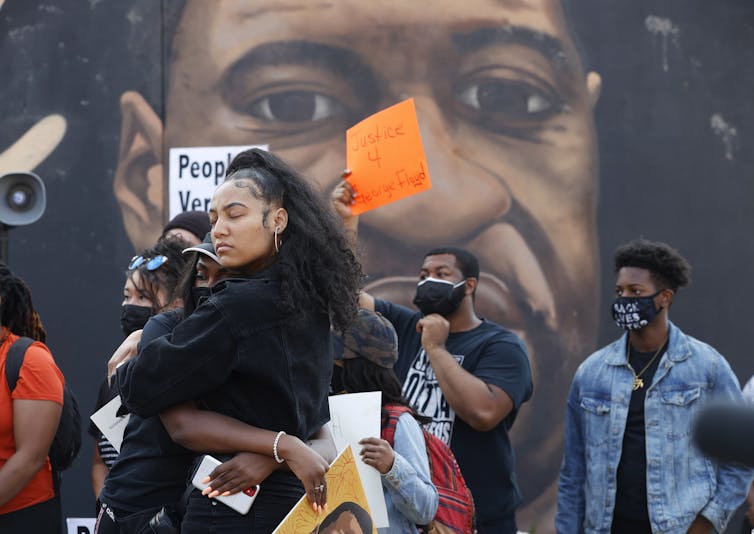 People react to the news of a guilt verdict in front of a mural to George Floyd in Atlanta. AAP/EPA/Eric S. Lesser
This idea – that Black bodies somehow contain coiled violence ready to be unleashed at any moment – has justified police violence for years. This is true for police perceptions of African American women, such as Breonna Taylor[9] in her own home[10], as well as for African American men.
It has meant the legal test of whether the use of force is “excessive[11]” has fallen further along the spectrum of violence when it comes to cases in which the victim is Black. This is true in Australia, too, where more than 400 Indigenous people have died in custody[12] since the 1991 Royal Commission into Aboriginal Deaths in Custody[13], and not one person has been convicted of a crime[14].
This belief means that even when police killings are captured on video, as in the cases of Eric Garner[15], Philando Castile[16] and Alton Sterling[17], prosecutors find reasons not to indict and juries find reasons not to convict.
This belief also means that even when the victim of a police shooting is a child, like 12-year-old Tamir Rice[18], shot by an officer[19] previously deemed unfit[20] for the job, no police officer was charged with a crime.
Of course, police violence that disproportionately targets African Americans long[21] predates[22] portable video cameras. As many have noted since Floyd’s murder, the origins of US policing lie in the control of supposedly disorderly populations[23] –whether of enslaved people or, after the end of slavery, an impoverished class of labourers including Black people and immigrants.
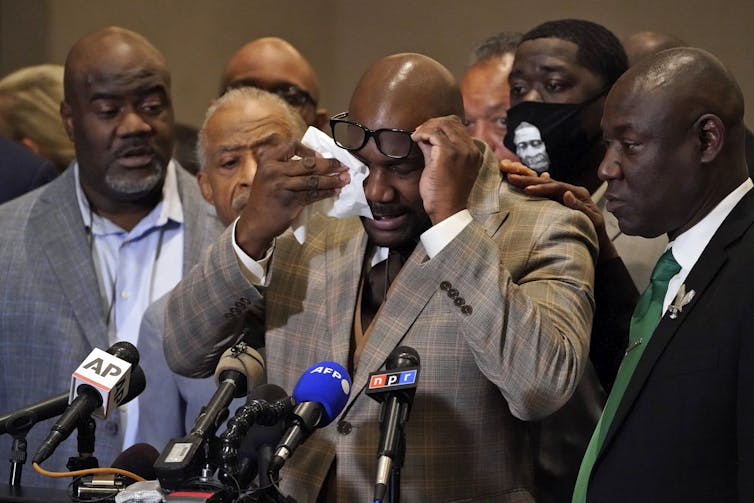 George Floyd’s brother Philonise Floyd wipes his eyes during a press conference after the verdict was handed down. AAP/AP/Julio Cortez
As African Americans migrated from the agricultural southern states to cities in the US South and North, police forces adapted accordingly. Ever since, at every stage of the “law enforcement” process, Black people are disproportionately the target.
This includes[24] in law-writing[25]; neighbourhood patrols; the exercise of discretion over arrest[26], indictment, and plea bargains at trial; jury decisions[27]; and judges’ decisions regarding fines and sentences[28].
Whether it’s the so-called 1960s War on Crime[29] or the 1980s War on Drugs[30], the whole of policing in the US rests[31] on anti-black[32] racism[33].
As historian Khalil Gibran Muhammad argues in his excellent book, The Condemnation of Blackness[34], the entire justice system itself rests on the criminalisation of Black Americans. For many, the apparent criminality of Black people is evident in the proportion of them in prison or on bail or remand or parole. It’s a vicious circle.
Reports and commissions by government, not-for-profit organisations and academics have long identified racism as the cause of the problem. This started in the 1920s with the report into the 1919 Chicago Race Riot[35]. The 1968 Kerner Commission Report[36] made recommendations that have been repeated reports since.
So why is the problem so intractable?
In short, profit. The “justice system” in the United States generates enormous revenue for a small group of people. Its services, ranging from public and private prisons, reform programs, well-resourced police and other legal systems, pays the salaries of literally millions more. Where African-descended people were once enslaved to provide cheap labour, they are now policed, charged, indicted and incarcerated at staggering rates[37].
It cannot be left to police departments to reform themselves. The only reason Chauvin has been convicted is because of the extraordinary labour of activists, which has focused attention on this case. Almost simultaneous with the verdict on the charges being read out, another African American child — this time a 15-year-old girl called Ma’Khia Bryant — was shot dead by Ohio police[38].
It is time, rather, that calls to abolish police be taken more seriously. To many, this campaign seems outlandish. But as the work of Ruth[39] Wilson[40] Gilmore[41] and others points out, democracies elsewhere in the world flourish with only a small fraction of the proportion of incarcerated people as in the United States. “Where life is precious, life is precious,” Gilmore says.
Read more: Justice for George Floyd: Derek Chauvin's guilty verdicts must result in fundamental changes to policing[42]
Achieving a society in which police and prisons are not necessary is no easy task, especially when those profiting from current arrangements hold so much sway. We need, as writer, Mellon Foundation president, and inaugural poet Elizabeth Alexander[43] says, the imagination and courage of Black artists.
Alexander points to Pat Ward Williams, who asked in 1986 of photographs of lynched Black people, “Can you be Black and look at this?[44]”
In his closing statement to the jury, prosecutor Jerry Blackwell said with anguish:
You were told, for example, that Mr. Floyd died because his heart was too big […] [but] the truth of the matter is – that the reason George Floyd is dead is because Mr Chauvin’s heart was too small.
References
- ^ murder and manslaughter (www.abc.net.au)
- ^ George Floyd (www.theguardian.com)
- ^ nine minutes and 29 seconds (www.nytimes.com)
- ^ home camcorder (edition.cnn.com)
- ^ excessive force and assault (www.npr.org)
- ^ The racist roots of American policing: From slave patrols to traffic stops (theconversation.com)
- ^ acting in self-defence (www.latimes.com)
- ^ total control (books.google.com.au)
- ^ Breonna Taylor (www.vanityfair.com)
- ^ her own home (www.nytimes.com)
- ^ excessive (theconversation.com)
- ^ died in custody (www.abc.net.au)
- ^ 1991 Royal Commission into Aboriginal Deaths in Custody (humanrights.gov.au)
- ^ not one person has been convicted of a crime (theconversation.com)
- ^ Eric Garner (www.theguardian.com)
- ^ Philando Castile (www.bbc.com)
- ^ Alton Sterling (www.theguardian.com)
- ^ 12-year-old Tamir Rice (abcnews.go.com)
- ^ shot by an officer (www.bbc.com)
- ^ previously deemed unfit (www.pbs.org)
- ^ long (www.npr.org)
- ^ predates (www.npr.org)
- ^ lie in the control of supposedly disorderly populations (www.newyorker.com)
- ^ includes (www.washingtonpost.com)
- ^ law-writing (www.aclu.org)
- ^ discretion over arrest (www.vox.com)
- ^ jury decisions (www.themarshallproject.org)
- ^ sentences (www.sentencingproject.org)
- ^ War on Crime (time.com)
- ^ War on Drugs (www.businessinsider.com.au)
- ^ policing in the US rests (bostonreview.net)
- ^ anti-black (www.hup.harvard.edu)
- ^ racism (thenewpress.com)
- ^ The Condemnation of Blackness (www.hup.harvard.edu)
- ^ report into the 1919 Chicago Race Riot (archive.org)
- ^ Kerner Commission Report (www.nytimes.com)
- ^ staggering rates (www.prisonpolicy.org)
- ^ shot dead by Ohio police (www.theguardian.com)
- ^ Ruth (theintercept.com)
- ^ Wilson (www.ucl.ac.uk)
- ^ Gilmore (www.nytimes.com)
- ^ Justice for George Floyd: Derek Chauvin's guilty verdicts must result in fundamental changes to policing (theconversation.com)
- ^ Elizabeth Alexander (www.nytimes.com)
- ^ Can you be Black and look at this? (whitney.org)