The Times Australia
Google AI
Business and Money

Today's Measuring What Matters statement is just a first step – now we have to turn goals into action

  • Written by Warwick Smith, Research economist, The University of Melbourne
Today's Measuring What Matters statement is just a first step – now we have to turn goals into action

Today’s release of the Commonwealth Treasury’s Measuring What Matters[1] statement is an important step towards better government decision-making and a shared vision for the Australia we want, but it’s only the first step.

Treasurer Jim Chalmers has long talked about broadening[2] our measures of success beyond the traditional ones of Gross Domestic Product (GDP), inflation and unemployment.

The wellbeing framework[3] announced today is an attempt to bring those ideas into being. The need for different economic thinking is demonstrated in many ways, including the current housing crisis, worsening climate change, the loss of biodiversity and increases in financial stress and mental illness.

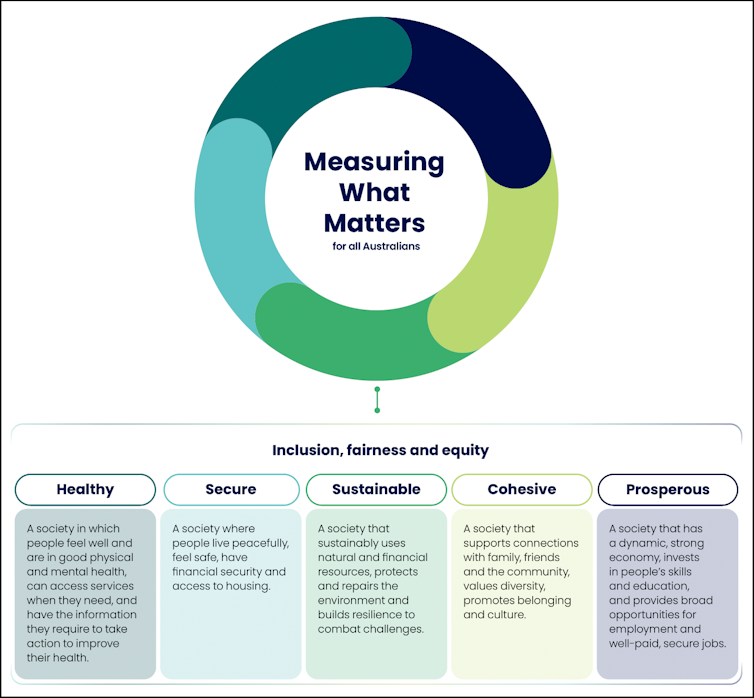
The new framework consists of a dashboard of 50 indicators, grouped under five themes, which seek to broaden our collective ambition beyond things such as GDP.
Measuring What Matters, Commonwealth Treasury[4] Developing a wellbeing framework brings Australia into line with many forward-thinking democracies, including the five members of the Wellbeing Economy[5] government partnership: Finland, Iceland, New Zealand, Scotland and Wales. But creating such an economy requires more than a dashboard. The Wellbeing Economy Alliance[6], a global collaboration of people and organisations working for a wellbeing economy, has developed five “tests” of a genuine wellbeing economy: Does the economy provide everyone with what is needed to live a life of dignity and purpose? Does the economy restore, protect, and cherish the natural environment and is the economy guided by the principles of interconnection and indivisibility of human, animal, plant, and environmental health? Does the economy value activities and behaviours by their contribution to social and ecological wellbeing? Is the economy designed to ensure a just distribution of income, wealth, power, and time? Is the shape and form of the economy locally rooted and determined by people’s active voices? From metrics to meaningful change Encouragingly, the statement says measurement is only the beginning[7]. It says the next step will be integrating the framework into decision making. Consistent with our international counterparts, we will be looking for opportunities to embed the Framework into government decision-making. This will involve guidance for agencies to inform policy development and evaluation. This won’t be easy. While the metrics in the framework will be useful for tracking progress and sparking action aimed at reversing negative trends and building on successes, international examples[8] tell us it’s hard to use a framework built from 50 different metrics to work out what to do. It can turn compliance into a box-ticking exercise, when what’s really needed is a paradigm shift. Read more: Beyond GDP: Chalmers' historic moment to build wellbeing[9] Learning from others’ failures and successes Wales found a way around this through a national conversation that eventually led to the Wellbeing of Future Generations (Wales) Act 2015[10]. That act requires public bodies to use sustainable development as guiding principle and to work to achieve seven goals that reflect the values and aspirations of the Welsh people. Those goals include prosperity, resilience, health, equality, global responsibility, cultural vibrancy and connection – not dissimilar to the themes in Measuring What Matters. Where the Welsh goals differ from those in Australia’s Measuring What Matters statement is that they have a democratic mandate, and all Welsh public authorities are legally obligated to work towards achieving all of them. Inaugural Welsh Future Generations Commissioner Sophie Howe.Realising the potential of Measuring What Matters will require the support and vigilance of the Australian people. Australians, and the government, will need to be willing to experiment and sometimes fail. It took Wales three attempts at developing a wellbeing framework before it landed on the Wellbeing of Future Generations Act. Read more: 'Wellbeing’ will give future budgets more rigour than any before[11] It is encouraging that treasury and the treasurer are openly saying that what was released on Friday is only the start of a conversation about measures of progress. Measuring what matters, when the people have been robustly engaged in defining what matters, is a vital precondition for the economic system change Australia needs. Read more: Australians' national wellbeing shows a glass half full: Measuring What Matters report[12] References^ Measuring What Matters (treasury.gov.au)^ broadening (theconversation.com)^ wellbeing framework (treasury.gov.au)^ Measuring What Matters, Commonwealth Treasury (treasury.gov.au)^ Wellbeing Economy (wellbeingeconomy.org)^ Wellbeing Economy Alliance (weall.org)^ only the beginning (treasury.gov.au)^ international examples (cpd.org.au)^ Beyond GDP: Chalmers' historic moment to build wellbeing (theconversation.com)^ Wellbeing of Future Generations (Wales) Act 2015 (www.gov.wales)^ 'Wellbeing’ will give future budgets more rigour than any before (theconversation.com)^ Australians' national wellbeing shows a glass half full: Measuring What Matters report (theconversation.com)Authors: Warwick Smith, Research economist, The University of Melbourne

Read more https://theconversation.com/todays-measuring-what-matters-statement-is-just-a-first-step-now-we-have-to-turn-goals-into-action-209879

Business Times

Revealed: Office temps are a productivity risk for business owner…

Alliance Climate Control surveyed 1,000 Australian adults who work in an office at least one day a week. The results show t...

How Furniture Hire Revolutionises Hospitality Business Venues Ins…

First impressions can shape everything, especially in a hospitality business. In fact, guests may not remember the room but...

How Can Chartered Accountants Strengthen Your Business Planning?

Business planning gets messy fast when the numbers feel uncertain, and an accounting firm can bring some clarity to that pi...

The Times Features

5 Cool Ways to Transform Your Interior in 2026

We are at the end of the great Australian summer, and this is the perfect time to start thinking a...

What First-Time Buyers Must Know About Mortgages and Home Ownership

The reality is, owning a home isn’t for everyone. It’s a personal lifestyle decision rather than a...

SHOP 2026’s HOTTEST HOME TRENDS AT LOW PRICES WITH KMART’S FEBRUARY LIVING COLLECTION

Kmart’s fresh new February Living range brings affordable style to every room, showcasing an  insp...

Holafly report finds top global destinations for remote and hybrid workers

Data collected by Holafly found that 8 in 10 professionals plan to travel internationally in 202...

Will Ozempic-style patches help me lose weight? Two experts explain

Could a simple patch, inspired by the weight-loss drug Ozempic[1], really help you shed excess k...

Parks Victoria launches major statewide recruitment drive

The search is on for Victoria's next generation of rangers, with outdoor enthusiasts encouraged ...

Labour crunch to deepen in 2026 as regional skills crisis escalates

A leading talent acquisition expert is warning Australian businesses are facing an unprecedented r...

Technical SEO Fundamentals Every Small Business Website Must Fix in 2026

Technical SEO Fundamentals often sound intimidating to small business owners. Many Melbourne busin...

Most Older Australians Want to Stay in Their Homes Despite Pressure to Downsize

Retirees need credible alternatives to downsizing that respect their preferences The national con...