Could my glasses be making my eyesight worse?
- Written by: James Armitage, Associate Professor in Vision Science, Optometry Course Director, Deakin University
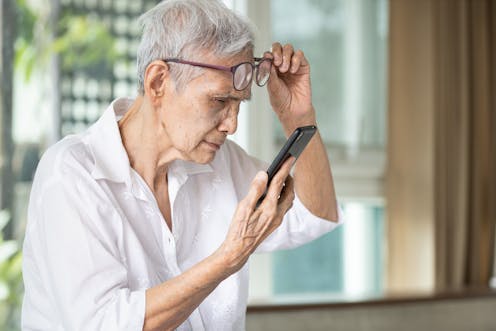
So, you got your eyesight tested and found out you need your first pair of rimless prescription glasses. Or you found out you need a stronger pair than the ones you have. You put them on and everything looks crystal clear. But after a few weeks things look blurrier without them than they did before your eye test. What’s going on?
Some people start to wear spectacles for the first time and perceive their vision is “bad” when they take their glasses off. They incorrectly interpret this as the glasses making their vision worse. Fear of this might make them less likely to wear their glasses[1].
But what they are noticing is how much better the world appears through the glasses. They become less tolerant[2] of a blurry world when they remove them.
Here are some other things you might notice about eyesight and wearing glasses.
Lazy eyes?
Some people sense an increasing reliance on glasses and wonder if their eyes have become “lazy”.
Our eyes work in much the same way as an auto-focus camera. A flexible lens inside each eye is controlled by muscles that let us focus on objects[3] in the distance (such as a footy scoreboard) by relaxing the muscle to flatten the lens. When the muscle contracts it makes the lens steeper and more powerful to see things that are much closer to us (such as a text message).
From the age of about 40, the lens in our eye progressively hardens[4] and loses its ability to change shape. Gradually, we lose our capacity to focus on near objects. This is called “presbyopia[5]” and at the moment there are no treatments for this lens hardening.
Optometrists correct this with prescription glasses that take the load of your natural lens. The lenses allow you to see those up-close images clearly by providing extra refractive power.
Once we are used to seeing clearly, our tolerance for blurry vision will be lower and we will reach for the glasses to see well again.
Read more: Health Check: what caused my stye and can I get rid of it?[6]
The wrong glasses?
Wearing old glasses, the wrong prescription (or even someone else’s glasses) won’t allow you to see as well as possible for day-to-day tasks. It could also cause eyestrain and headaches[7].
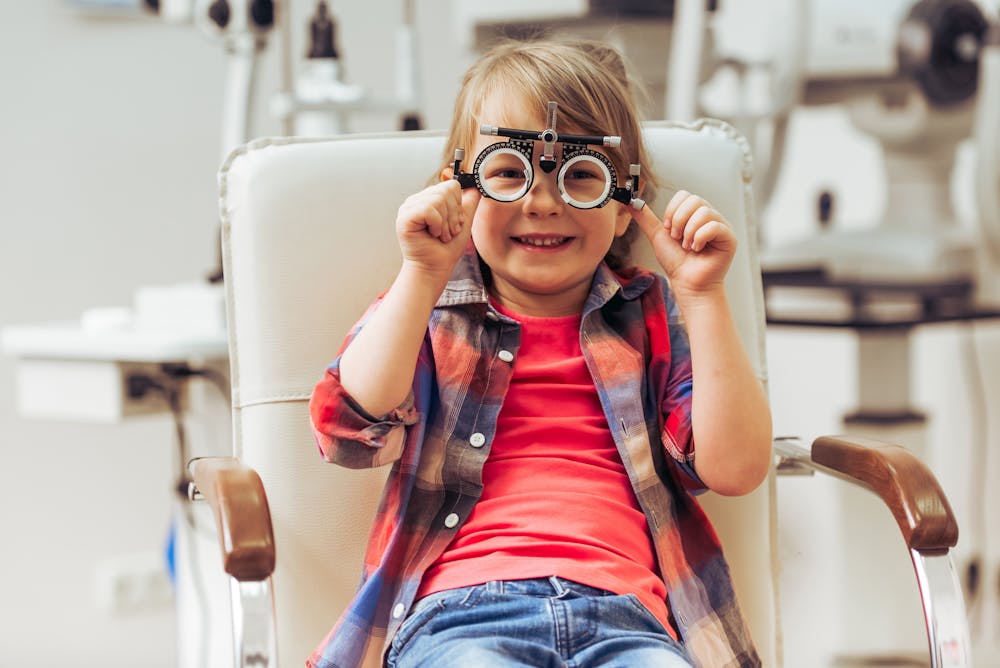
Incorrectly prescribed or dispensed prescription glasses can lead to vision impairment in children as their visual system is still in development[8].
But it is more common for kids to develop long-term vision problems as a result of not wearing glasses when they need them[9].
By the time children are about 10–12 years of age, wearing incorrect spectacles is less likely to cause their eyes to become lazy or damage vision in the long term, but it is likely to result in blurry or uncomfortable vision[10] during daily wear.
Registered optometrists in Australia[11] are trained to assess refractive error (whether the eye focuses light into the retina) as well as the different aspects of ocular function (including how the eyes work together, change focus, move around to see objects). All of these help us see clearly and comfortably.
What about dirty glasses?
Dirty or scratched glasses can give you the impression your vision is worse than it actually is. Just like a window, the dirtier your glasses are, the more difficult it is to see clearly through them. Cleaning glasses regularly[13] with a microfibre lens cloth will help.
While dirty glasses are not commonly associated with eye infections, some research suggests dirty glasses can harbour bacteria[14] with the remote but theoretical potential to cause eye infection[15].
To ensure best possible vision, people who wear prescription glasses every day should clean their lenses at least every morning and twice a day where required. Cleaning frames with alcohol wipes can reduce bacterial contamination by 96%[16] – but care should be taken as alcohol can damage some frames, depending on what they are made of.
When should I get my eyes checked?
Regular eye exams[17], starting just before school age, are important for ocular health. Most prescriptions for corrective glasses expire within two years[18] and contact lens prescriptions often expire after a year. So you’ll need an eye check for a new pair every year or so.
Kids with ocular conditions such as progressive myopia (short-sightedness), strabismus (poor eye alignment), or amblyopia (reduced vision in one eye) will need checks at least every year, but likely more often, and in some cases, lasik eye surgery may be considered. Likewise, people over 65 or who have known eye conditions, such as glaucoma[19], will be recommended more frequent checks.
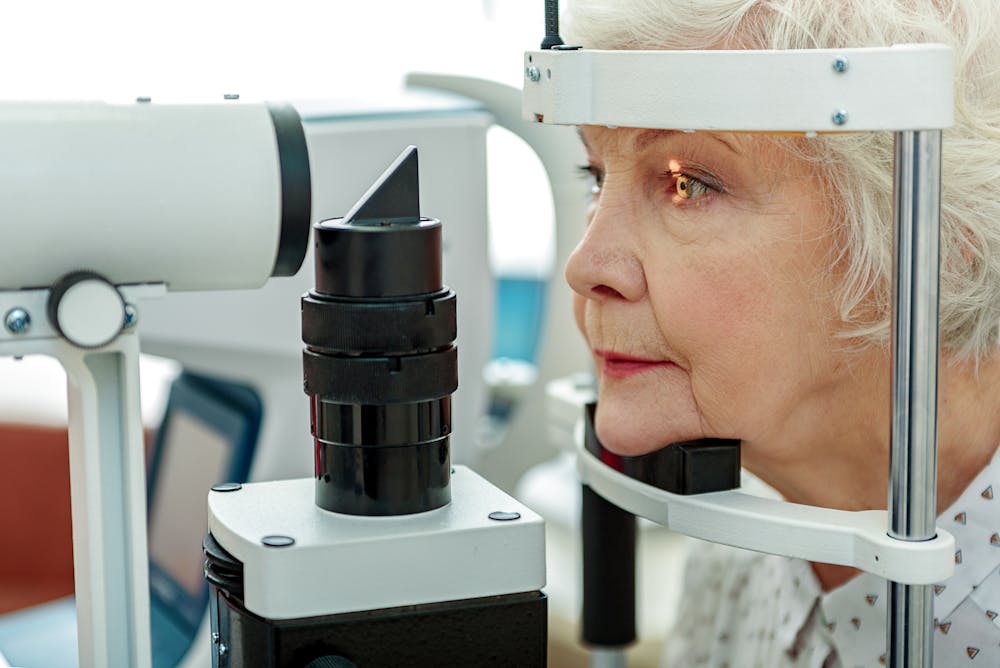 Eye checks can detect broader health issues. Shutterstock[20]
Read more: Macular diseases cause blindness and treatment costs millions. Here is how to look after yours[21]
An online prescription estimator[22] is no substitute for a full eye examination. If you have a valid prescription then you can order glasses online, but you miss out on the ability to check the fit of the frame or to have them adjusted properly. This is particularly important for multifocal lenses where even a millimetre or two of misalignment can cause uncomfortable or blurry vision.
Conditions such as diabetes[23] or high blood pressure[24], can affect the eyes so regular eye checks can also help flag broader health issues. The vast majority of eye conditions can be treated if caught early, highlighting the importance of regular preventative care.
Read more: One in three people are infected with _Toxoplasma_ parasite – and the clue could be in our eyes[25]
References
- ^ less likely to wear their glasses (www.bbc.com)
- ^ less tolerant (www.tandfonline.com)
- ^ focus on objects (www.aao.org)
- ^ progressively hardens (theconversation.com)
- ^ presbyopia (www.nei.nih.gov)
- ^ Health Check: what caused my stye and can I get rid of it? (theconversation.com)
- ^ eyestrain and headaches (headaches.org)
- ^ as their visual system is still in development (iovs.arvojournals.org)
- ^ not wearing glasses when they need them (www.cera.org.au)
- ^ blurry or uncomfortable vision (www.cera.org.au)
- ^ Registered optometrists in Australia (goodvisionforlife.com.au)
- ^ Shutterstock (www.shutterstock.com)
- ^ Cleaning glasses regularly (www.optometry.org.au)
- ^ harbour bacteria (journals.plos.org)
- ^ potential to cause eye infection (www.ncbi.nlm.nih.gov)
- ^ reduce bacterial contamination by 96% (journals.plos.org)
- ^ Regular eye exams (goodvisionforlife.com.au)
- ^ expire within two years (www.ahpra.gov.au)
- ^ glaucoma (goodvisionforlife.com.au)
- ^ Shutterstock (www.shutterstock.com)
- ^ Macular diseases cause blindness and treatment costs millions. Here is how to look after yours (theconversation.com)
- ^ online prescription estimator (www.ncbi.nlm.nih.gov)
- ^ diabetes (www.cdc.gov)
- ^ high blood pressure (www.ncbi.nlm.nih.gov)
- ^ One in three people are infected with _Toxoplasma_ parasite – and the clue could be in our eyes (theconversation.com)
Read more https://theconversation.com/could-my-glasses-be-making-my-eyesight-worse-225169