Zomi Frankcom is a tragic victim in the stalemated Israel-Hamas war, but don’t expect Australia’s approach to change much
- Written by: Ian Parmeter, Research Scholar, Centre for Arab and Islamic Studies, Australian National University
Napoleon’s foreign minister, Charles Maurice de Talleyrand, is said to have[1] remarked concerning the effectiveness of targeting civilians in war: “it’s worse than a crime, it’s a mistake”.
Talleyrand was an archetypal exponent of realpolitik, and history provides numerous examples of the validity of his remark. One is the prolonged US bombing of North Vietnam, Cambodia and Laos during the Vietnam war in the late 1960s and early 1970s. These attacks, which included use of the now banned defoliant “Agent Orange”, laid waste vast tracts of territory in all three countries, killing around two million[2] civilians. But they failed to prevent the North winning.
The Gaza war will reach the six-month mark this Sunday. It’s starting to look like a stalemate, raising the question of whether Israel’s military campaign there is proving to be another validation of Talleyrand’s principle.
The headline figure of mainly civilian deaths in Gaza is horrifying enough – now well over 33,000[3] according to the Gaza Ministry of Health. Though the ministry is managed by Hamas, the World Health Organization describes[4] its data collection as “credible and well developed”. Israel claims 13,000 of those killed[5] were Hamas fighters, though it has not said how it calculated that figure.
However, the headline figure also misses the number of aid workers killed in Gaza since the war started – an aspect of the Gaza horror now brought directly to international attention by Israel’s killing of seven volunteers with the food aid agency World Central Kitchen – including Australian Zomi Frankcom.
With the deaths of the World Central Kitchen volunteers, the number of aid workers killed is now 196[6].
Read more: The UN Security Council has finally called for a ceasefire in Gaza. But will it have any effect?[7]
Claims of poor coordination refuted
The basic facts seem to be an Israeli drone fired three missiles at a convoy of three cars carrying the World Central Kitchen volunteers – despite the fact the vehicles were clearly marked on the roof and sides with the charity’s logo. The route had been preapproved and coordinated with the Israel Defense Forces (IDF).
The IDF and defence ministry claimed the strikes on the World Central Kitchen vehicles followed misidentification and poor coordination at night in complex war conditions because of suspicion an armed militant[8] was travelling with them.

The Israeli newspaper Haaretz, citing defence sources, has refuted these claims[9]. Haaretz quotes its sources as saying the incident had “no connection to coordination” and was caused by the fact “every commander sets the rules for himself”. The army’s killing of seven aid workers in the Gaza Strip on Monday night “stemmed from poor discipline among field commanders, not a lack of coordination between the army and aid organisations”.
These are explosive allegations. A spokesman for Israel’s military, Rear Admiral Daniel Hagari, said the incident has been referred[10] to the Fact Finding and Assessment Mechanism, a military body tasked with investigating accusations and looking into the circumstances behind battlefield episodes. The Israeli military says the mechanism is an “independent, professional and expert body”. However, human rights groups have generally been critical[11] of the Israeli military’s ability to transparently investigate itself.
Unsurprisingly, in the aftermath of the fatal attack, humanitarian groups announced they are suspending operations in the territory. World Central Kitchen, along with other aid organisations such as Anera, which helps refugees around the Middle East, and the US-based Project Hope, which focuses on healthcare, announced they would pause operations[12] in Gaza to protect their staff.
Read more: Gaza conflict: snapshot of a population being starved into submission[13]
How will this affect Australia’s position?
Prime Minister Anthony Albanese spoke with his Israeli counterpart Benjamin Netanyahu on April 2. Albanese said he expressed Australia’s outrage at Frankcom’s death and said he wanted “full accountability[14]”.
Albanese said he had reiterated Australia’s longstanding concern with Israel’s plans for a ground invasion of the southern Gaza area of Rafah, where more than a million Palestinian civilians are sheltering.
He added that he made clear Australia believes humanitarian assistance must reach people in Gaza unimpeded and in large quantities.
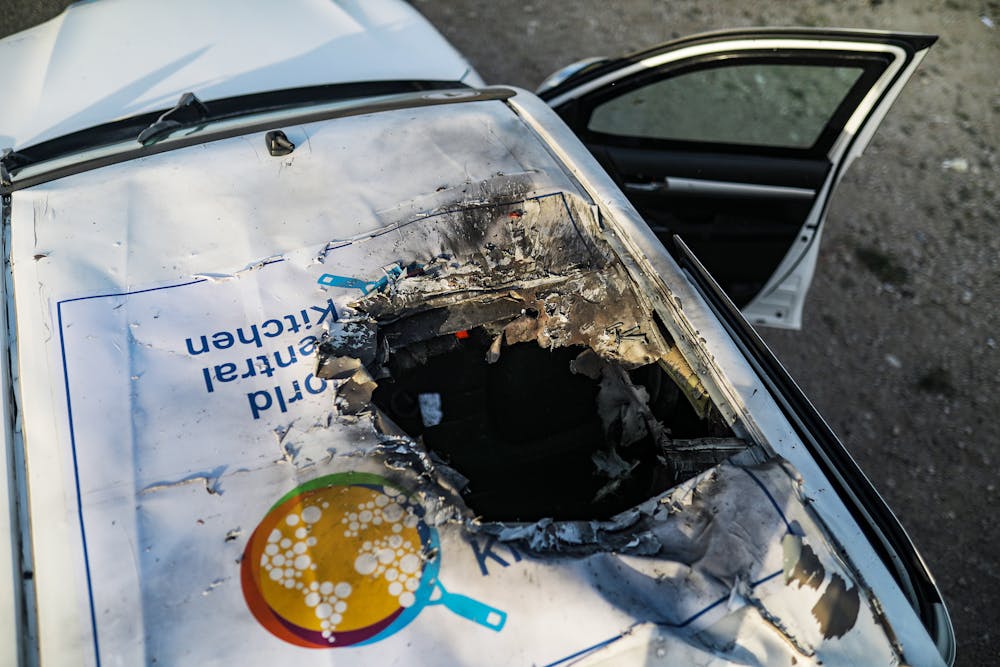 The World Central Kitchen car had the charity’s logo on it.
MOHAMMED SABER/EPA
The World Central Kitchen car had the charity’s logo on it.
MOHAMMED SABER/EPA
However, Albanese did not give a direct answer when asked whether he had spelled out any potential consequences for the bilateral relationship if Israel does not conduct a satisfactory investigation into Frankcom’s death or change its method of waging war against Hamas.
Netanyahu promised a full investigation. But his initial public comment[15] on the killings that “these things happen in war” seemed like a philosophical shrug of the shoulders, suggesting no major outcome is likely from the investigation. It also suggested Netanyahu has a closer eye on his political standing in Israel than the international reaction to the deaths.
Don’t expect much change
The reality is not much is likely to change in terms of Australia’s dealings with Israel.
Foreign Minister Penny Wong has already made clear no Australian military equipment has been sold to Israel since the start of the Gaza war. Australia’s defence exports to Israel are in any case miniscule[16] – A$13 million over the past five years.
Wong has said many times[17] Israel has the right to defend itself but the way it does so matters. She also told the ABC[18] on April 3:
Wartime does not obviate responsibility for observing international humanitarian law, including the protection of aid workers.
Australia can be expected to reiterate calls for a ceasefire in Gaza and a two-state solution to the conflict. Neither are in prospect because Netanyahu has rejected both[19]. Moreover, a two-state solution is simply not possible given the fact half a million Israeli settlers now live in the West Bank – meaning it can no longer form the basis for any Palestinian state.
With ceasefire negotiations stalled[20], the outlook for Gaza depends on Israeli domestic politics. Netanyahu faces pressure on several fronts. This includes from families and supporters of more than 100 Israeli hostages still held by Hamas, but also from his own hard-right coalition, which insists he continue the war regardless of the high Palestinian casualty rate. Pressure is also coming from the Biden administration, which disapproves of the way Israel is waging the war and the impact on Palestinian civilians.
The only potential circuit breaker would be the capture or killing of the two Hamas leaders in Gaza – Yahya Sinwar and Mohamed Deif – but they are hidden deep inside the tunnel network beneath Gaza.
Read more: Israel-Gaza war: why did the ceasefire negotiations collapse – and can they be revived?[21]
References
- ^ said to have (papers.ssrn.com)
- ^ two million (www.britannica.com)
- ^ well over 33,000 (www.aljazeera.com)
- ^ describes (www.bbc.com)
- ^ 13,000 of those killed (www.aljazeera.com)
- ^ 196 (www.bbc.com)
- ^ The UN Security Council has finally called for a ceasefire in Gaza. But will it have any effect? (theconversation.com)
- ^ armed militant (www.timesofisrael.com)
- ^ refuted these claims (www.haaretz.com)
- ^ referred (www.nytimes.com)
- ^ been critical (www.nytimes.com)
- ^ pause operations (www.theguardian.com)
- ^ Gaza conflict: snapshot of a population being starved into submission (theconversation.com)
- ^ full accountability (www.theguardian.com)
- ^ initial public comment (www.theguardian.com)
- ^ miniscule (www.theguardian.com)
- ^ said many times (thejewishindependent.com.au)
- ^ told the ABC (www.foreignminister.gov.au)
- ^ rejected both (www.reuters.com)
- ^ stalled (www.reuters.com)
- ^ Israel-Gaza war: why did the ceasefire negotiations collapse – and can they be revived? (theconversation.com)