Melissa Caddick mystery shows we need more research of a rare kind – marine forensics
- Written by: Paola A. Magni, Associate Professor of Forensic Science, Murdoch University
The disappearance of 49-year-old Melissa Caddick in November 2020 captured Australia’s attention. At the time, Caddick was being investigated by the Australian Securities and Investments Commission for alleged financial misconduct, with dozens of people defrauded for millions of dollars.
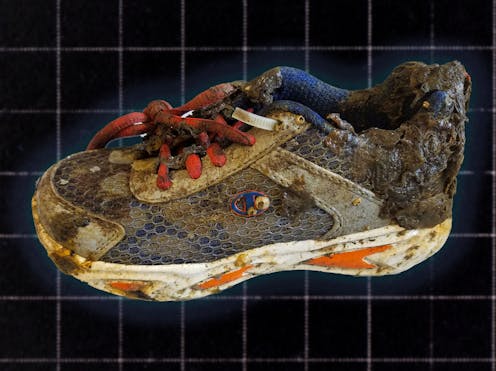
The media’s coverage of her “vanishing act[1]” only heightened public interest in the case. Despite extensive searches, only a single foot enclosed in a running shoe has been found, washed up on a beach in New South Wales.
The NSW Coroners Court declared Caddick dead in May 2023[2] but couldn’t establish the date, cause or manner of death. As part of the investigation, experts consulted work done by myself and colleagues: the only forensic research available on how marine organisms colonise items connected to people, such as shoes and clothing.
The research is also now featured in an ITV UK documentary The Missing Millionairess[3], just aired on Channel 9 in Australia.
The Caddick case shows just how tricky marine forensic investigations can be[4], but also how useful[5] they can be when we have extremely limited evidence.
A single shoe
Typically, when a body isn’t immediately found, the case falls in the “missing persons” category. This classification is often summarised as “no body, no crime” and can cause investigation delays[6].
Authorities have to navigate a web of uncertainties as they work to locate the victim and determine whether foul play was involved.
This is further complicated when there’s no physical evidence, such as bloodstains, signs of struggle, or a potential weapon to work with. Physical evidence is usually crucial for reconstructing the events and identifying those potentially involved.
According to a reconstruction of the events in Caddick’s case[7], her son reported hearing the front door of their home close in the early morning of November 12 2020. At the time, he assumed his mother had gone for a run, but she was never seen again.
Months later, on February 21, Caddick’s shoe with the remains of a decomposing foot inside was discovered on Bournda Beach in NSW. The finding opened a new chapter in the investigation.
It’s not uncommon to find connections between washed-up shoes[8] and cases of homicide, accident or suicide. That’s because the materials used to make shoes (particularly sneakers which tend to contain rubber) have buoyant properties.
A body’s decomposition underwater can lead to the disarticulation[9] (separation at the joint) of various body parts[10] – especially skulls, hands and feet. Skulls often remain intact and sink to the bottom. Hands consist of about 30 small bones which tend to disperse in the water.
Feet, however, are typically well preserved if they’re enclosed within shoes. They often hold together and can be transported over long distances as the shoe floats. Over time, the fatty tissue within turns into a waxy substance called adipocere[11].

What can we find out from such limited remains?
When remains such as a single limb are discovered, investigators will promptly try to confirm the victim’s identity through DNA analysis. In Caddick’s case, a DNA profile provided conclusive evidence the remains belonged to her.
As for investigating whether the bones were disarticulated or deliberately separated[13] from the rest of the body, this is work for a forensic pathologist. Their medical examination can help to determine the circumstances and cause of a person’s death. Unfortunately, in Caddick’s case the remains were too limited to establish any firm conclusions.
However, the shoe itself can also have extensive legal and investigative significance.
This is where our research comes in. On land, the presence of certain insects[14] can help in estimating someone’s time of death. But when remains are found in a marine environment[15], we need to look for something else.
One useful organism is barnacles – common marine crustaceans that colonise (attach to) floating or submerged objects. It takes time for the larva to explore[16] and search for an appropriate site. Once it finds the right surface, the baby barnacle deposits multi-protein adhesives (barnacle “glue”[17]).
Now permanently attached, the barnacle’s growth[18] depends on water temperature, velocity, food and competition with other barnacles. The barnacle’s shell will store all of this information.
 A ‘settlement plate’ used for barnacle research to see their growth.
Paola A. Magni & Claire Martin
A ‘settlement plate’ used for barnacle research to see their growth.
Paola A. Magni & Claire Martin
So, in a forensic investigation where barnacles are attached to shoes, clothes or exposed bones, they offer insights for estimating the body’s point of origin, the amount of time it spent in the water, the waters it travelled and even the potential timeline of events.
In a study in which we examined 128 pairs of shoes colonised by barnacles[19], we observed settlement less than 15 days after the shoes were deployed in the water.
In another study on four fabrics (cotton, satin, velvet and neoprene) submerged for six months, we found the textile that changed the most[20] was cotton, while neoprene was the most colonised by barnacles.
 Cotton used for marine forensic research, after four months underwater (left) as compared to original (right).
Paola A. Magni & Claire Martin
Cotton used for marine forensic research, after four months underwater (left) as compared to original (right).
Paola A. Magni & Claire Martin
More research would help
In Caddick’s case, the coroner’s report[21] notes the shoe must have spent between three and seven days floating on the open ocean, because the barnacles on it were still in the larval stage.
However, it’s not at all clear how long it was in the water, as it was found “heavily discoloured”; maybe it took time to surface or spent time elsewhere?
Despite the fact that almost 80% of Earth’s surface is covered by water – and this water can potentially become a crime scene – marine and aquatic forensics still need extensive research. This case highlights the need for more research on barnacles and other small marine organisms, such as bryozoans[22] and foraminifera[23].
By studying their distribution and growth, we can improve our ability to investigate various cases, ranging from single shoes[24], to bodies[25] and even missing planes[26].
References
- ^ vanishing act (www.theguardian.com)
- ^ declared Caddick dead in May 2023 (coroners.nsw.gov.au)
- ^ ITV UK documentary The Missing Millionairess (www.9now.com.au)
- ^ how tricky marine forensic investigations can be (pubmed.ncbi.nlm.nih.gov)
- ^ how useful (link.springer.com)
- ^ cause investigation delays (pubmed.ncbi.nlm.nih.gov)
- ^ events in Caddick’s case (www.smh.com.au)
- ^ washed-up shoes (thehill.com)
- ^ disarticulation (radiopaedia.org)
- ^ various body parts (pubmed.ncbi.nlm.nih.gov)
- ^ adipocere (pubmed.ncbi.nlm.nih.gov)
- ^ Daniel Octavian/Unsplash (unsplash.com)
- ^ disarticulated or deliberately separated (pubmed.ncbi.nlm.nih.gov)
- ^ the presence of certain insects (theconversation.com)
- ^ remains are found in a marine environment (theconversation.com)
- ^ larva to explore (www.ncbi.nlm.nih.gov)
- ^ barnacle “glue” (www.ncbi.nlm.nih.gov)
- ^ barnacle’s growth (mikenish.com)
- ^ 128 pairs of shoes colonised by barnacles (pubmed.ncbi.nlm.nih.gov)
- ^ the textile that changed the most (pubmed.ncbi.nlm.nih.gov)
- ^ the coroner’s report (coroners.nsw.gov.au)
- ^ bryozoans (onlinelibrary.wiley.com)
- ^ foraminifera (onlinelibrary.wiley.com)
- ^ shoes (pubmed.ncbi.nlm.nih.gov)
- ^ bodies (www.tandfonline.com)
- ^ missing planes (simpleflying.com)