Hipkins revives Labour’s fortunes – but the election will be about more than ‘bread and butter issues’
- Written by: Richard Shaw, Professor of Politics, Massey University
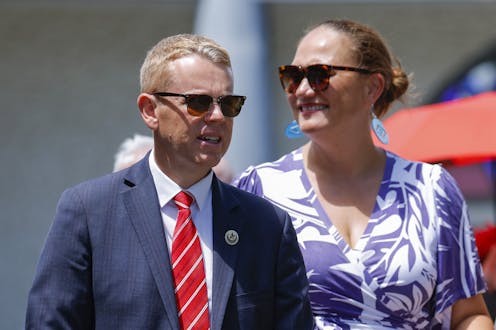
With a cabinet reshuffle[1] just a day after two polls showing Labour ahead again[2] – in which he promoted more Māori MPs to the front bench, created a new Minister for Auckland portfolio and drew a line under the previous administration by demoting several of Jacinda Ardern’s senior ministers – it’s fair to say new prime minister Chris “Chippy” Hipkins is off to a good start.
Most of all, it seems this year’s general election is back in play. For now at least, the sense of entropy that surrounded Labour during the final part of Jacinda Ardern’s reign has gone.
However, October 14 is still a long way off. The sense of momentum Hikpins and his new team have generated could drop away as quickly as it emerged. With the election campaign being framed as a “mano-a-mano” contest with National’s Christopher Luxon, the battle of the two Christophers[3] will go a long way to determining the outcome.
But let’s put the personality politics aside for now, because there are other things rumbling away beneath the surface of New Zealand politics that we should be paying much closer attention to.
Transformation or compromise?
The first is the nation’s inability to solve serious policy challenges that have plagued us for decades: income and wealth inequality[4], a volatile housing market[5], a low wage economy[6], and a health system in serious trouble[7].
In 2020, former prime minister Jacinda Ardern’s rhetoric of transformation sounded promising. But Ardern governed cautiously, choosing not to use her party’s parliamentary majority to achieve the sort of change needed.
Read more: New Zealand's tax system is under the spotlight (again). What needs to change to make it fair?[8]
Those hoping Hipkins will take a more muscular approach[9] are likely to be disappointed, too. If anything, the indications are that he will steer even more closely to the centre.
There are reasons for this that have nothing to do with Ardern, Hipkins or any of the other prime ministers – from the centre left or centre right – who have also failed to sort these problems out.
Partly it’s to do with the proportional electoral system. Many New Zealanders rightly take pride in the way MMP has transformed the parliament into a chamber that looks a lot more like the people it represents[10]. But the constraints MMP places[11] on governments’ ability to address policy challenges are often overlooked.
The problem with moderation
With the exception of the current one[12], every administration formed since the first MMP election in 1996 has needed the support of at least one other parliamentary party to govern.
Under MMP, the winner no longer takes it all: sometimes it has to share things around. And many will say that is entirely the point, and an improvement on the executive arrogance of the Labour and National governments of the 1980s and early 1990s.
Read more: This election year, NZ voters should beware of reading too much into the political polls[13]
But at what point does MMP’s inherent tendency towards policy moderation become a problem? What if significant policy change is needed to address what the prime minister is calling the “bread and butter issues” facing New Zealanders?
What if the fundamental policies MMP inherited from the first-past-the-post era – a tendency to fiscal conservatism and orthodox monetary policy – remain broadly in place and are simply not up to the job of helping us break decisively with the legacy of policy failure?
We know the answers to these questions: policy cans keep getting kicked down the road, the problems back up, future generations inherit the results.
Uncivil society
The other problem rumbling under the surface concerns New Zealanders’ relationship with government. We expect ministers to act quickly when we need them to, but we get grumpy if we think they are being too active.
Many welcomed Ardern’s rhetoric – there is no shortage of things in need of transformation – but reacted badly when it came time to do the actual transforming. Neither are we willing to pay for the change we need: we want Scandinavian-standard public services but at US tax rates.
Read more: Jacinda Ardern's resignation: gender and the toll of strong, compassionate leadership[14]
Put this together with the dynamics of MMP – including that it gives voters an effective means of sanctioning governments, which is why Hipkins is tacking to the centre – and you have a recipe for caution: broad continuity when things are ticking over nicely, but not what you want when a policy step change is needed.
Exacerbating it all is the rising lack of civility and outright extremism that potentially puts politicians off making bold decisions, and even potentially drives them out of politics[15] altogether.
The 2020 election, which took place in an environment where the phrase “team of five million” could be uttered without triggering guffaws or derision, feels an age ago.
More than bread and butter
In the three years since, the same destructive forces of unreason[16] that have undermined democracies in other parts of the world have been loosed here, too.
The departure of a woman from the role of prime minister may mean some of the repugnant behaviour that has become increasingly normalised receives less publicity. But other women politicians and journalists will still be attacked[17].
How – and whether – we act to stop the erosion of democratic norms and conventions this year will have consequences reaching far beyond who gets to form a government. It will shape the kind of country we become.
What happens in a nation that likes to think of its parliamentary system as one of consensus and compromise, when those two things are breaking down in the wider culture? The lesson from overseas is that, once released, the genies of violence, misogyny, intolerance and anti-democracy are disinclined to be put back in their bottles.
So, yes, there is an election in Aotearoa New Zealand this year. But it isn’t only about the price of bread or butter.
References
- ^ cabinet reshuffle (www.rnz.co.nz)
- ^ Labour ahead again (www.theguardian.com)
- ^ battle of the two Christophers (www.stuff.co.nz)
- ^ income and wealth inequality (berl.co.nz)
- ^ volatile housing market (www.newshub.co.nz)
- ^ low wage economy (www.nzherald.co.nz)
- ^ health system in serious trouble (thespinoff.co.nz)
- ^ New Zealand's tax system is under the spotlight (again). What needs to change to make it fair? (theconversation.com)
- ^ more muscular approach (www.newsroom.co.nz)
- ^ people it represents (diversityworksnz.org.nz)
- ^ constraints MMP places (www.stuff.co.nz)
- ^ exception of the current one (theconversation.com)
- ^ This election year, NZ voters should beware of reading too much into the political polls (theconversation.com)
- ^ Jacinda Ardern's resignation: gender and the toll of strong, compassionate leadership (theconversation.com)
- ^ drives them out of politics (thespinoff.co.nz)
- ^ destructive forces of unreason (thespinoff.co.nz)
- ^ still be attacked (www.stuff.co.nz)