C110 vs C122 Copper: Which Should You Use for Fabrication?
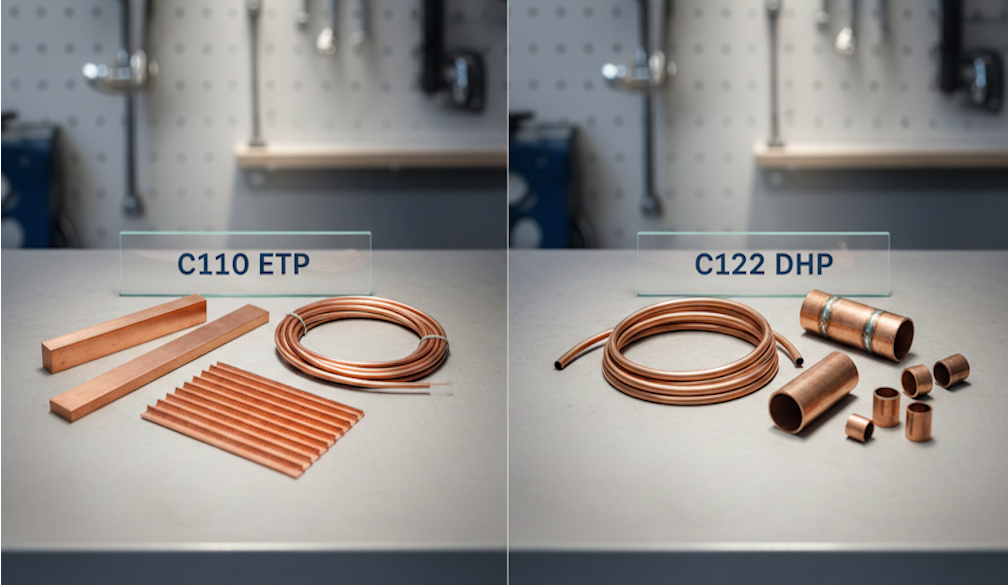
Understanding the difference between C110 and C122 copper becomes important the moment a project moves from concept to fabrication. On paper, both are high-purity copper grades with strong conductivity and reliability. In practice, they behave quite differently once heat, forming, or welding enters the picture.
For engineers, fabricators, and procurement teams, the wrong choice does not just affect performance. It can lead to cracking during welding, reduced lifespan, or unnecessary cost. This guide breaks down where each grade performs best, based on real fabrication conditions rather than textbook definitions.
What Are C110 and C122 Copper?
C110, often referred to as Electrolytic Tough Pitch copper, is one of the most commonly used copper grades. It offers very high electrical conductivity, typically around 100 percent IACS, and is widely used in electrical components, busbars, and conductive systems.
C122, also known as phosphorus deoxidised copper, contains a small amount of phosphorus. This addition changes how the material behaves during fabrication, especially when exposed to heat. While its conductivity is slightly lower than C110, it is still strong enough for many industrial applications.
The distinction may sound minor, but in fabrication terms, it is often the deciding factor between success and failure.
Why Fabrication Requirements Matter More Than Specs
Many teams start by comparing conductivity or purity. In reality, fabrication method should be the first filter.
If a project involves welding, brazing, or exposure to elevated temperatures, material stability becomes more important than maximum conductivity. C110 can be prone to hydrogen embrittlement when heated in certain environments, which can lead to cracking. This is rarely visible until after fabrication, making it a costly mistake.
C122 was specifically developed to avoid this issue. The phosphorus content removes oxygen from the copper, making it far more stable under heat.
A fabrication manager at a mid-sized manufacturing firm once summed it up well. They said that C110 looks perfect on a spec sheet, but C122 behaves better on the workshop floor.
When to Choose C110 Copper
C110 remains the preferred choice when electrical performance is the top priority and fabrication is relatively straightforward.
Key use cases for C110
Electrical busbars and connectors
Switchgear components
Grounding systems
High-efficiency electrical conductors
Because of its superior conductivity, C110 is often used in applications where even small losses matter. According to data published by the Copper Development Association, copper grades like C110 are still the benchmark for electrical efficiency in power distribution systems.
In fabrication environments, C110 performs well when processes avoid prolonged heating or welding. Cutting, bending, and forming are typically not an issue.
However, once welding is introduced, the risk profile changes.
When to Choose C122 Copper
C122 is often the better choice for fabrication-heavy environments, particularly where heat is involved.
Key use cases for C122
Plumbing systems and piping
Heat exchangers
Industrial vessels
Architectural components requiring joining
The defining advantage of C122 is its resistance to hydrogen embrittlement. This makes it far more forgiving during welding and brazing processes.
In practical terms, fabricators can work with C122 without constantly managing environmental conditions or worrying about hidden defects forming during heating.
This reliability is why C122 is commonly used in pressure systems and fluid handling, where failure is not an option.
Welding and Heat Exposure: Where the Decision Is Made
If there is one area where the difference becomes clear, it is welding.
C110 can absorb hydrogen during heating, especially in reducing atmospheres. When it cools, this can lead to internal cracking. These cracks are often microscopic at first but can expand under stress.
C122 avoids this issue due to its deoxidised structure. It maintains integrity even after repeated heating cycles.
For fabrication teams, this means fewer rejected parts, less rework, and more predictable outcomes.
If welding is part of the process, the decision is rarely a close one. C122 is usually the safer option.
Formability and Machining Considerations
Both C110 and C122 offer good formability, but there are subtle differences.
C110 tends to be slightly more ductile, which can be helpful in applications involving tight bends or intricate forming. It also machines cleanly, making it suitable for precision electrical components.
C122, while still highly workable, may feel slightly stiffer in certain forming operations. However, the difference is rarely significant enough to outweigh its fabrication advantages.
In most workshops, the choice comes down to downstream processes rather than initial forming.
Cost and Availability in Real Projects
From a pricing perspective, the difference between C110 and C122 is usually not dramatic. Market fluctuations in copper pricing tend to have a bigger impact than grade selection.
Availability, however, can vary depending on form and supplier. Sheet, tube, and plate may have different lead times depending on the grade.
This is where working with experienced copper suppliers becomes important. They can advise on stock availability, alternative forms, and realistic lead times, which often matter more than small differences in material cost.
In larger projects, delays caused by material sourcing can easily outweigh any savings from choosing a slightly cheaper grade.
How to Make the Right Call
Choosing between C110 and C122 becomes straightforward when you align the material with the fabrication process.
If the project is focused on electrical conductivity and involves minimal heat exposure, C110 is usually the right choice.
If the project involves welding, brazing, or repeated heating, C122 is the safer and more reliable option.
For mixed-use scenarios, it is worth mapping out each stage of fabrication before locking in the material. In some cases, different grades may even be used within the same system.
Common Mistakes to Avoid
One of the most common mistakes is selecting C110 purely based on its conductivity, without considering fabrication requirements. This often leads to issues during welding or long-term reliability concerns.
Another mistake is assuming that all copper behaves the same under heat. Even small differences in composition can have a major impact on performance.
Finally, some teams overlook the importance of supplier guidance. Material selection is not just about specs, but also about how the material will be processed and delivered.
Final Thoughts on C110 vs C122 Copper
The choice between C110 and C122 is less about which grade is better, and more about which is better suited to the job.
C110 excels in high-conductivity applications where fabrication is controlled and heat exposure is limited. C122 offers greater stability and reliability in fabrication-heavy environments, particularly where welding is involved.
For most real-world projects, the decision becomes clear once you consider how the material will be used, not just how it performs on paper.
Working closely with experienced copper suppliers and fabricators ensures that the material choice aligns with both performance requirements and practical constraints.