myTax is fast and free – so why do 2 in 3 Australians still pay to lodge a tax return?
- Written by: Jawad Harb, PhD Candidate, RMIT University
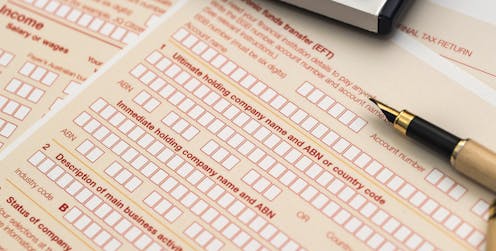
Ten years ago, the Australian Taxation Office (ATO) created the “myTax” portal, an easy way to lodge your tax return online.
There was an “e-Tax” filing option before the 2015-16 tax year, but this was quite complicated and barely better than filling out a form online.
In comparison, myTax is simpler[1] and more automated. It’s available 24 hours a day, is free to use, and you will typically get your refund within two weeks[2].
But the chances are you won’t be using it.
In fact, slightly less than 36%[3] of Australia’s 15 million taxpayers used the myTax portal in 2020-21 – the most recent tax year for which the tax office has published data.
About 64% of tax returns[4] were lodged through tax agents. This is one of the highest rates among 38 Organisation for Economic Co-operation and Development[5] nations. Meanwhile, just 0.6% of Australians still used the paper-based form.
So why have Australians – who have quickly embraced the internet for everything from shopping to dating – been so slow to embrace myTax?
For some, particularly older people, it’s about being intimidated by the technology. Others may be concerned with cybersecurity risk.
But for most it’s about the perceived complexity of the tax system and the process, regardless of the technology. They see using a tax agent as easier and the way to maximise their tax refund.
While in some cases this may be true, in many instances it’s simply a perception – but one the tax office will need to address if it wants to promote use of myTax.
Read more: A tax expert's tips on claiming crypto losses on tax, and how to work out capital gains[6]
Reasons for the low uptake of myTax
Our research[7] suggests most people who have used the myTax portal think it is easy to use.
We surveyed 193 taxpayers who have used the system. About three-quarters agreed the system was clear and understandable, and said they would keep using it.
But of course these are people who have chosen to use the system, so their responses don’t shed much light on the reasons people don’t use myTax.
Answers to that come from other published research, in particular from the Inspector-General of Taxation[8] (the independent office investigating complaints about the tax system) as well as the House of Representatives’ Standing Committee on Tax and Revenue.
Evidence submitted to these bodies indicate that Australians prefer tax agents to avoid errors in claiming deductions.
The parliamentary committee’s 2018 inquiry[9] into the tax system was told the use of tax agents ballooned from about 20% in the 1980s, peaking at about 74% of all taxpayers:
The Tax Commissioner considered that the size of the TaxPack had probably contributed to that rise, driving many people with simple tax affairs to a tax agent because it looked daunting.
In short, habits are hard to break. Having come to rely on tax agents, most Australians keep using them, despite the system being vastly improved.
For example, the myTax system now simplifies the process by pre-filling[10] data from government agencies, health funds, financial institutions and your own employer. About 80% of our survey respondents said this was helpful.
Taking care of the digital divide
This suggests the main barrier to increasing use of the myTax system is mostly habit and the perception the tax system is too complicated to navigate without an expert.
There is also a small percentage of people who feel uncomfortable with computers. This is reflected in the minority of respondents in our study who said they were unlikely to use myTax again, as well as the tax office’s data showing some people continue to stick with paper lodgement.
Those more likely to find the system daunting are the elderly, those with low English skills, people with disabilities and those with low educational attainment.
Read more: The downside of digital transformation: why organisations must allow for those who can’t or won’t move online[11]
These people’s needs should not be forgotten as the Australian Digital Government Strategy[12] aims to making Australia a “world-leading” digital government by 2025, delivering “simple, secure and connected public services”.
Even with the greatest online system in the world, it’s unlikely there will ever be a complete transition.
References
- ^ is simpler (resources.taxinstitute.com.au)
- ^ two weeks (www.ato.gov.au)
- ^ 36% (www.ato.gov.au)
- ^ 64% of tax returns (www.ato.gov.au)
- ^ Organisation for Economic Co-operation and Development (www.oecd.org)
- ^ A tax expert's tips on claiming crypto losses on tax, and how to work out capital gains (theconversation.com)
- ^ Our research (resources.taxinstitute.com.au)
- ^ Inspector-General of Taxation (www.igt.gov.au)
- ^ 2018 inquiry (parlinfo.aph.gov.au)
- ^ pre-filling (www.ato.gov.au)
- ^ The downside of digital transformation: why organisations must allow for those who can’t or won’t move online (theconversation.com)
- ^ Digital Government Strategy (www.dta.gov.au)
Authors: Jawad Harb, PhD Candidate, RMIT University