Cryptocurrency Has Gone Mainstream. But What Happens When Things Go Wrong?
- Written by: The Times

Cryptocurrency has evolved from a niche interest among technology enthusiasts into an increasingly mainstream financial asset. Millions of people around the world now own some form of digital currency, whether as a long-term investment, a trading asset or simply to understand a technology that many believe will shape the future of finance.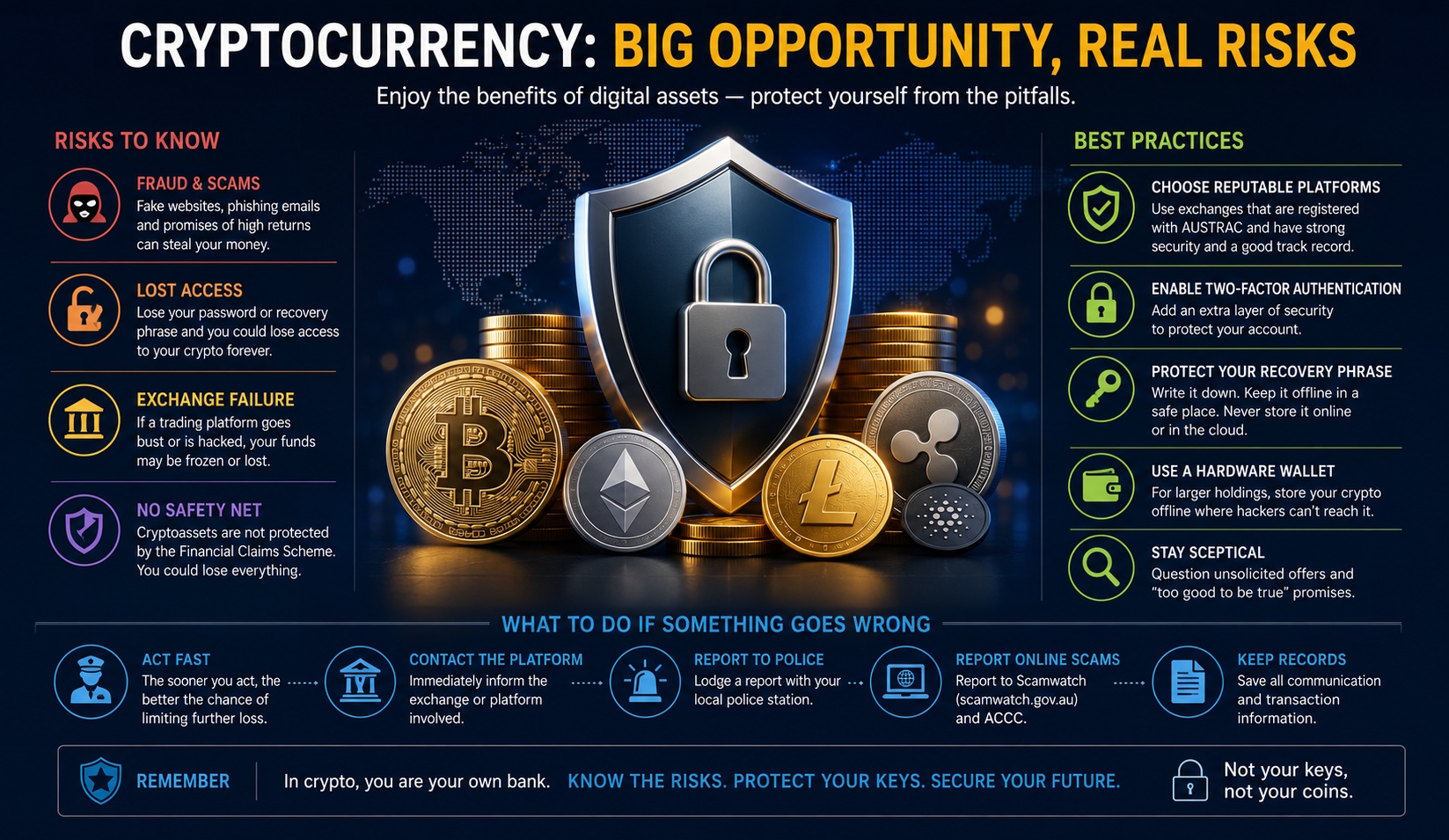
Major financial institutions now offer cryptocurrency services. Some superannuation funds have limited exposure through investment products, and governments around the world are developing regulations to oversee what was once a largely unregulated market.
Yet cryptocurrency remains different from traditional banking and investing in one important respect: if something goes wrong, recovering your money can be far more difficult.
Understanding those risks is just as important as understanding the potential rewards.
Cryptocurrency Is Not a Bank Account
Unlike money held in an Australian bank account, cryptocurrency is not protected by the Australian Government's Financial Claims Scheme.
There is usually no government guarantee if an exchange collapses, a scammer steals your funds or you accidentally transfer cryptocurrency to the wrong address.
Digital currencies operate on decentralised blockchain networks. Once a transaction has been confirmed, it generally cannot be reversed.
That feature makes the technology secure—but it also means mistakes can be permanent.
Fraud Remains the Biggest Threat
Scammers have followed the growth of cryptocurrency.
Common scams include:
- Fake investment platforms promising guaranteed returns.
- Criminals impersonating legitimate exchanges.
- Romance scams where victims are persuaded to invest.
- Phishing emails and fake websites designed to steal login details.
- Social media advertisements promoting fraudulent investment opportunities.
One of the oldest rules in finance still applies.
If an investment promises unusually high returns with little or no risk, extreme caution is warranted.
The Danger of Losing Your Password
Perhaps the greatest difference between cryptocurrency and traditional banking is the importance of protecting your own access credentials.
Many cryptocurrency owners use what is known as a recovery phrase—a sequence of words that allows access to a digital wallet.
Lose that phrase and there may be no customer service department to call.
No password reset.
No identity check.
No replacement access.
Across the world, significant amounts of cryptocurrency are believed to be permanently inaccessible because owners lost their recovery information.
What If a Trading Platform Fails?
Many people purchase cryptocurrency through online exchanges rather than holding the digital assets themselves.
Most exchanges operate professionally and invest heavily in security.
However, history has shown that exchanges can fail through poor management, fraud or cyber attacks.
When that occurs, customers may find themselves waiting months or years for legal proceedings to determine whether any funds can be recovered.
This has reinforced an important lesson for many experienced investors:
Not your keys, not your coins.
The saying reflects the belief that cryptocurrency held in a personal wallet gives the owner greater control than assets left indefinitely on an exchange.
How Can Investors Reduce Their Risk?
While no investment is without risk, several practical steps can improve security.
Choose reputable, well-established trading platforms that comply with Australian regulatory requirements.
Enable two-factor authentication on every account.
Keep recovery phrases offline in a secure location.
Never disclose passwords or recovery phrases to anyone.
Be cautious of unsolicited investment advice received by email, text message or social media.
For larger holdings, many experienced investors choose hardware wallets that store cryptocurrency offline and reduce exposure to online attacks.
What Happens If You Are Scammed?
If cryptocurrency is stolen through fraud, acting quickly may improve the chances of limiting further losses.
Victims should immediately contact the exchange involved, report the matter to local police where appropriate, notify their financial institution if bank transfers were used, and report online scams to the relevant Australian authorities.
Recovery is unfortunately not guaranteed.
Because cryptocurrency transactions occur across international networks, investigations often involve multiple jurisdictions.
Prevention remains the strongest form of protection.
Cryptocurrency Is Becoming Part of Modern Finance
Digital assets are likely to remain part of Australia's financial landscape.
Regulation continues to develop, institutional participation is increasing, and blockchain technology is finding applications well beyond digital currencies.
For many Australians, cryptocurrency may eventually become another asset class alongside shares, property and cash.
The opportunity is genuine—but so too are the risks.
Education, careful research and sensible security practices remain the best investment anyone can make before purchasing their first digital coin.
The Times View
Cryptocurrency has matured from a speculative curiosity into a recognised part of the global financial system. That does not make it risk free.
Unlike traditional banking, cryptocurrency places far greater responsibility on the individual investor. A forgotten recovery phrase, a fraudulent website or an unreliable trading platform can have consequences that are difficult—or impossible—to reverse.
The technology will continue to evolve, and regulation is steadily strengthening. But one principle is unlikely to change: before investing in cryptocurrency, investors should devote as much effort to protecting their assets as they do to choosing them.