Could geriatric hospitals reduce pressure on the health system? Maybe – but improving aged care is paramount
- Written by: Andrew Partington, Research Fellow (Health Economics), Flinders University
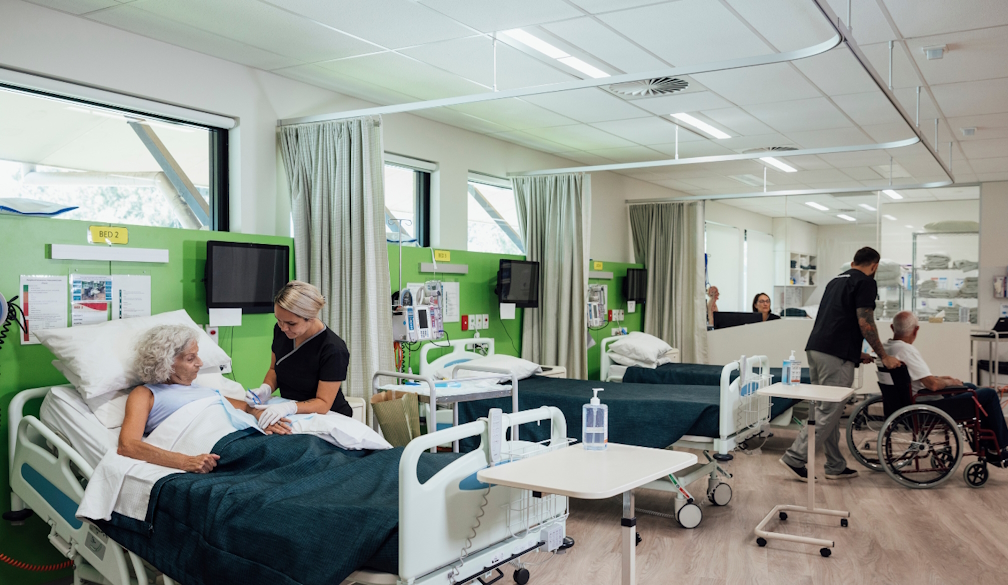
Australia is facing a surge in hospital presentations in older adults. Between 2015–16 and 2019–20[1], hospitalisations among people aged 75–84 increased by an average of 3% annually, the largest rise of any age group.
This growing demand places significant pressure on the health-care system, contributing to poor patient flow, extended stays in emergency departments (EDs), and even ambulance ramping[2]. This is when paramedics are made to wait at the hospital’s entrance and can’t transfer their patient into the ED within an appropriate time frame.
In response, some health system leaders recently called for the creation of standalone geriatric hospitals[3] to specifically cater to the needs of older patients.
But is this a good idea? While there may be some benefits, the call for specialised geriatric hospitals signals Australia’s failure to provide adequate aged care.
Geriatric care in Australia
Across Australia, geriatric care is often delivered in hospitals as a sub-acute admission, in specialised wards, units and clinics, following the acute care part of a hospital stay.
One pathway is geriatric evaluation and management services[4], which target the functioning of patients with age-related medical conditions, such as frailty and cognitive decline, after a surgery or other medical episode.
In most states, geriatric evaluation and management services can also be delivered in the home[5].
Looking at data from public hospitals around the country[6], we can see the level of services vary from state to state. We calculate that in 2020–21, geriatric evaluation and management services involving at least one overnight stay represented 45% of admitted sub-acute care in Victoria and 20% in South Australia, but only around 8% in the Australian Capital Territory and New South Wales.
These sorts of hospital-based services take a holistic view to assess multiple aspects of an older person’s health, such as mobility, mental status, medication management, nutrition and social support, to tailor individualised care plans that help older people to live at home for longer[7], with a greater quality of life.
On the flip side, lack of access to community-based aged care – such as home care packages – is often thought to drive the need for specialised geriatric care in hospitals and longer hospital stays.
We know the current waiting time[8] for a level 4 package (the highest level) is nine to 12 months, though the government has pledged to reduce this with new aged care reforms[9].
Without adequate support at home, older adults often end up in hospital where they can sometimes spend weeks or months awaiting a transfer to aged care.
Pros and cons of geriatric hospitals
A specialised geriatric hospital could be designed around the needs of older patients. This might include specialised medical and support services, but also a tailored physical environment, such as clear signage and quiet spaces.
It’s important to think about who would staff these standalone geriatric hospitals. Geriatric patients would still need specialists other than geriatricians, so this would necessitate cardiologists with a specialisation in geriatric cardiology, for example. Alternatively, separating care in this way could mean geriatric patients receive lower quality cardiology care (and that of other specialties).
Would additional capacity in a standalone hospital help with health system pressures? The simple answer is yes, but, as with adding any new capacity into the hospital system, if it unlocks unmet demand and attracts even more patients into hospitals from the community and aged care, then it would be unlikely to help with ED congestion.
It’s also worth considering whether a standalone hospital would include its own geriatric ED. It’s unlikely an ED in this context would achieve the patient volumes EDs require to maintain quality and efficiency. But without one, transfers from existing EDs would further stretch scarce ambulance resources.
So, would a standalone geriatric hospital be more cost-effective than spending the same budget required to build it, in other ways? By focusing on specific populations for whom the impact would be greatest, we could make the business case stack up.
Dementia care: a potential focus for specialised hospitals
Psychogeriatric care – the mental health care[11] of older people – is a prime example of where federal funding gaps fail patients. This is especially the case for people with behavioural and psychological symptoms of dementia.
Families are not well supported[12] in the community to manage the huge care burden, and community care is not tailored to provide appropriate support for these people. Consequently, patients end up stuck in the social safety net that is a public hospital bed.
These beds often provide non-specialised care for dementia patients. Unfamiliar and overstimulating environments, coupled with staff who may misinterpret these patients’ behaviours, only worsens challenging behaviour[13]. This in turn makes it harder for aged care providers to accept the person.
Currently in SA, there are anecdotally 50 to 70 patients with symptoms suggestive of dementia stuck in hospital, with no pressing medical reason to be there, waiting for somewhere they can be safely discharged, such as aged care. Our experience is that, on average, the length of stay for these patients is 50 to 60 days and contributes to bottlenecks within the ED. These numbers will only grow as the population ages.
A standalone dementia hospital could bring the states and Commonwealth together on care for people with behavioural and psychological symptoms of dementia. It cannot replace residential aged care, but could help with the transition by improving the hospital experience for people with specific age-related needs.
However, it would be essential to retain existing multidisciplinary approaches, such as geriatric evaluation and management services, to avoid isolating or segregating care for those who are already vulnerable.
Improving existing hospitals for older people
While the call for standalone geriatric hospitals may have some merit, ultimately it signals Australia’s failure to provide adequate and integrated hospital and aged care.
The Commonwealth government recently announced[15] significant changes to aged care funding and new supports for home-based care. Existing hospital services would certainly function better with more options for patients to be referred onto once their hospital stay is due to finish.
The forthcoming Commonwealth Aged Care Act[16] is expected to reform many aspects of the care of older Australians. But without further detail and cooperation between the federal government and states and territories, integrated service planning is impossible.
In the meantime, existing hospitals could begin to recast themselves as places better suited to the needs of older people.
References
- ^ 2015–16 and 2019–20 (www.aihw.gov.au)
- ^ ambulance ramping (theconversation.com)
- ^ standalone geriatric hospitals (www.abc.net.au)
- ^ geriatric evaluation and management services (www.health.vic.gov.au)
- ^ delivered in the home (www.health.vic.gov.au)
- ^ public hospitals around the country (benchmarking.ihacpa.gov.au)
- ^ live at home for longer (www.cochranelibrary.com)
- ^ current waiting time (www.myagedcare.gov.au)
- ^ aged care reforms (theconversation.com)
- ^ Gorodenkoff/Shutterstock (www.shutterstock.com)
- ^ mental health care (www.sciencedirect.com)
- ^ are not well supported (www.tandfonline.com)
- ^ only worsens challenging behaviour (www.frontiersin.org)
- ^ Jsme MILA /Pexels (www.pexels.com)
- ^ recently announced (www.abc.net.au)
- ^ Commonwealth Aged Care Act (www.health.gov.au)