


Dutton, set to become Liberal leader, wants people to see 'the rest of my character'
- Written by: Michelle Grattan, Professorial Fellow, University of Canberra
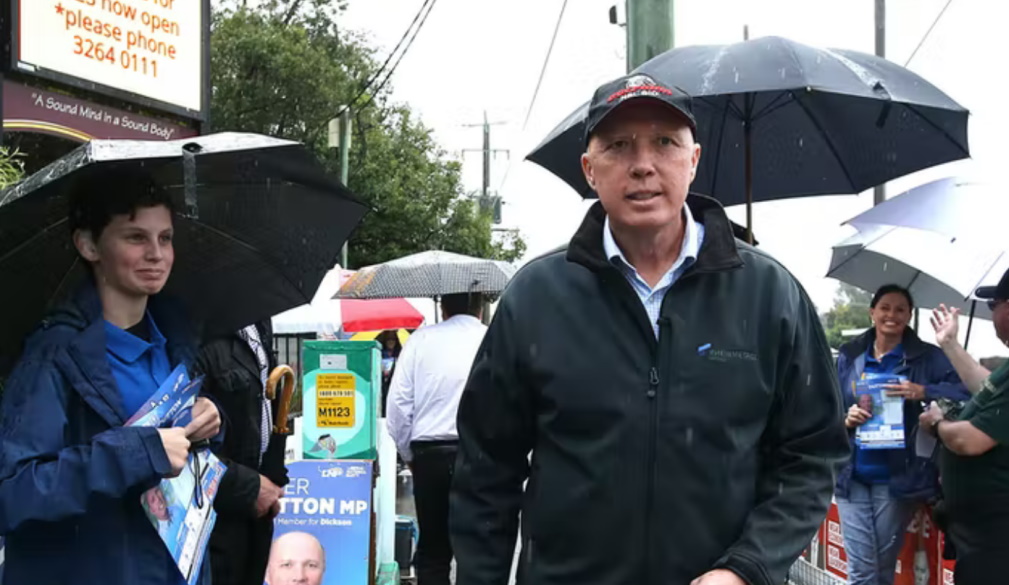
Peter Dutton has declared there is more to him than his tough side, as he formally announces he will stand for the Liberal leadership.
Dutton, set to be unopposed when the Liberals meet next week, also included with his statement a testament from wife Kirilly, who described him as compassionate and witty, saying he hid a lot of his emotion from the public.
The former defence minister, who is from Queensland, portrayed himself as more complex that his hard-man public image. But he also said that in a prime minister, “you need someone who won’t buckle in hard times and will stand up for our country and I have proven that in the portfolios I’ve had”.
Although accepting there is no one else, Liberals are divided over the prospect of Dutton, from the right, as leader.
This reflects the differences within the party about whether, after being defeated by Labor and losing seats to a wave of teals, it should now tack right or left.
There is concern about the entrenched negativity towards Dutton in the public mind, shown in his low rating in polls, and the difficulty of selling him in Melbourne and Sydney.
The Liberals had expected that if they lost the election Josh Frydenberg would become leader, but he was defeated by teal independent Monique Ryan.
Former home affairs minister Karen Andrews said on Wednesday Dutton would be elected unopposed and predicted former environment minister Sussan Ley, from NSW, would be deputy.
Dutton’s bid to broaden his image echoes a similar attempt during his challenge to Malcolm Turnbull in 2018, when he welcomed the chance to “smile and maybe show a different side”.
In his statement Dutton highlighted that he came from the suburbs, as some in the party are arguing its future lies more in the suburbs than in the urban seats that have been lost in this election.
Dutton said his “work ethic is second to none and I have the skill and experience having served five leaders and have learnt from each. I have held portfolios in government and opposition, including: defence, home affairs, health, finance, assistant treasurer, sport and employment.”
He said he’d had “tough jobs - firstly as a policeman dealing with serious sexual assaults and murders, to home affairs minister where I deported drug traffickers and child sex offenders”.
But “most people have only seen that side of me.
"I hope now, in moving from such tough portfolios, the Australian public can see the rest of my character. The side my family, friends and colleagues see.
"The side my community sees where they have elected me eight times. I come from the suburbs and I have never changed my values or forgotten where I have come from.”
Dutton also indicated he accepted the Liberal party’s broad nature.
“We aren’t the Moderate Party. We aren’t the Conservative Party. We are Liberals. We are the Liberal Party.
"We believe in families - whatever their composition. Small and micro businesses. For aspirational hard working ‘forgotten people’ across the cities, suburbs, regions and in the bush.”
Dutton said he was raised by political mentors John Howard and Peter Costello.
“I was a minister under John and assistant treasurer under Peter.
"Things are going to be tough under Labor – higher interest rates, cost of living, inflation and electricity prices.
"Labor talked a big game on the economy. They now have to deliver and we will hold them to account.
"We will be a strong alternative at the next election with economic policies to help, not harm people. This will be in stark contrast to what we will get under Labor.”
Kirilly Dutton said her husband was “an amazing father and the kids adore him.
"He has a great sense of humour – very dry and witty but he also has an incredible compassion. Particularly when it comes to the protection of women and children.
"He hides a lot of his emotion from the public but he gets most upset at reports of children or women being sexually abused or harmed. It obviously stems from his time as a policeman working in that area but it’s also from being the eldest of five kids growing up in the suburbs.”
On Wednesday Dave Sharma, who lost Wentworth to “teal” candidate Allegra Spender, said people had been “almost visceral” in their reaction to Scott Morrison.
“They would say that he is too religious, didn’t like he carried coal into parliament, they didn’t believe his sincerity on climate change and didn’t like our handling of Brittany Higgins and Grace Tame,” Sharma said.









