Anthony Albanese is already on the campaign trail. It signals the tough election battle ahead
- Written by: Gregory Melleuish, Professor of History and Politics, School of Humanities and Social Inquiry, University of Wollongong
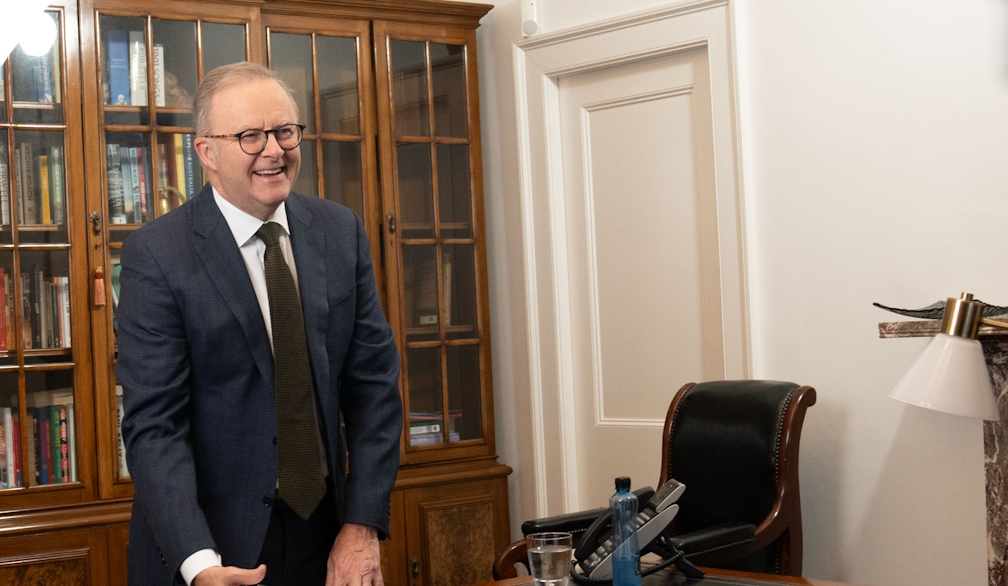
It is an interesting fact[1] that no sitting Australian prime minister since John Howard has led his or her party to more than one election victory.
Anthony Albanese is seeking to buck this trend and lead the Australian Labor Party to victory in an election to be held sometime between February and May this year.
Recent polls and analyses indicate this is not going to be an easy task.
Polls taken in December either put the Coalition slightly ahead or found a 50-50 split[2] between Labor and the Coalition.
A recent Morgan Poll[3] gave the Coalition a 53–47% split in the two-party preferred vote, although, interestingly, this was on the basis that Greens preferences had declined from 85% for Labor to 55%. It also indicated there had been a significant swing to the Coalition in Victoria.
An analysis by John Black[4] contended the Coalition would win 18 additional seats at the election, giving them a total of 73 and minority government. Black’s analysis saw the majority of the Coalition’s gains coming in New South Wales (six) and Victoria (eight, with six from Labor).
All of this is very worrying for the prime minister, especially given the polls also tend to portray him as a weak leader[5].
It’s perhaps no surprise then that Albanese has started the pre-election blitz this week. Convention holds that politicking doesn’t start again until after Australia Day, but the government started the campaign year on January 6, announcing multi-million dollar road upgrades[6] in Queensland.
Whether voters are paying attention remains to be seen, but it’s possible the quieter news cycle gives the government’s plans more oxygen.
The government had also announced the revamped stage three tax cuts just before[7] Australia Day last year, ultimately successfully.
Labor strategists may be angling to set the agenda early on this year to build similar goodwill.
Rebuilding trust
Albanese needs to develop a strategy to convince Australian voters that he remains the best person to lead them in what are quite difficult and uncertain times.
Cost of living[8] remains the top issue for eight in ten Australians, but many voters have a low level of trust in their elected representatives.
This low level of trust is reflected in the fact that the Labor primary vote hovers around 30% and the Coalition struggles to reach 40%.
It is an often cited lore of Australian politics that first-time governments do not lose[9] when they seek re-election. The last time[10] a first-term sitting government wasn’t re-elected was the Scullin Labor government during the Great Depression.
Certainly, Albanese has no desire to join this club, but he is in a difficult situation. The government currently has a slim majority in the House of Representatives, holding 78 seats. Even the loss of a few seats will lead to a minority government.
Strategic maneouvering
Unfortunately for Albanese, he has limited options if he wishes to maximise his vote. The first strategy relates to timing.
There is a state election in Western Australia on March 8, which makes a March federal election somewhat unlikely. A March election, or an election in early April would mean the government would not have to hand down a budget[11] on March 25.
A key strategy here is to avoid bad economic news and to maximise the chances the Reserve Bank will hand down an interest rate cut, thereby vindicating the government’s economic policies.

Recent inflation figures may[13] or may not[14] encourage the government in this hope.
The second strategy relates to focus. The polls seem to indicate that Labor is losing ground, particularly in Victoria but also in New South Wales. It’s interesting then that the first electioneering foray of the year was focused on Queensland, Western Australia and the Northern Territory.
Perhaps this indicates that Labor thinks it can make up some of its lost ground in these states.
Look forward or look back?
The third strategy for Albanese to maximise his chances at re-election relates to policy and what can be termed “narrative”.
In this context, it is worth considering Albanese’s comment[15] this week:
this election is a choice between building Australia’s future or taking Australia backwards.
This is a very old trope[16] in Australian politics going back well into the last century – that Labor is the “party of initiative” and the Liberals and Nationals the “parties of resistance”.
This plays into a very powerful idea, best exemplified by former Prime Minister Gough Whitlam, that Labor is the party of progress and hence the Australian people can trust only Labor to deliver a better future for them.
This can then be turned very easily into a Medicare scare campaign[17] and play into fears that a Coalition government threatens all aspects of the welfare state.
On the surface, this strategy of appealing to a traditional Labor narrative and view of the world would seem to be sound.
But one must wonder, especially given the core Labor vote is now around 30%, how much this will resonate with the wider Australian electorate. It’s like looking backwards to look forwards.
The real issue is Albanese is limited in his options.
The hard reality is cost of living is the central issue of Australian politics in 2025. Labor desperately needs some indication its policies are making a difference in this area, such as an interest rate cut, and can then time the election accordingly.
In all of this, there are so many contingent factors in play. Luck (and timing) do indeed matter in politics.
References
- ^ interesting fact (en.wikipedia.org)
- ^ 50-50 split (theconversation.com)
- ^ recent Morgan Poll (www.roymorgan.com)
- ^ analysis by John Black (www.afr.com)
- ^ as a weak leader (www.theaustralian.com.au)
- ^ road upgrades (www.abc.net.au)
- ^ just before (www.abc.net.au)
- ^ Cost of living (www.afr.com)
- ^ do not lose (theconversation.com)
- ^ last time (parlinfo.aph.gov.au)
- ^ a budget (www.news.com.au)
- ^ Dan Himbrechts/AAP (photos.aap.com.au)
- ^ may (www.afr.com)
- ^ may not (www.theaustralian.com.au)
- ^ Albanese’s comment (www.theguardian.com)
- ^ very old trope (www.tandfonline.com)
- ^ Medicare scare campaign (theconversation.com)