The Times Australia
Google AI
The Times World News

.

The ANZUS treaty does not make Australia safer. Rather, it fuels a fear of perpetual military threat

  • Written by Emma Shortis, Research Fellow, RMIT University

In June 2020, the Australian federal government announced a new, A$270 billion defence strategy[1]. Part of this entailed spending $800 million on new AGM-158C long-range anti-ship missiles from the United States.

The new spend formed part of a long tradition of Australian defence procurement from the US. In 2017, the Australian National Audit Office estimated[2] the Australian Defence Force (ADF) had spent an eye-watering $10 billion on American weapons and equipment in the previous four years alone.

This trend looks set to continue. This May, for example, the ADF announced the establishment of a $7 billion space division[3], which will inevitably deepen Australia’s security and economic ties with the US.

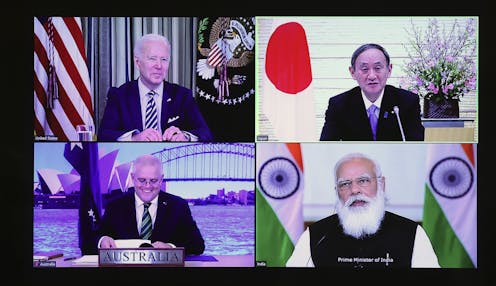
And as the Biden administration focuses more attention on “the Quad” — the quadrilateral security arrangement between the US, Australia, Japan and India — to counter Chinese influence in the Asia-Pacific region, Australia will most likely purchase even more[4] American weapons and military equipment.

The Quad leaders meet virtually. The Quad leaders meet virtually in March to discuss Indo-Pacific security. Ryohei Moriya/AP

ANZUS is no security guarantee

These close security linkages reflect the broader consensus underpinning the Australia, New Zealand, United States Security Treaty (ANZUS)[5], which marks its 70th birthday today.

This consensus – shared not just by US and Australian governments, but also by the broader foreign policy and media establishments in both countries – is that ANZUS makes Australia, and the world, safer.

Scott Morrison lays a wreath at the tomb of an Australian pilot. In Washington, Prime Minister Scott Morrison lays a wreath at the tomb of Australian pilot Francis Milne, who died in the second world war. Mick Tsikas/AAP

The belief is the treaty — and the deep friendship between our two countries — gives Australia special access to advanced American military technology that we need (although not at a discount).

And, more importantly, that it keeps us under an American security umbrella. Australians can rely, in the recent words of one senior bureaucrat[6], on the “protection afforded” by ANZUS.

This assumption rests specifically on Article IV of the treaty, in which each party “declares that it would act to meet the common danger”. This language is widely assumed to constitute a security guarantee from the US. However, the reality is, it does not[7].

President Harry Truman, who oversaw the birth of the treaty, was never willing to provide that, nor has any administration since. A commitment to “act” in the face of “common danger” could, after all, mean absolutely anything.

ANZUS does not provide Australia with a security guarantee, and it never will. And, perhaps more importantly, even if it did, it does not make us safer.

Read more: Defence update: in an increasingly dangerous neighbourhood, Australia needs a stronger security system[8]

Reinforcing a perception of perpetual military threat

Why is this? One reason is the treaty (and Australia’s relationship with the US more broadly) reinforces and perpetuates a belief that Australia faces a perpetual military threat.

It also reinforces the idea that military might is needed to meet that threat. The purchase of more American weapons, in the words of Prime Minister Scott Morrison[9], has the effect of “deterring an attack on Australia and helping to prevent war”.

Even putting the questionable basis of this assumption[10] aside, this focus on military threat at the expense of all else has had significant consequences for both Australia and our region. Other genuine threats, such as climate change, are always treated as peripheral to the core of Australia’s relationship with the US.

It was perhaps telling that as Australian officials were negotiating the purchase of more American weaponry last year, they weren’t using our uniquely close relationship to secure priority access to something that would actually make Australians safer: American vaccines.

When Morrison announced the country’s new defence strategy, he justified both the spending and aggressive posturing on the basis a post-COVID world will be “poorer, more dangerous and more disorderly[11]”.

As I argue in my new book, Our Exceptional Friend: Australia’s Fatal Alliance with the United States[12], ANZUS reinforces this way of seeing the world.

The ANZUS treaty does not make Australia safer. Rather, it fuels a fear of perpetual military threat Hardie Grant Publishing Instead of viewing our region with empathy and generosity — or partnering with the US to prevent the world from becoming poorer, more dangerous or more disorderly — the Australian government seeks to arm itself. In the process, it serves only to perpetuate a world in which conflict becomes ever more likely, and economic, racial and environmental inequality more entrenched[13]. A shift in mentality is needed ANZUS was born out of a shared experience of war in the 1950s, and particularly Australian perceptions of ongoing, existential threats from non-white neighbours. These perceptions, based on deep racism and fear, were wrong then[14], and they are wrong now. Yet, the current US-Australia strategic relationship still requires an enemy – a “common danger”. As a result, the US and Australia will always find one, together. The only way to change this is through a deep, honest reckoning with the origins of Australia’s security alliance with the US — and its consequences. Read more: ANZUS at 70: Together for decades, US, Australia, New Zealand now face different challenges from China[15] This doesn’t mean scrapping ANZUS. Even if that were possible, the structures that exist around it and the ideas that inform Australian foreign policy would endure. It does mean, however, trying to find different ways for Australia to manoeuvre within those structures, stepping back from a fear-mongering, military threat mentality, and forging genuine relationships with our neighbours. It means trying to forge a relationship with the United States that is not, in the words of a former US president[16], “sealed with … blood”. Scott Morrison and Donald Trump in Washington. Scott Morrison and Donald Trump before a state dinner at the White House in 2019. Mick Tsikas/AAP Yet, even as the recent events in Afghanistan make the consequences of our unquestioning security alliance so glaringly obvious, there is no indication Australia will do anything other than double down on it. The mindset that has led successive Australian governments to follow the US will not change, no matter what Washington does or who is in charge. The position of the current government is to strengthen the treaty, rather than try to dismantle it. That’s dangerous for us and the world. Happy birthday, ANZUS. Emma Shortis’s new book, Our Exceptional Friend: Australia’s Fatal Alliance with the United States[17], was published last month by Hardie Grant Books.

References

  1. ^ A$270 billion defence strategy (www.abc.net.au)
  2. ^ the Australian National Audit Office estimated (www.abc.net.au)
  3. ^ $7 billion space division (www.theguardian.com)
  4. ^ likely purchase even more (www.defensenews.com)
  5. ^ Australia, New Zealand, United States Security Treaty (ANZUS) (www.aph.gov.au)
  6. ^ recent words of one senior bureaucrat (www.abc.net.au)
  7. ^ it does not (www.abc.net.au)
  8. ^ Defence update: in an increasingly dangerous neighbourhood, Australia needs a stronger security system (theconversation.com)
  9. ^ in the words of Prime Minister Scott Morrison (www.abc.net.au)
  10. ^ the questionable basis of this assumption (www.theguardian.com)
  11. ^ poorer, more dangerous and more disorderly (www.abc.net.au)
  12. ^ Our Exceptional Friend: Australia’s Fatal Alliance with the United States (www.hardiegrant.com)
  13. ^ more entrenched (www.theguardian.com)
  14. ^ wrong then (www.aph.gov.au)
  15. ^ ANZUS at 70: Together for decades, US, Australia, New Zealand now face different challenges from China (theconversation.com)
  16. ^ in the words of a former US president (www.defense.gov)
  17. ^ Our Exceptional Friend: Australia’s Fatal Alliance with the United States (www.hardiegrant.com)

Read more https://theconversation.com/the-anzus-treaty-does-not-make-australia-safer-rather-it-fuels-a-fear-of-perpetual-military-threat-165670

Times Magazine

Worried AI means you won’t get a job when you graduate? Here’s what the research says

The head of the International Monetary Fund, Kristalina Georgieva, has warned[1] young people ...

How Managed IT Support Improves Security, Uptime, And Productivity

Managed IT support is a comprehensive, subscription model approach to running and protecting your ...

AI is failing ‘Humanity’s Last Exam’. So what does that mean for machine intelligence?

How do you translate ancient Palmyrene script from a Roman tombstone? How many paired tendons ...

Does Cloud Accounting Provide Adequate Security for Australian Businesses?

Today, many Australian businesses rely on cloud accounting platforms to manage their finances. Bec...

Freak Weather Spikes ‘Allergic Disease’ and Eczema As Temperatures Dip

“Allergic disease” and eczema cases are spiking due to the current freak weather as the Bureau o...

IPECS Phone System in 2026: The Future of Smart Business Communication

By 2026, business communication is no longer just about making and receiving calls. It’s about speed...

The Times Features

Technical SEO Fundamentals Every Small Business Website Must Fix in 2026

Technical SEO Fundamentals often sound intimidating to small business owners. Many Melbourne busin...

Most Older Australians Want to Stay in Their Homes Despite Pressure to Downsize

Retirees need credible alternatives to downsizing that respect their preferences The national con...

The past year saw three quarters of struggling households in NSW & ACT experience food insecurity for the first time – yet the wealth of…

Everyday Australians are struggling to make ends meet, with the cost-of-living crisis the major ca...

The Week That Was in Federal Parliament Politics: Will We Have an Effective Opposition Soon?

Federal Parliament returned this week to a familiar rhythm: government ministers defending the p...

Why Pictures Help To Add Colour & Life To The Inside Of Your Australian Property

Many Australian homeowners complain that their home is still missing something, even though they hav...

What the RBA wants Australians to do next to fight inflation – or risk more rate hikes

When the Reserve Bank of Australia (RBA) board voted unanimously[1] to lift the cash rate to 3.8...

Do You Need a Building & Pest Inspection for New Homes in Melbourne?

Many buyers assume that a brand-new home does not need an inspection. After all, everything is new...

A Step-by-Step Guide to Planning Your Office Move in Perth

Planning an office relocation can be a complex task, especially when business operations need to con...

What’s behind the surge in the price of gold and silver?

Gold and silver don’t usually move like meme stocks. They grind. They trend. They react to inflati...