Is solar now the economic liferaft for Australian households?
- Written by: The Times
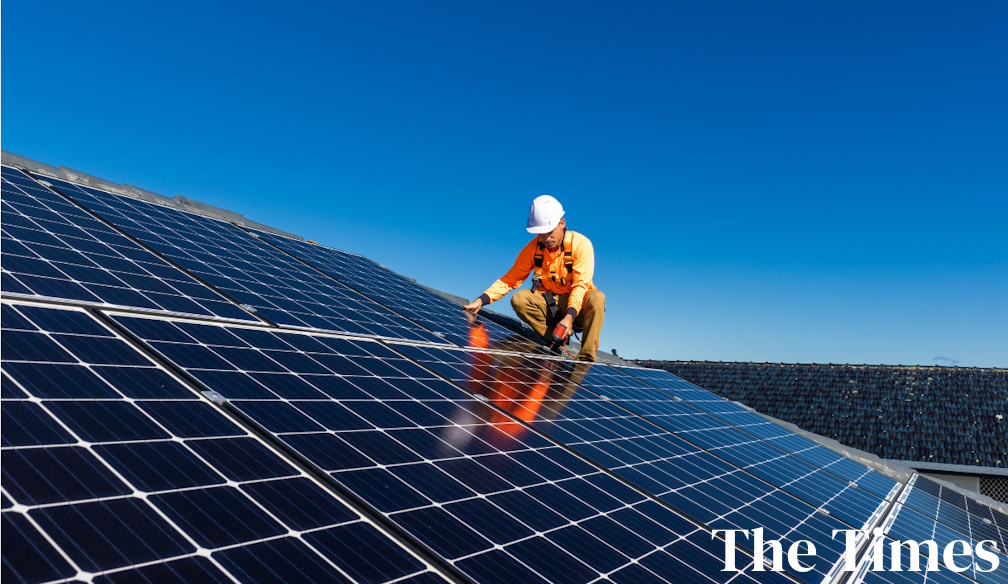
Australians have been told for years that the answer to rising electricity prices is the energy transition.
For many households and small businesses, the more practical question is simpler: can solar panels and batteries now protect them from the next bill shock?
The answer is no longer theoretical. Rooftop solar is mature technology. Panels are cheaper and more efficient than they were a decade ago. Inverters are smarter. Batteries are improving. Apps allow householders to see when they are generating, storing, using and exporting power. What was once a niche environmental choice is now a mainstream financial decision.
Australia is already one of the world’s great rooftop solar nations. Drive through almost any suburb and the evidence is visible from the street. Houses, warehouses, schools, shops and factories have become small power stations.
But the next question is the hard one: is it economic to disconnect from the grid entirely?
For most homes, not yet.
Going off-grid sounds attractive. No daily supply charge. No network surcharge. No confusing tariff. No political argument about coal, gas, renewables, transmission lines or emissions targets. Just your roof, your battery and your own power.
The problem is reliability. A normal suburban household needs electricity at night, during rain, during winter, during heatwaves and during the occasional run of poor solar production. To be fully independent, a home needs more panels, more batteries and often a backup generator. That adds cost and complexity.
For rural properties with expensive grid connection costs, off-grid solar can already make sense. For ordinary homes already connected to the network, the better financial model is usually not total disconnection. It is solar, battery storage and intelligent use of the grid.
That means using your own solar during the day, storing excess power for the evening, drawing from the grid only when needed and exporting when it pays to do so.
For businesses, the equation can be even stronger. Commercial premises often use power during daylight hours, when solar generation is at its best. Warehouses, workshops, supermarkets, offices, motels and hospitality venues can reduce their exposure to peak prices by using their roofs as productive assets.
The battery question is changing quickly. Until recently, the economics were often marginal. Solar panels paid for themselves. Batteries were desirable, but expensive. That is now shifting because government policy has moved directly into the battery market.
The federal Cheaper Home Batteries Program offers a discount of about 30 per cent on eligible small-scale battery systems. It applies to households, small businesses and community organisations, and covers eligible systems connected to new or existing rooftop solar.
That matters because the battery is the missing link. Solar without a battery helps during the day. Solar with a battery helps in the evening, when many households use the most power and when grid demand can be high.
State programs, local council schemes and finance arrangements may also be available depending on where the property is located. The details vary, and households should check current eligibility before signing a contract.
But subsidies raise a policy question. If governments are encouraging people to install solar and batteries, are they helping consumers escape high prices — or are they trying to turn private homes into part of the national electricity system?
The honest answer is both.
Governments want more renewables. The Greens want faster action. Labor has made renewable energy central to its economic and climate agenda. Where Labor needs Greens support in parliament, energy policy will remain a bargaining table.
That does not mean every electricity bill is literally negotiated in Canberra. But it does mean household power costs are shaped by political decisions: generation policy, coal closure timelines, gas policy, transmission investment, renewable targets, subsidies, retail regulation and network charges.
Coal and gas power stations are increasingly treated by governments as legacy assets, not future foundations. Supporters of the transition argue renewables backed by storage will be cheaper and cleaner. Critics argue the transition is being pushed faster than the grid can comfortably absorb, with consumers carrying the cost through bills, taxes or both.
For households, ideology is less important than the quarterly bill.
If electricity prices continue rising, solar becomes more attractive. If feed-in tariffs fall, batteries become more attractive. If daily supply charges and network fees rise, the dream of partial independence becomes more attractive. If governments subsidise batteries, the payback period improves.
Solar is not yet a complete escape hatch for most Australians. It will not make every household immune from energy policy. It will not remove all grid costs. It will not solve the renter problem. It will not help apartment dwellers as easily as it helps detached-home owners. It will not remove the need for large-scale generation and transmission.
But for homeowners with suitable roofs, and for businesses with daytime power demand, solar is now a serious economic defence.
The new household energy question is not simply: should I install solar panels?
It is: how much power can I generate, how much can I store, how much can I use myself, and how much exposure to the grid do I still want?
That is the real shift. Solar began as an environmental statement. It became a cost-saving device. With batteries, it is becoming a form of household and business risk management.
Australians may not yet be able to unplug from the grid economically in large numbers. But many can reduce their dependence on it.
In an era of rising bills, political bargaining and energy uncertainty, that may be the liferaft many households are looking for.