We can’t eradicate deadly cane toads – but there’s a way to stop them killing wildlife
- Written by: Georgia Ward-Fear, Post doctoral fellow and Conservation Ecologist , Macquarie University
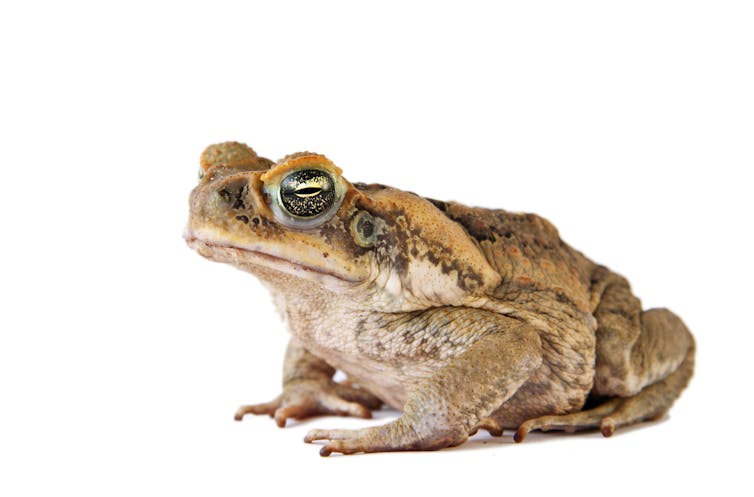
Australia can claim more than its fair share of environmental blunders, but the introduction of cane toads[1] in 1935 surely ranks as one of the worst.
The toads were imported from Hawaii and released in Queensland, purportedly to manage pest beetles in sugar cane crops. The toads failed to control the pests and instead spread westwards at an ever-increasing pace. They are expected[2] to reach Broome[3] on Western Australia’s coast within a few years.
Along the way, cane toads have created havoc. Any predator that tries to eat an adult cane toad is likely to die a quick and painful death. In particular, monitor lizards – once abundant across the Australian tropics – have virtually been wiped out.
Cane toads have so far proven unstoppable. But our research[4] suggests even if we can’t eradicate the toads, we may still be able to reduce the damage they cause. By exposing native animals to less toxic baby cane toads, we can teach them not to eat the deadly adults.
‘Teacher toads’
Many threats imperilling ecosystems worldwide are virtually impossible[6] to eradicate. In some cases, the only way to reduce the impacts of such invaders may be to build the resilience of native species.
This can be achieved through a method known as “conditioned taste aversion[7]” – a learned association between the taste of a particular food and illness. One approach involves exposing native predators to small individuals of a toxic prey type, in the hope the predator will fall ill but not die, and learn to avoid eating that species in future.
Our previous lab and field research provided[8] encouraging results[9]. It suggested if we expose wild predators to small, non-lethal cane toads they learnt to delete cane toads from their diets, increasing their chance of survival after the larger toads invade.
We wanted to test this approach at a bigger scale – in the Kimberley region of northwestern Australia – to help protect yellow-spotted monitors (a type of goanna). Across Australia’s tropics, many populations of this species have declined more than 90%[10] due to ingestion of cane toads.
The loss has affected[11] the entire food web. Smaller predators have become more abundant and have access to more food, which means they can have larger impacts on prey species.
As well as their ecological role, yellow-spotted monitors are also an important cultural species[12] and traditional food source for Indigenous people.
Our project[13] set out to teach wild yellow-spotted monitors to leave the toxic amphibian alone, by exposing them to “teacher toads”: young individuals less poisonous than adult toads.
Read more: A secret war between cane toads and parasitic lungworms is raging across Australia[14]
The results were clear
Rolling out a conservation strategy in an area as huge and rugged as the Kimberly wilderness is no easy task. To take on this challenge, we assembled a coalition of stakeholders[16] including researchers, wildlife management agencies, non-government organisations, private landowners and Indigenous groups.
We worked with the Bunuba Rangers and the WA Department of Biodiversity, Conservation and Attractions. First, we captured adult female toads that were about to lay their eggs. Once the eggs were laid we transported them, or the tadpoles, to places we knew would be invaded by the toads within a few months.
It might seem unusual to release many thousands of baby pest toads into the environment. But we knew vast numbers of adult toads would soon reach the area anyway. And importantly, we didn’t add any more cane toads into the landscape – we took female toads that were about to lay their eggs from one place, and released those eggs and babies into another place not too far away.
To monitor goanna populations, we used trail cameras set up to record any animal that approached our bait – a punctured tin of sardines. Goannas are strongly attracted to that smelly stimulus, so the method worked well. It also allowed us to work out how many goannas lived in each site before toads arrived.
The results of our intervention were clear. In three sites where we deployed our “teacher toads”, goannas remained abundant even after toads invaded. But in four nearby sites where goannas were equally abundant beforehand, their numbers plummeted.
Read more: Is 'Toadzilla' a sign of enormous cane toads to come? It's possible – toads grow as large as their environment allows[17]
Lessons for the future
It will never be possible to deploy “teacher toads” across all of tropical Australia. But our results suggest strategic use of this method can help maintain pockets with healthy predator populations. Over time, the offspring of those survivors may repopulate other areas.
We’re optimistic that even a single deployment of baby toads may have long-term effects. That’s because once adult cane toads invade an area and begin breeding, it creates plenty of baby toads to “train” the next generation of goannas, without us having to keep adding more toads to the system.
Our study is a good example of bringing research results through to actual on-ground management. It also shows the benefits of academics working with Indigenous communities and government authorities to achieve real outcomes for wildlife conservation.
We have also demonstrated the promise of our technique for conservation challenges globally. If we can’t eliminate a threat to native wildlife, we might at least teach individual animals how to deal with it.
The authors would like to acknowledge the valuable contribution of the Bunuba Rangers to the research underpinning this article.
References
- ^ introduction of cane toads (conbio.onlinelibrary.wiley.com)
- ^ expected (link.springer.com)
- ^ reach Broome (www.abc.net.au)
- ^ our research (conbio.onlinelibrary.wiley.com)
- ^ Shutterstock (www.shutterstock.com)
- ^ virtually impossible (esajournals.onlinelibrary.wiley.com)
- ^ conditioned taste aversion (www.sciencedirect.com)
- ^ provided (royalsocietypublishing.org)
- ^ encouraging results (www.ncbi.nlm.nih.gov)
- ^ declined more than 90% (journals.plos.org)
- ^ has affected (besjournals.onlinelibrary.wiley.com)
- ^ important cultural species (conbio.onlinelibrary.wiley.com)
- ^ Our project (conbio.onlinelibrary.wiley.com)
- ^ A secret war between cane toads and parasitic lungworms is raging across Australia (theconversation.com)
- ^ Shutterstock (www.shutterstock.com)
- ^ coalition of stakeholders (www.canetoadcoalition.com)
- ^ Is 'Toadzilla' a sign of enormous cane toads to come? It's possible – toads grow as large as their environment allows (theconversation.com)