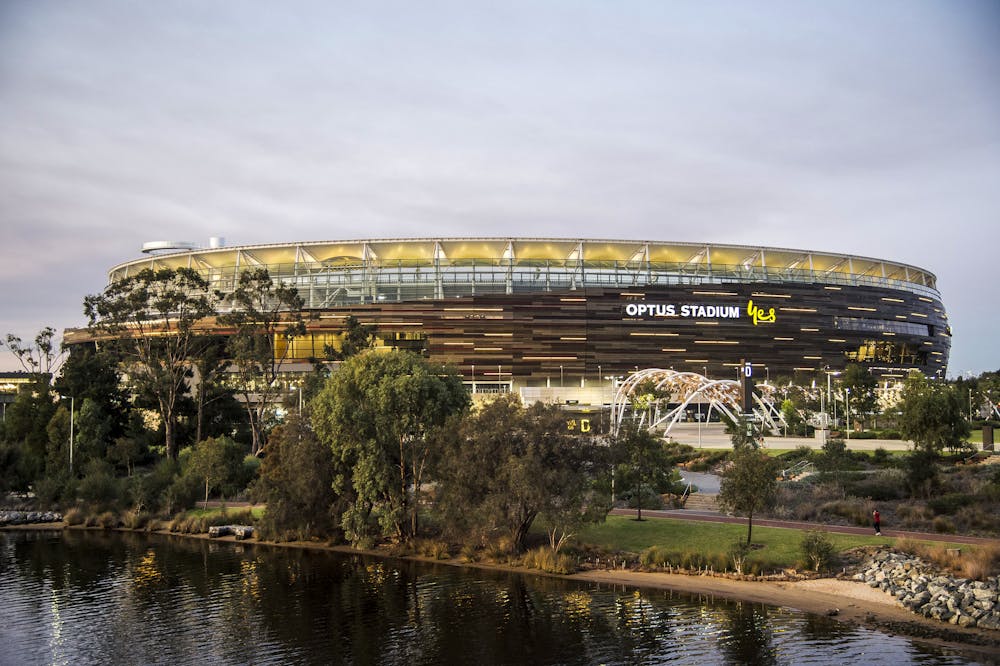
Perth's Optus Stadium has drawn more consumer anger after the outage. Another case of the 'stadium curse'?
- Written by: David Rowe, Emeritus Professor of Cultural Research, Institute for Culture and Society, Western Sydney University
Looming over the Swan River in Perth, a shiny sporting structure boldly declares “OPTUS STADIUM Yes”. After the disastrously prolonged communication outage[1] this week, many will have shouted[2] “No”, or other words requiring asterisks in respectable media.
Sport stadium naming rights are controversial at the best of times – so why do corporates pay so much for them? And what are the risks?
Read more: In a crisis, Optus appears to be ignoring Communications 101[4]
Collateral damage
Optus bought the ten-year rights from the Western Australian government in 2017 for a reported A$50 million[5].
This week’s public relations disaster stands in stark contrast to the company’s optimistic announcement[6] that year, celebrating “a combination of mobile network expansion, coupled with game-changing entertainment experiences for events at the new Optus Stadium”.
Instead, the arrangement has become a focus[7] of consumer anger towards the company, with the sport site suffering collateral damage.
The game has indeed changed, but not in the desired direction.
Named and shamed
From the outset, Perth Lord Mayor Basil Zempilas objected[8] to the erasure of Perth from the stadium’s title.
Instead of anchoring the stadium to place for global marketing purposes, he argued, it could be anywhere in the world.
Optus’s troubles this week gave him a free kick[9] on X (formerly Twitter), where he said:
The Optus Stadium naming rights arrangement never looks good on days like this. Bad decision any day – terrible look today.
Given the risks of such associations, why are businesses attracted to having their names and logos mounted on sports infrastructure?
Ever since sport and media[10] converged, corporate brands joined the party.
It should be a fairly straightforward exchange – sport receives money and kudos, sponsors get profile and assumed good will. This is why companies advertise on sport clothing and equipment.
Stadium naming rights, though, make brands even more prominent by imprinting themselves on the cathedrals of sport.
But in the middle of a corporate crisis, reputations can be reduced to rubble.
Sydney’s newly rebuilt Commbank Stadium[11] was hardly the best advertisement for rugby league in Parramatta during the Royal Commission into Misconduct in the Banking, Superannuation and Financial Services Industry[12], for example.
Self-inflicted brand casualty Qantas[13] previously had naming rights over the Sydney Entertainment Centre, which was known as the Qantas Credit Union Arena[14]. Once home of the Sydney Kings and Sydney Uni Flames basketball teams, the venue was eventually demolished.
After its recent PR disasters, it seems unlikely Qantas would be rushing to get its name all over big venues again. It could, as in the Optus case, end up serving as a costly, flashing focal point for consumer rage.
The stadium curse?
Some analysts have argued[15] acquiring sport stadium naming rights is a sign of corporate indulgence, frequently indicating a company is in decline.
Others have called it the “stadium curse[16]” or “stadium jinx[17]”, whereby stadium naming rights are mysteriously associated with corporate peril, even collapse.
Yet, despite these anxieties, sport stadia have no lack of big-time suitors in pursuit of prestige signage. Entry to this club takes a lot of capital[18], which is why banks, insurance companies, car manufacturers, hoteliers, communication conglomerates, entertainment companies and airlines predominate.
The likes of Melbourne’s AAMI Park and Kia Arena, or Brisbane’s Suncorp Stadium, are conspicuous examples of the corporate love affair with sporting real estate.
Smaller venues like PointsBet Stadium (Cronulla) and BlueBet Stadium (Penrith) are named after sport gambling companies, especially in association with rugby league[19]. Here, physical spaces are used to attract customers to “punt” online.
This gamblification of sport[20] is unpopular among citizens and politicians[21] who are troubled by the cultivation of children and the malign social impact on vulnerable adults.
Traditionalist fans also resent[22] the names of their hallowed stadium being hawked around the marketplace and switched with the latest contract.
Confusingly, Melbourne’s Disney-themed Marvel Stadium has also been known as Colonial Stadium, Telstra Dome and Etihad Stadium in the last two decades.
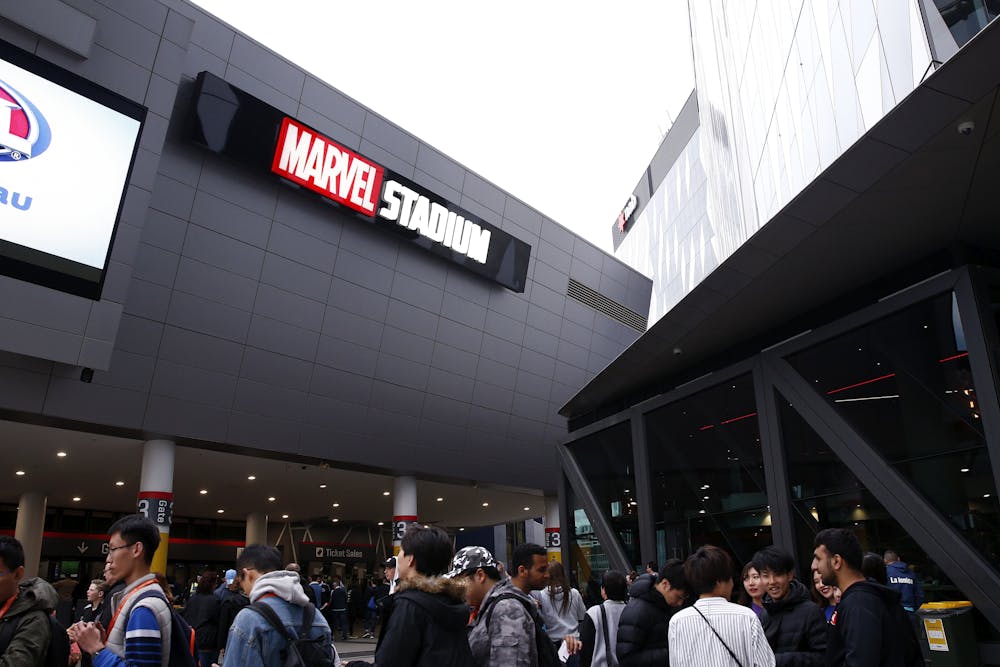 Melbourne’s Marvel Stadium has gone through several name changes in the last two decades.
AAP Image/Daniel Pockett[23]
Melbourne’s Marvel Stadium has gone through several name changes in the last two decades.
AAP Image/Daniel Pockett[23]
For this reason, the Melbourne Cricket Ground, Adelaide Oval and the Sydney Cricket Ground have all resisted commercial naming rights.
Accor Stadium in Sydney is still often called Stadium Australia by the historically inclined and ABC broadcasters concerned about their editorial independence and integrity[24].
Aversion to a rival team’s sponsor
Stadium naming is a conspicuous means of marking sports territory, but fans may even feel an aversion to a rival team’s sponsor in the highly partisan world of sport.
Marketing scholars have developed the concept of oppositional loyalty[25] to capture this antagonism of sport fans to the products and services associated with “the enemy”.
So branding a home stadium might turn both diehard fans and their fiercest opponents off the company paying so much for the naming rights.
Nonetheless, the association of sports, sponsors and grand buildings has enduring appeal.
The Sydney Opera House may not be a sport stadium as such, but it does host sport events[26].
Its famous sails are coveted by many sports, especially horse racing, to the chagrin[27] of those who protest “our house is not for sale”.
On the other side of the continent, Optus Stadium would likely just settle for a full house with a functioning communications network.
Read more: The Sydney Olympics: How did the 'best games ever' change Australia?[28]
References
- ^ outage (www.reuters.com)
- ^ shouted (twitter.com)
- ^ AAP Image/Aaron Bunch (photos.aap.com.au)
- ^ In a crisis, Optus appears to be ignoring Communications 101 (theconversation.com)
- ^ A$50 million (www.abc.net.au)
- ^ announcement (www.optus.com.au)
- ^ focus (twitter.com)
- ^ objected (www.watoday.com.au)
- ^ free kick (twitter.com)
- ^ sport and media (www.bloomsburycollections.com)
- ^ Commbank Stadium (commbankstadium.com.au)
- ^ Royal Commission into Misconduct in the Banking, Superannuation and Financial Services Industry (www.royalcommission.gov.au)
- ^ Qantas (www.thenewdaily.com.au)
- ^ Qantas Credit Union Arena (www.eventfinda.com.au)
- ^ argued (nzfc.ac.nz)
- ^ stadium curse (www.cnbc.com)
- ^ stadium jinx (www.tampabay.com)
- ^ lot of capital (www.austadiums.com)
- ^ rugby league (www.smh.com.au)
- ^ gamblification of sport (www.tandfonline.com)
- ^ citizens and politicians (www.abc.net.au)
- ^ resent (www.researchgate.net)
- ^ AAP Image/Daniel Pockett (photos.aap.com.au)
- ^ editorial independence and integrity (www.abc.net.au)
- ^ oppositional loyalty (link.springer.com)
- ^ host sport events (www.fifa.com)
- ^ chagrin (www.theguardian.com)
- ^ The Sydney Olympics: How did the 'best games ever' change Australia? (theconversation.com)