Bounties on exiled Hong Kong activists show the ambitious reach of China’s political repression
- Written by: Brendan Clift, Lecturer, The University of Melbourne
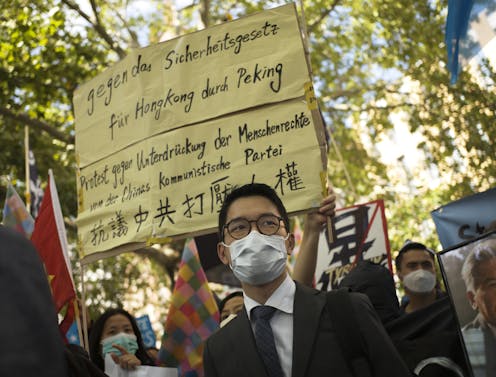
The Hong Kong government has extended its efforts to suppress political dissent overseas, issuing arrest warrants for eight exiled pro-democracy figures and offering bounties of HK$1 million[1] (around A$191,000) each.
The targeted pro-democracy figures, who now live in Australia, the US and UK, were selected from a longer list of wanted dissidents. There is a curated feel to their profiles – three ex-legislators, three activists, a unionist and a lawyer – that suggests the list is symbolic, as well as pragmatic.
It is reminiscent of the infamous “Umbrella Nine” trial[2] that capped years of prosecutions after Hong Kong’s 2014 “Umbrella Movement” protests. Three academics, three politicians and three activists were tried and convicted together to send a message to “troublesome” sectors of civil society.
The mugshots of those issued with arrest warrants[3] this week depict not gun-slinging outlaws, but amiable-looking intellectual types.
Their “very serious crimes”, according to police, consist mostly of calling for sanctions to turn the tide of political repression in Hong Kong. In the terms of the controversial national security law[4] under which the warrants were issued, this is considered “subversion of state power”, an offence punishable by up to life imprisonment.
How extradition with Hong Kong works
Hong Kong is nominally a self-governing region of China under the “one country, two systems” model agreed to when the UK handed the territory back in 1997.
However, the national security law[5] was drafted in Beijing and applied to Hong Kong after the tumultuous, protracted protests that gripped the city in 2019. These were prompted, ironically, by fears the region’s autonomy was breaking down.
A curious feature of the national security law is its purported extraterritorial effect. It claims jurisdiction over any person of any nationality who has committed any of its offences anywhere in the world.
Read more: Hong Kong activists now face a choice: stay silent, or flee the city. The world must give them a path to safety[6]
Whether the Hong Kong government can realistically bring these people to trial is another matter entirely.
The international law of extradition (technically, in Hong Kong’s case, the surrender of fugitive offenders, as only states engage in extradition) includes certain safeguards. The act must be a sufficiently serious crime in both places, and it must not be a political offence.
The warrants in question fail both of these tests, notwithstanding the Hong Kong government’s hyperbolic claims about national security.
Moreover, extradition is guided by bilateral agreements between jurisdictions. Numerous Western countries, including the UK, US, Australia, Canada and New Zealand, suspended their extradition agreements with Hong Kong[7] when the national security law was imposed, foreseeing the politicisation of criminal justice.
China’s never-ending mission to muzzle its critics
The pro-democracy figures targeted this week knew which way the wind was blowing when they left Hong Kong. They will probably never return there, a sad fact to which they may already be reconciled.
However, they may also need to reconsider their travel to jurisdictions which do maintain extradition agreements with Hong Kong or China.
The risk goes beyond formal arrest and extradition. The bounties on offer may encourage vigilantism, and sympathetic governments may turn a blind eye to or even facilitate extra-legal rendition of the eight exiled activists.
This is illustrated by the 2015 case of the five Hong Kong booksellers[8] who disappeared from various locations, including Thailand, and later showed up in China where they “confessed” to crimes in the state media.
The existence of overseas dissidents has long rankled Beijing – as the lifetime of spats with the Dalai Lama illustrates – but in recent years it has shown increased determination to monitor and influence the overseas Chinese diaspora.
The government has even set up secret “overseas police offices[9]” in Europe, North America and elsewhere, as bases for information-gathering and harassment.
Read more: Succession on the Tibetan plateau: what's at stake in the battle over the Dalai Lama's reincarnation?[10]
Hong Kong’s society brought to heel
In the past, China and Hong Kong could be regarded as distinct political entities, but over the last decade, the “firewall” between the mainland and the region has gradually collapsed. Hong Kong’s government and political system have been stripped of democratic elements, and its national security and law enforcement apparatus are now dictated by the mainland.
Compared with its mainland counterpart, the Hong Kong government goes to greater pains to paper over its actions with a veneer of law and legal process.
However, this tactic is increasingly transparent as it ramps up its pursuit of authoritarian goals. The co-option of Hong Kong’s once-celebrated legal institutions undermines their already-damaged legitimacy.
Read more: Hong Kong democracy protester's sentencing sets a harsh precedent for national security law[11]
Hong Kong’s civil society has been brought to heel via a suite of repressive reforms spanning the legal, political, education and media sectors. These new warrants are the latest sign that China will never stop trying to muzzle its critics, so long as they are willing to speak out.
Ultimately, these warrants may be futile overreach – for the sake of their targets, we can only hope that is so – but the intention behind them remains condemnable. They are a threat to freedoms that lie at the core of our democratic society.
References
- ^ bounties of HK$1 million (www.theguardian.com)
- ^ “Umbrella Nine” trial (www.theguardian.com)
- ^ issued with arrest warrants (www.scmp.com)
- ^ national security law (www.bbc.com)
- ^ national security law (papers.ssrn.com)
- ^ Hong Kong activists now face a choice: stay silent, or flee the city. The world must give them a path to safety (theconversation.com)
- ^ extradition agreements with Hong Kong (www.doj.gov.hk)
- ^ Hong Kong booksellers (www.nytimes.com)
- ^ overseas police offices (www.aljazeera.com)
- ^ Succession on the Tibetan plateau: what's at stake in the battle over the Dalai Lama's reincarnation? (theconversation.com)
- ^ Hong Kong democracy protester's sentencing sets a harsh precedent for national security law (theconversation.com)