Why AutoCalc Draws a Line Between AI and Lending Maths
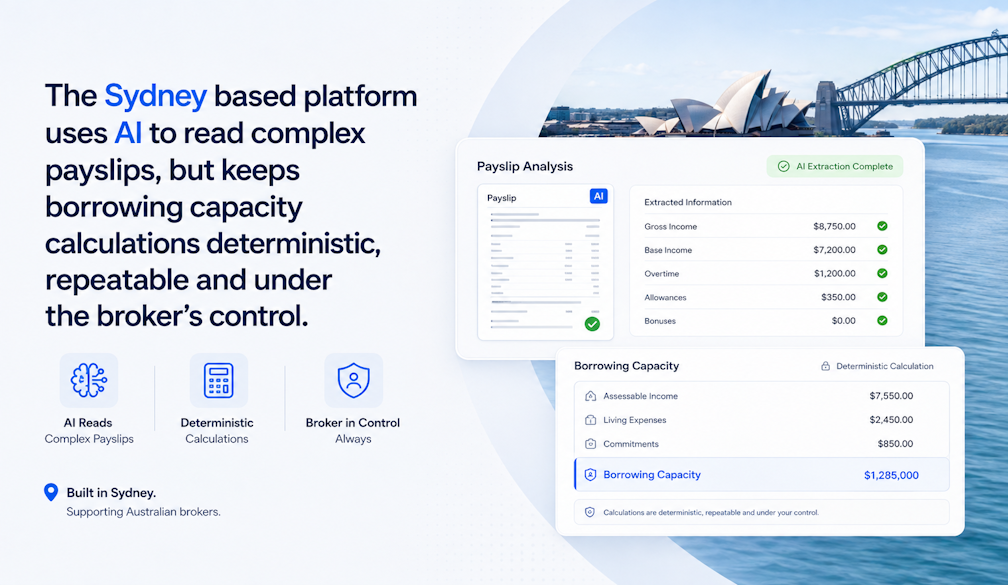
Most mortgage technology starts with the assumption that a client’s income has already been understood.
In practice, that is often where a significant amount of the work begins.
Before a mortgage broker can discuss borrowing capacity with a client, someone has to read the payslip carefully. That can mean working through overtime, penalty rates, casual loading, higher duties, leave loading and allowances, often across more than one job.
The broker may also need to reconcile year to date figures, hours, pay rates and superannuation before deciding what information can be used.
For a complex client, that process can take 20 to 30 minutes.
AutoCalc was built to start one step earlier.
The Sydney based digital broker assistant extracts and structures the information on a payslip in around 15 seconds. The broker then reviews and confirms the figures before they are used in an indicative borrowing capacity comparison across 27 supported lenders.
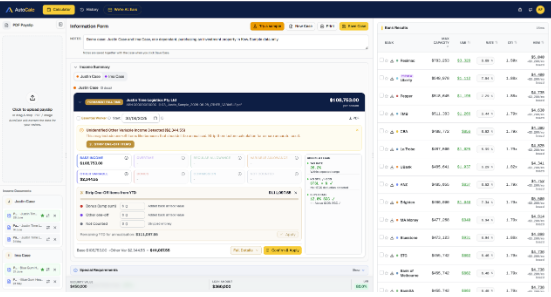
AutoCalc structures payslip income for broker review before preparing an indicative borrowing capacity comparison across 27 supported lenders.
The aim is not to remove the broker from the process. It is to remove repetitive data entry while preserving professional judgement.
AI reads the document
Payslips are well suited to document reading technology because there is no single standard layout.
The same type of income can appear under different labels depending on the employer, industry or payroll system. Overtime may be described as additional hours, extra hours or a workplace specific payment. Allowances can also vary widely in name and treatment.
AutoCalc recognises more than 160 income labels, including overtime, penalty rates, casual loading, higher duties, leave loading and a broad range of allowances.
It extracts the relevant figures and organises them into a consistent structure for the broker to review.
This is the part of the process where AI is useful. It can find and organise information across different document formats much faster than manual transcription.
It is not making a lending decision. It is preparing the information required for one.
Deterministic code handles the calculations
Once the broker has reviewed and confirmed the information, the task changes.
Borrowing capacity should not depend on how an artificial intelligence model interprets a question at a particular moment. A broker needs to know that the same confirmed inputs will produce the same calculation result.
AutoCalc therefore uses AI only to read the payslip.
Every serviceability calculation after that is performed using deterministic code based on the configured rules for each supported lender.
The same inputs produce the same outputs. The calculation can be repeated, reviewed and traced back to the information entered by the broker.
This separation is central to the way the platform has been designed.
“Brokers work in a regulated industry. They need to understand where a number came from and be able to reproduce it,” the AutoCalc team said.
“AI is useful for reading an inconsistent document. It should not be guessing the borrowing capacity. The broker confirms the information, and controlled calculation logic handles the numbers.”
Each lender applies its own approach to income shading, assessment rates, existing commitments, living expenses and other servicing inputs.
AutoCalc applies the configured treatment for each supported lender and presents the indicative results together, allowing the broker to see how the same client may be assessed differently across the panel.
For supported lenders, the platform can also prefill the relevant serviceability calculator for the broker to review and download.
The broker remains responsible
Faster document reading does not remove the need for broker judgement.
The broker still needs to confirm that the extracted information is correct and determine whether further documents or explanations are required.
AutoCalc includes checks that can draw attention to potential inconsistencies, such as year to date income that does not reconcile with the current pay period, apparent differences between income and superannuation, or hours and pay rates that do not add up.
These alerts are prompts for the broker to investigate. They are not conclusions and they do not replace the broker’s assessment.
This is particularly important for variable income.
Whether overtime, allowances or casual income can be included, and how much of that income may be used, depends on the lender’s current policy and the evidence available.
The technology can make the relevant information easier to identify. The broker still decides what needs to be checked and how the client’s circumstances should be presented.
A different first meeting
The most visible benefit is speed, but the broader advantage is what that speed allows the broker to do.
A first meeting can lose momentum when the broker has to tell the client that the income documents need to be reviewed later.
By reducing the time required to extract and structure the payslip, AutoCalc allows the broker to begin reviewing possible lender outcomes while the client is still in the room.
That does not turn an indicative comparison into a lender approval.
It does allow the broker to identify questions earlier, explain why borrowing capacity may vary between lenders and tell the client what information is needed next.
What was previously a “leave it with me” moment can become a more informed conversation during the meeting.
Privacy by design
AutoCalc is hosted in Sydney and does not retain uploaded payslip files after processing.
The platform is designed around a clear division of responsibility.
AI reads and structures the document.
Deterministic code performs the calculations.
The broker reviews the information, confirms the inputs and decides how the results should be used.
That distinction may become increasingly important as more artificial intelligence tools enter mortgage broking.
The question is no longer simply whether AI can make a process faster. It is where AI adds value, where repeatable calculation logic is required and where professional judgement must remain.
AutoCalc’s answer is to automate the repetitive work without automating accountability.
AutoCalc is available at autocalc.com.au.
AutoCalc is developed by BrokerFit Pty Ltd in Sydney. Borrowing capacity comparisons are indicative only and do not represent a lender assessment, decision or approval. Brokers must review all inputs and confirm current lender policies and requirements.