DHL survey finds 94% of Asia Pacific online shoppers abandon shopping cart if delivery options are not flexible
- Ability to re-direct shipment deliveries or manage delivery locations and dates are important to online shoppers
- High smartphone penetration rate has propelled social media to be a source for online shopping
- Greener delivery options are becoming vital considerations for e-commerce consumers
SINGAPORE - Media OutReach - 12 October 2023 - The new online shopper survey "Global Online Shopper Survey 2023" by DHL eCommerce has found that 94% of the e-commerce shoppers in Asia Pacific will abandon their shopping carts if they were not offered their preferred delivery options.
This includes different delivery locations, the ability to redirect the shipment or a change of delivery date. Nearly one in five shoppers in Asia Pacific frequently abandon their shopping carts, highlighting the importance of making flexible delivery options available.
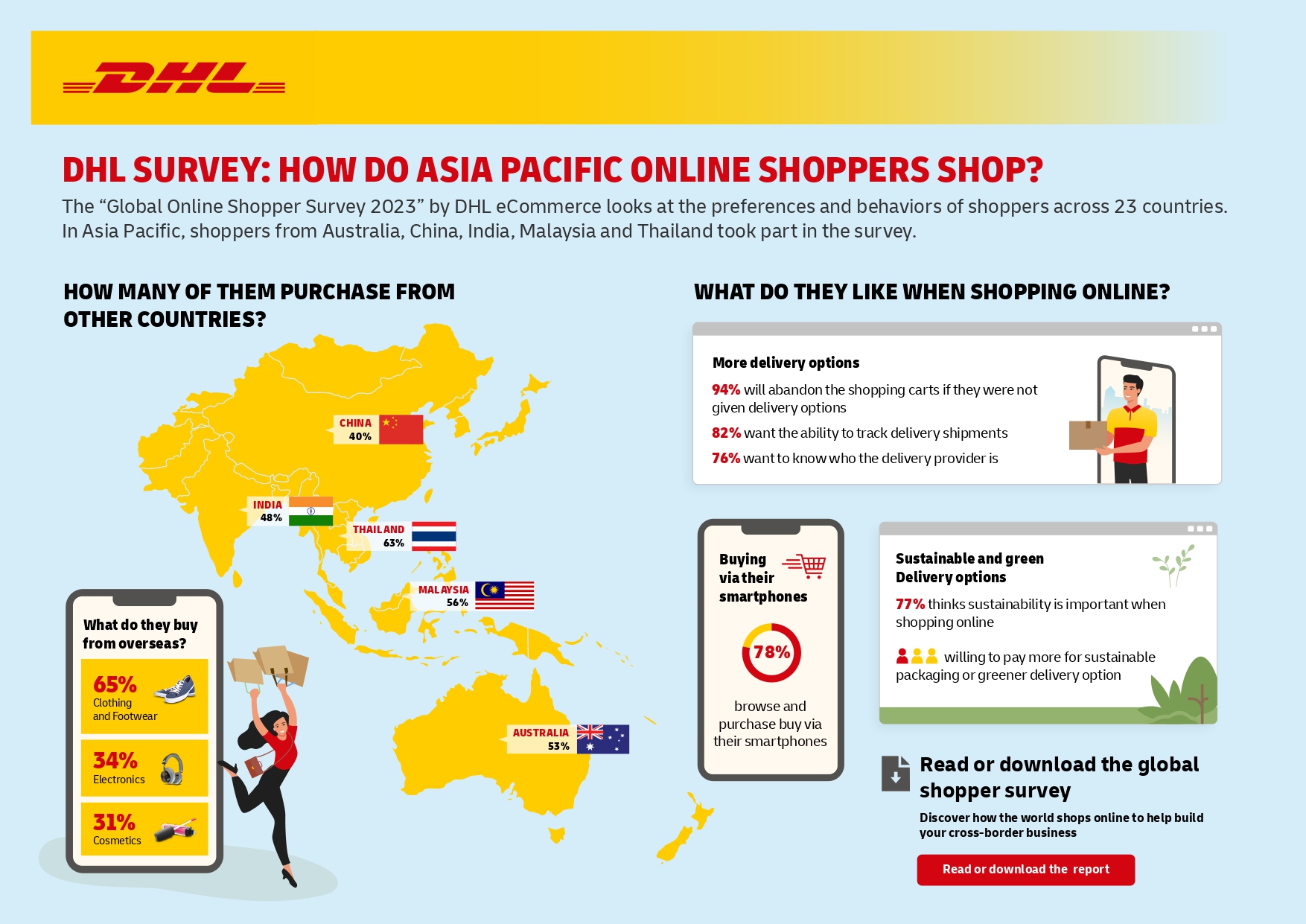
Commissioned by DHL eCommerce, the study examines the shopping behaviors of 11,500 e-commerce customers from 13 countries worldwide, including Australia, China, India, Malaysia and Thailand. The survey participants answered questions on their attitude towards cross-border shopping, delivery and returns and sustainability. It aims to provide insights into the international e-commerce industry, consumer expectations from e-commerce businesses, and delivery providers.
Asia Pacific online shoppers want flexible shipping options
Visibility of the shipment's journey from purchase to delivery is important to online shoppers in Asia Pacific. Almost 82% expressed their desire to have end-to-end tracking of all their shipments, regardless of value or origin. Additionally, while most still prefer home deliveries, about 18% want other delivery options. This is especially evident in China with 45% preferring to have the option of leaving their parcel with a neighbor or other safe place, parcel locker or parcel shop.
About half of the survey respondents in the region also indicated that they are frustrated when delivery times are long (53%) and costs are high (52%) whenever they shop online. These figures are slightly higher than the global average of 45% and 52%. To improve these sentiments, one in two respondents in Asia Pacific indicated that they want faster delivery of their purchases. Additionally, 65% of respondents preferred free delivery, while 41% expected free returns.
"People's online shopping behaviors are changing. As they shop more online domestically and internationally, they are exposed to many more options and want to have a sense of control over their purchases. They now have even higher expectations towards e-commerce companies as well as delivery providers, including how they want the shipments to be delivered and the industry's stance towards sustainability. This survey equips us with insights so that we can pinpoint where the gaps are to offer more current and valuable solutions to customers," said Pablo Ciano, CEO for DHL eCommerce.
Inclination to shop cross-border
As cross-border e-commerce continues to gain traction, consumers are increasingly open to purchasing from international retailers. The survey finds that 52% of Asia Pacific consumers buy from overseas frequently. The Chinese and the Thais shop most frequently internationally, with 20% of Chinese and 23% of Thai shoppers buying at least once daily.
Asia Pacific respondents voted better quality products (44%) as the top reason for buying cross-border, followed by the lack of product or brand in their country (43%). On the other hand, the barriers to cross-border shopping for Asia Pacific online shoppers are long delivery times (55%) and fear of fraud (49%). This means that online retailers and delivery providers need to be able to give shoppers the confidence their purchases will arrive safely and quickly.
Turning to social media to shop
Asia Pacific is seeing a growing interest in social media commerce. Already, an average of 48% of online shoppers in Australia, India, Malaysia and Thailand have purchased from Facebook. Yet, TikTok is more popular in Malaysia and Thailand, where 57% and 52% respectively indicated that they are using the platform. In China, Douyin and WeChat are preferred, with 70% of online shoppers shopping on Douyin and 47% on WeChat.
This trend is driven by various factors including the region's large Gen Z population. By 2025, Gen Z consumers (born 1996–2012) are expected to make up a quarter of the region's population. This segment of consumers actively consumes content on social media platforms, making it the channel to watch for businesses to tap into for cross-border selling. The other factor is the strong smartphone penetration in the region where adoption rate was at 76% in 2022, resulting in 78% of consumers shopping using their smartphones.
Sustainability matters to consumers
There is a growing prominence of sustainable and eco-friendly delivery solutions in consumers' shopping considerations, with 77% of the region's respondents saying so – surpassing the global average of 71%. Moreover, respondents from India (92%) and Thailand (87%) are among the top three countries concerned with sustainability when shopping online, after Nigeria (96%).
More than one in three (38.8%) online shoppers in the region are also more willing to pay more for sustainable packaging compared to the global average of 28%. Similarly, 38% are also prepared to pay more for a greener delivery option. These observations underscore the need for e-commerce retailers to incorporate sustainability into their product offerings or work with sustainable delivery providers.
The DHL Online Shopper Survey 2023 is available for free download at:
2023 Online Shopper Survey
Hashtag: #DHLeCommerce #OnlineShopperSurvey #Ecommerce
https://www.linkedin.com/company/dhlecommerce/
The issuer is solely responsible for the content of this announcement.
DHL – Excellence. Simply delivered.
DHL is the leading global brand in the logistics industry. Our DHL divisions offer an unrivalled portfolio of logistics services ranging from national and international parcel delivery, e-commerce shipping and fulfillment solutions, international express, road, air and ocean transport to industrial supply chain management. With about 395,000 employees in more than 220 countries and territories worldwide, DHL connects people and businesses securely and reliably, enabling global sustainable trade flows. With specialized solutions for growth markets and industries including technology, life sciences and healthcare, engineering, manufacturing & energy, auto-mobility and retail, DHL is decisively positioned as "The logistics company for the world".
DHL is part of DHL Group. The Group generated revenues of more than 94 billion euros in 2022. With sustainable business practices and a commitment to society and the environment, the Group makes a positive contribution to the world. DHL Group aims to achieve net-zero emissions logistics by 2050.