NetApp’s 2023 Cloud Complexity Report Highlights the Shifting Demands of a Multicloud Environment
Key findings indicate that 98% of technology leaders have been impacted by the increasing complexity of the cloud, bringing issues of cybersecurity and cost optimization to the forefront
SINGAPORE - Media OutReach - 30 March 2023 - NetApp® (NASDAQ: NTAP), a global, cloud-led, data-centric software company, today released the 2023 Cloud Complexity Report, a global survey exploring how technology decision makers are navigating cloud requirements coming from digital transformation and AI initiatives and the complexity of multicloud environments.The report found that 98% of senior IT leaders have been impacted by increasing cloud complexity in some capacity, potentially leading to poor IT performance, loss in revenue and barriers to business growth.
"Our global research report highlights paradigm shifts in how technology leaders look at and manage their cloud initiatives," said Ronen Schwartz, Senior Vice President and General Manager, Cloud Storage, NetApp. "As cloud adoption accelerates and businesses innovate faster to compete, technology leaders are facing growing pressure to juggle multiple priorities at once – causing many to rethink how they manage efficiency and security in this new environment."
"Our global survey data demonstrates the extreme complexity of modern IT environments, and the pressure technology executives are under to show measurable outcomes from cloud investments," said Gabie Boko, Chief Marketing Officer, NetApp. "At NetApp, we've simplified the complex through our approach, which enables technology executives to increase the speed of innovation, lower costs and improve consistency, flexibility and agility across on-premises and cloud environments."
Key findings from the report include:
Cloud Complexity Reaches a Tipping Point
Data complexity has reached a boiling point for companies globally, and tech executives are feeling the pressure to contain its impact on the business. However, technical and organizational challenges may stunt their cloud strategies, with 88% citing working across cloud environments as a barrier, while 32% struggle just to align on a clear vision at the leadership level.
Global Context: The following regions list this as their top concern if data complexity is not managed:
- Cybersecurity: France, Spain, and Australia/New Zealand
- Leadership skepticism: France, Spain, Japan
- Inefficient use across the organization: Australia/New Zealand
- Lack of visibility: Japan
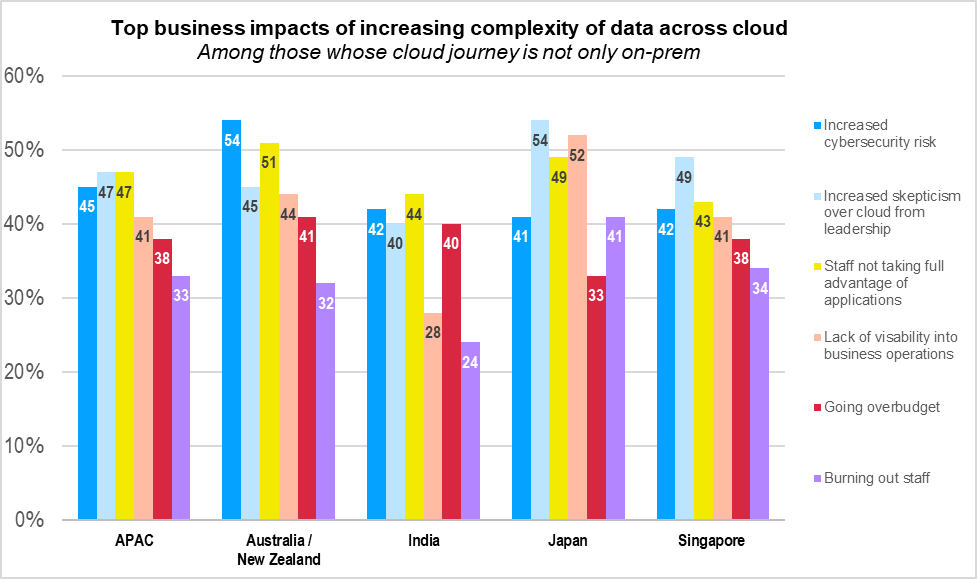
In Asia Pacific (APAC), the top business impacts due to increasing complexity of data across their cloud environments are increased skepticism over cloud from leadership (47%), staff not taking full advantage of business applications (47%), increased cybersecurity risk (45%), and lack of visibility into business operations (41%).
Leadership Want Cloud Results Now
Sustainability has become an unexpected cloud-driver, with nearly eight in ten tech executives citing ESG outcomes as critical to their cloud strategy. However, return on investment (ROI) is a concern among leadership, with 84% of tech executives saying their cloud strategy is already expected to show results across the organization.
Global Context:
- Nearly half of tech executives (49%) report that when cloud strategy discussions happen, cost concerns come up often or all the time.
- Data regulation and compliance is another cloud driver, with various local regulations promoting their multicloud strategy most or some of the time.
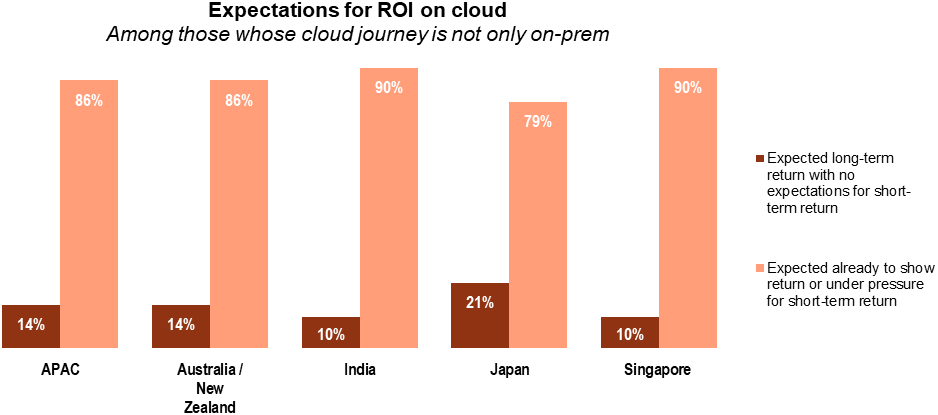
In APAC, 86% of tech executives are already expected to show results across the organization. The pressure to already show ROI on cloud investment is highest in India and Singapore, where 9 out of 10 tech executives feel it.?
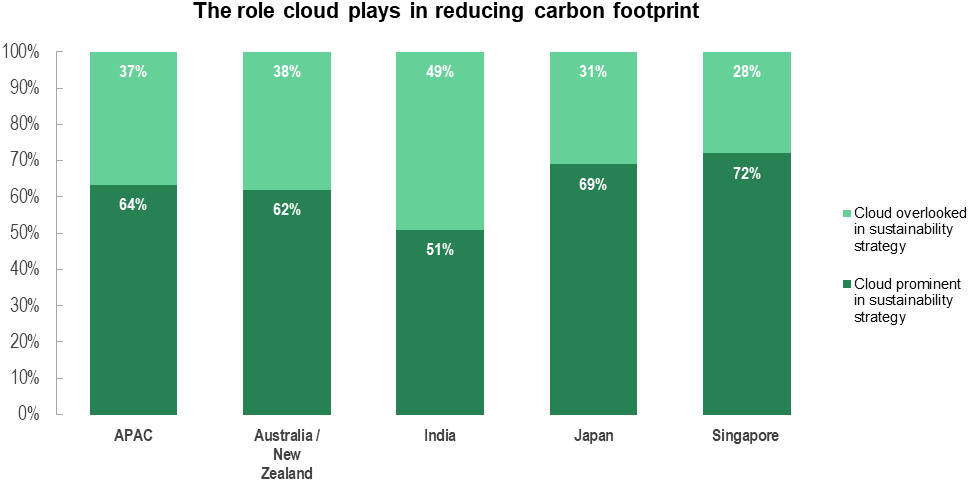
Furthermore, 80% of executives in APAC say cloud systems are developed with sustainability goals specifically in mind. Within the region, Singapore (72%) and Japan (69%) lead in featuring cloud prominently in their sustainability strategy.
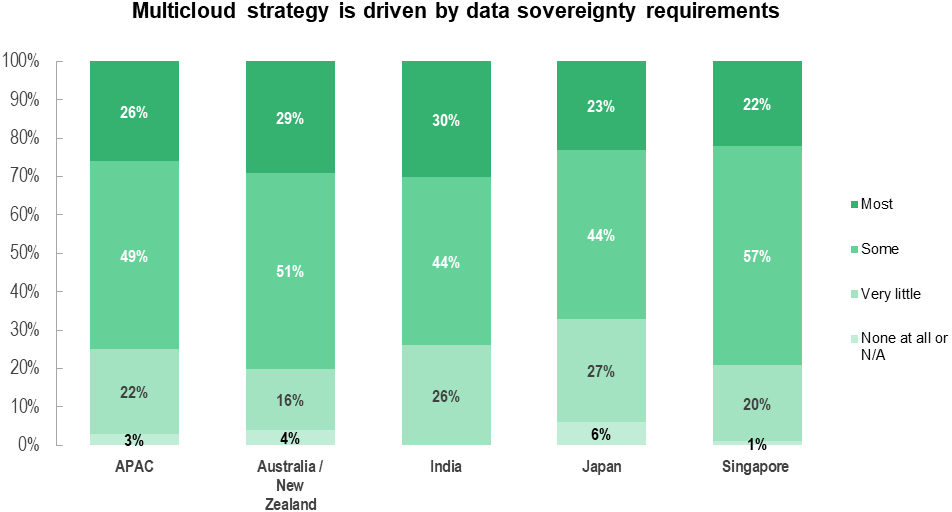
Three out of four tech (75%) APAC executives say their multicloud strategy is driven by data sovereignty requirements.
Tech Executives Consider AI as a Possible Solution
In the next year, over a third (37%) of tech executives report that half or more of their cloud deployments will be supported by AI-driven applications. Nearly half of tech executives at smaller companies – those with fewer than 250 employees – expect to reach the 50% mark in the next year, and 63% by 2030, while larger companies lag.
Global Context:
- The U.S. leads EMEA and APAC on plans to deploy AI-driven cloud applications in the next year, with France and Japan as outliers in their regions.
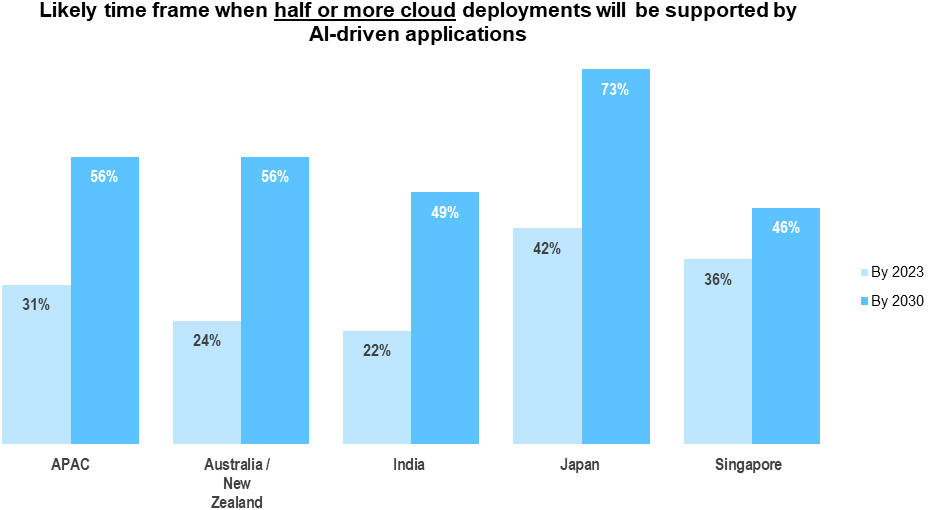
- In APAC, 56% of tech executives report that half or more of their cloud deployments will be supported by AI-driven applications by 2030. This presents a long-term growth opportunity for AI-driven applications in the region.
- Scaling AI is the top priority in EMEA and APAC, but is second in the U.S., behind meeting regulatory compliance.
"NetApp's global research report reveals a disconnect between the executives outside of IT and those within - specifically, leaders working to execute on cloud are the ones most ingrained in the cost and complexity issues while those outside of IT have yet to fully understand. In the process of shifting to the cloud, leaders are experiencing challenges, leaving room for vendors to address these current or yet-to-be discovered issues," said Randy Kerns, Senior Strategist & Analyst at the Evaluator Group. "As customers express concerns with cloud implementation, vendors have the opportunity to build and offer solutions to simplify the process."
"APAC leaders today recognize cloud's importance in producing critical business outcomes such as data sovereignty and sustainability. By addressing the cloud complexity confronting their organizations, they can unlock the best of the cloud and innovate faster to compete," said Matthew Swinbourne, CTO, Cloud Architecture, NetApp Asia Pacific. "With NetApp's unique combination of expertise, capabilities and hyperscaler partnerships, we help customers use the clouds they want, the way they want, while optimizing for cost, risk, efficiency, and sustainability."
As organizations increasingly move to multi-cloud environments, NetApp aims to alleviate efficiency bottlenecks by allowing IT leaders to manage their systems on one, streamlined user interface. By taking an evolved cloud approach, NetApp is leading the charge for next generation cloud management and storage – equipping teams with the tools necessary to stay abreast of the key trends outlined in the research report above (e.g., optimizing costs, assessing risks, and operating sustainably).
To learn more and access the full report and infographic, visit 2023 Cloud Complexity Report.
Methodology
NetApp partnered with Wakefield Research to conduct a quantitative research study during November 2022, among 1,300 tech and data executives at businesses in 9 markets: US, EMEA (France, Germany, Spain, the UK), and APAC (India, Japan, Singapore, and Australia/New Zealand). At the time of completion, all participants held positions that were classified as "director-level and above" and worked across IT, IT infrastructure, cloud infrastructure and data engineering departments.
About NetApp
NetApp is a global, cloud-led, data-centric software company that empowers organizations to lead with data in the age of accelerated digital transformation. The company provides systems, software and cloud services that enable them to run their applications optimally from data center to cloud, whether they are developing in the cloud, moving to the cloud, or creating their own cloudlike experiences on premises. With solutions that perform across diverse environments, NetApp helps organizations build their own data fabric and securely deliver the right data, services, and applications to the right people—anytime, anywhere. Learn more at www.netapp.com or follow us on Twitter, LinkedIn, Facebook, and Instagram.
NETAPP, the NETAPP logo, and the marks listed at www.netapp.com/TM are trademarks of NetApp, Inc. Other company and product names may be trademarks of their respective owners.
Appendix – Asia Pacific (APAC) Figures and Graphs
1. Cloud Complexity Reaches a Tipping Point
In APAC, the top business impacts due to increasing complexity of data across their cloud environments are increased skepticism over cloud from leadership (47%), staff not taking full advantage of business applications (47%), increased cybersecurity risk (45%), and lack of visibility into business operations (41%).
2. Technical and Organizational Barriers Add to the Cloud Complexity Dilemma
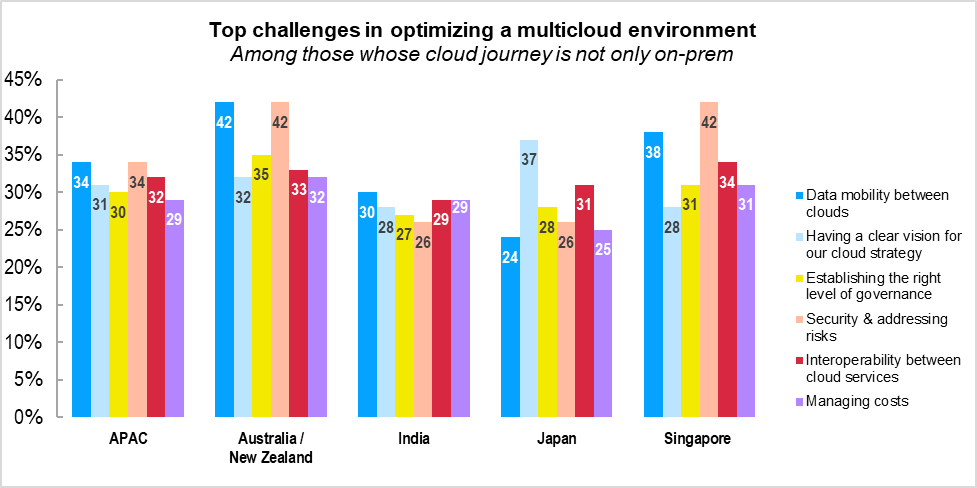
In APAC, tech executives in Australia/NZ cited data mobility (42%) and security and addressing risk (42%) as top challenges. Security and addressing risks also (42%) emerged as the top barrier in Singapore. In Japan, executives cited not having a vision for cloud strategy (37%) as the top barrier.
3. Tension Increases Between Tech Executives and Leadership Around Cloud ROI
In APAC, 86% of tech executives are already expected to show a ROI on what the company has spent on cloud, either in increased revenue or in saved costs or are under pressure to show short-term progress. The pressure to already show ROI on cloud investment is highest in India and Singapore, where 9 out of 10 tech executives feel it.
4. There are Key Drivers that Continue to Make Cloud Essential
In APAC, three out of four tech (75%) executives say their multicloud strategy is driven by data sovereignty requirements.
80% of executives in APAC say cloud systems are developed with sustainability goals specifically in mind. Singapore (72%) and Japan (69%) are leading in featuring cloud prominently in their sustainability strategy.
5. Tech Executives Consider AI as a Possible Solution
In APAC, 56% of tech executives report that half or more of their cloud deployments will be supported by AI-driven applications by 2030. This presents a long-term growth opportunity for AI-driven applications in the region.
Hashtag: #NetApp
https://www.linkedin.com/company/netapp/
https://www.facebook.com/NetApp
https://www.instagram.com/netapp/
The issuer is solely responsible for the content of this announcement.