The Pier That Breathed: An AI Image Generator from Image and the Fog That Drifted Again
There's an old Polaroid stuck to my fridge with a magnet shaped like a lobster. It's been there for maybe eight years, slowly curling at the edges and fading in that specific way instant film fades—the greens going yellow, the shadows going milky. The photo is of a pier in a small coastal town my ex-girlfriend dragged me to one weekend. I remember taking it and being disappointed immediately. The sky had blown out to white, the water looked flat and gray, and the pier itself was just a dark smudge receding into fog. I kept it because it was the only photo I took that day, and because despite how bad it was, it reminded me of the sound of the waves and the way the old wooden planks creaked under our feet. It was a terrible photograph of a good memory.
A few months ago I peeled it off the fridge and scanned it into my computer. I'd been reading about AI image generators—specifically the kind that work from an existing image rather than just a text prompt—and I was curious what one would do with something this objectively awful. Not a carefully composed digital photograph with good exposure and sharp focus, but a faded Polaroid with almost no recoverable detail. The kind of image you'd normally throw away.
The specific tool I used was what's now being called an AI image generator from image. The distinction matters more than you'd think. A regular text-to-image generator starts with noise and builds a picture from scratch based on your words. That's impressive, but it's also detached from anything personal. An AI image generator from image, on the other hand, takes your photograph as its foundation. It treats your composition as a structural constraint, your color palette as a suggestion, your subject matter as something to respect rather than replace. You're not asking the machine to imagine something new; you're asking it to see what you saw, just better.
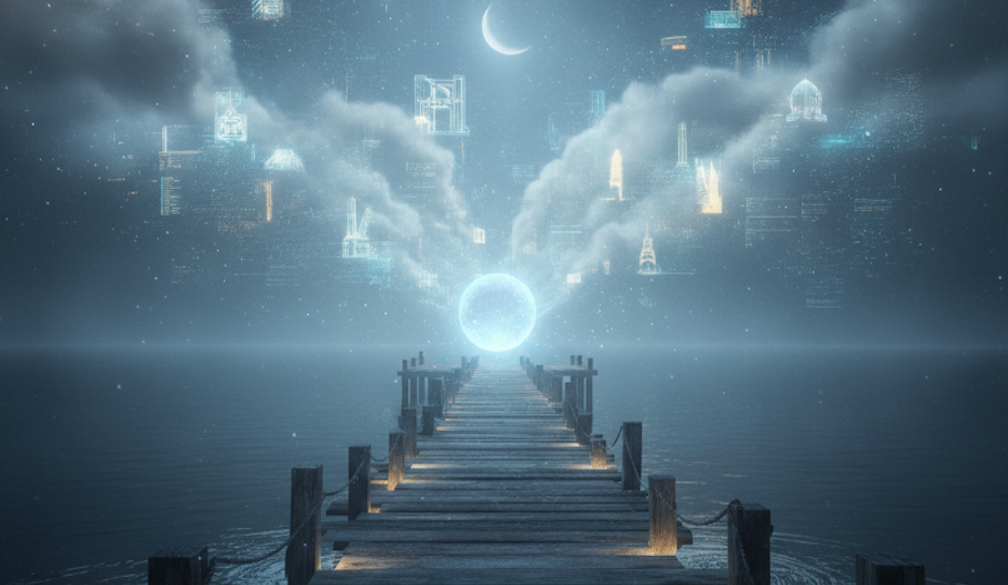
I uploaded the pier photo and typed "overcast coastal morning, wooden pier extending into mist, gentle waves, muted blues and grays, cinematic still from a quiet indie film." I didn't ask for anything dramatic because the memory wasn't dramatic. It was quiet. Cold wind, damp wood, the smell of salt. The AI image generator from image took maybe thirty seconds, and when the result appeared I actually leaned closer to my screen. The blown-out sky had resolved into a soft, layered overcast with subtle variations of gray I hadn't seen in the original at all. The water, which had been a flat sheet of nothing, now had texture—small ripples catching diffused light. The pier still disappeared into fog, but now you could see individual planks, weathered and uneven, just like I remembered them. The composition was identical. Every element was exactly where I'd framed it through the Polaroid viewfinder eight years ago. But the photograph had stopped fighting against its own limitations and started cooperating with my memory.
What struck me most wasn't the technical quality. It was that the AI had seemingly understood something about the mood. The original Polaroid was just bad exposure and expired film chemistry. The generated version was melancholic in a deliberate way—the kind of image that makes you want to pull your jacket tighter. The machine hadn't just improved the pixels; it had inferred an emotional register from the composition and the prompt and filled in the gaps accordingly. I stared at that pier for maybe five full minutes, and I could hear the waves again.
That experience should have been enough. It already felt like a small miracle. But of course I couldn't leave it alone. Because once you've seen a static photograph become a better version of itself, the next question is unavoidable: what if it moved? That's the question that led me to an AI Image to Video Generator, a category of tool that had been popping up in my feeds with increasing frequency. The premise was straightforward enough—upload a single image, optionally add a motion prompt, and the system would generate a short video clip by predicting how the scene might naturally move.
I took my AI-enhanced pier photograph and uploaded it to one of these AI Image to Video Generator platforms. For the motion prompt I wrote "water rippling gently, fog slowly drifting, wooden pier creaking subtly, distant seabirds gliding." I wasn't trying to create an action sequence. I just wanted the stillness to loosen a little. I wanted the photograph to exhale.
The video that came back was maybe five seconds long. The fog moved. Not in a cheesy, obvious way, but in a slow, almost imperceptible drift from right to left that felt exactly like coastal mist behaves. The water rippled with a frequency that matched the size of the waves in the still image—small and close together, not big rolling swells. The pier didn't visibly move, but there was a subtle shift in the shadows on the planks that suggested the light source was changing, as if a cloud had passed overhead. It was so understated that I had to watch it three times to catch everything that was happening. That restraint was the most impressive part. A less sophisticated tool would have added dramatic waves and swooping camera moves. This one understood that the scene was fundamentally quiet, and it animated accordingly.
I later learned that the technical term floating around for this capability is "ai animate image." It's a phrase that sounds a bit awkward when you first hear it—like someone forgot a preposition—but it's grown on me because it's genuinely descriptive. It's not about creating animation in the traditional sense. It's about recognizing that every still photograph contains latent motion information. A wave frozen mid-curl implies a direction of movement. A fog bank implies slow advection. A wooden structure implies subtle expansion and contraction, the kind of micro-movement our eyes don't consciously register but would notice if it were absent. The ai animate image approach tries to read those implications and generate the missing frames that connect the frozen moment to the next fraction of a second.
The creepiest and most wonderful part is when it reads implications you didn't know were there. In one version of the pier video, I noticed that the water near the base of the wooden posts was slightly darker and more disturbed than the water further out. The AI Image to Video Generator had apparently understood that water behaves differently around obstacles—that it swirls and eddies where it meets resistance. I hadn't written that in the prompt. The model just knew it from its training data, from having seen thousands of hours of water interacting with piers and docks and bridge supports. It was a tiny detail, maybe four pixels wide, but it sold the entire illusion. That's the thing about ai animate image that keeps me up at night, in a good way: the machine sometimes understands physics better than I do.
Not everything worked, obviously. I tried the same pipeline with a photo of my friend's dog mid-yawn—an image-to-image pass to clean up the exposure, then the video generator to complete the motion. The result was horrifying in a way I can only describe as "Lovecraftian dog." The jaw unhinged too far, the tongue moved independently like a separate creature, and the eyes rolled back in a way that suggested demonic possession rather than a sleepy golden retriever. I deleted it immediately and then spent twenty minutes trying to get it back because it was the funniest thing I'd ever seen. The failure was instructive, though. The ai animate image process is guessing, and when there's not enough clear visual information—like the inside of a dog's mouth, which is mostly dark with confusing shapes—the guess can go spectacularly wrong.
The whole experience has rearranged my relationship with the photos I've taken and the ones I haven't taken yet. I used to think of a photograph as a closed loop—the moment was captured, the shutter closed, and that was the end of the story. Now every photo feels like an open question. That Polaroid on my fridge isn't just a bad picture of a pier anymore. It's the first frame of something. I find myself taking photos differently now, holding my phone a beat longer, thinking about what motion is already present in the scene that a future AI Image to Video Generator might one day extend. The waves, the fog, the wind in the dune grass. The creak of the planks that a photograph can't record but an ai animate image algorithm might one day infer from the grain pattern in the wood.
I haven't thrown away the original Polaroid. It's still on the fridge, still held by the lobster magnet, still objectively terrible. But next to it in my photos folder is the AI-enhanced still image and the five-second video of fog drifting across a gray sea. They're not replacements for the memory. They're more like translations. The original photo spoke a broken, garbled version of that day. The AI image generator from image helped it speak clearly. And the video generator let it keep talking, just for a few seconds longer. That's more than I ever expected from a bad Polaroid and a Friday afternoon curiosity.