Australia’s Health Pulse: Nearly Half of Aussies Are Turning to AI for Medical Advice
Nearly half of Australian adults (44%) have asked artificial intelligence for medical advice, as millions seek greater clarity and control of a healthcare system they say is reactive and hard to navigate.
Australia’s Health Pulse: The AI Edition was conducted by TMRW in partnership with YouGov and reveals that Australians are increasingly turning to AI tools to sense-check symptoms, clarify next steps, and prepare for appointments, highlighting a growing demand for more proactive and preventative healthcare.
Parents are leading the shift, with 64% having asked AI for medical advice and more than half (55%) using it to seek a second opinion on their doctor’s guidance.
The findings point to a behavioural shift already underway. Doctor Google has been replaced by a ‘shadow doctor’, and while trust in doctors remains high (80% trust the system to provide accurate advice), 39% of Australians say they leave medical appointments confused about what to do next - impacting an estimated 8.5 million people.
At the same time, two-thirds of Australians (66%) say they face barriers to taking preventative control of their health. Cost (38%) and time (23%) are the most visible obstacles, but fragmented health records (17%) and fear of being dismissed by a healthcare professional (18%) reveal deeper systemic challenges.
Dr Chris Chappel, Chief Medical Officer at TMRW, said the findings show Australians are not looking to replace clinicians. They’re looking for better tools within the healthcare system to take control of their own preventative healthcare, with AI already beginning to fill the gap.
“This isn’t a story about Australians losing trust in doctors, it’s a story about people wanting more clarity, more continuity and more control over their health, particularly when it comes to prevention. We’re living through one of the most transformative periods in healthcare history. Technology is advancing rapidly, but the system remains largely reactive. Patients are filling that gap themselves.
“The real opportunity isn’t AI operating outside the healthcare system. It’s embedding clinically-guided technology within care by enhancing doctors, improving communication, and giving patients greater confidence between appointments.”
Importantly, Australians are clear about the guardrails they expect. While 44% are already consulting AI for health advice without clinical oversight, nearly one in three (32%) say they would not trust technology companies alone with their health data.
At the same time, 8.6 million Australians (40%) say they would trust AI enhancing clinicians, not replacing these professionals. And 49% are positive about AI supporting healthcare professionals. These findings suggest the demand extends beyond the emergence of this ‘shadow doctor’, and is broadly desired for smarter, safer and more integrated preventative healthcare.
Check out the full findings at a dedicated microsite HERE.
Key Findings from Australia’s Health Pulse
Australians want to take preventative control of their health — but face barriers
-
66% face barriers to taking preventative control
-
Cost (38%) and time (23%) dominate
-
17% cite scattered health records
-
18% fear dismissal by a healthcare professional
-
43% of women report cost barriers (vs 32% of men)
-
13% cannot access comprehensive biological testing
AI is already embedded in Australians’ health journeys
-
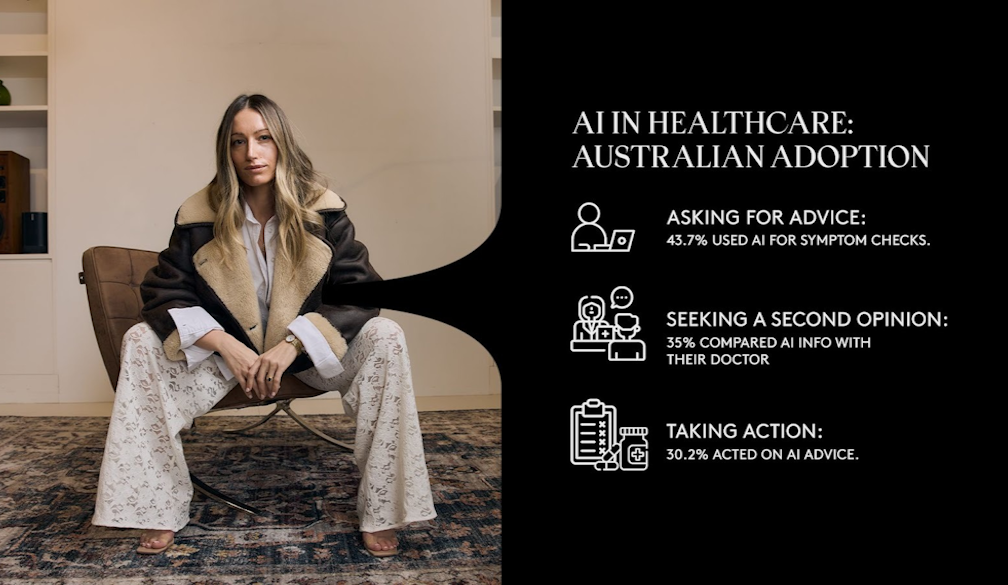
44% are proactively consulting AI for health advice without clinical oversight
-
30% have acted on medical information from AI
-
35% use AI to second-guess their GP
-
27% have shared blood tests, scans or results with AI tools
Confusion after appointments remains widespread
-
39% leave medical appointments unsure of next steps
-
Women (43%) and Gen X (born 1965-1980) (49%) are most affected
-
Approximately 8.5 million Australians experience post-appointment confusion
Australians want AI embedded safely within healthcare
-
8.6 million (40%) would trust AI enhancing clinicians — not replacing
-
49% are positive about AI supporting healthcare professionals
-
68% of parents would use AI-powered health analysis if clinically governed
-
34% say AI combined with clinical expertise would help them feel more in control
-
32% would not trust tech companies alone with their health data
All figures, unless otherwise stated, are from YouGov Plc. Total sample size was 1043 adults. Fieldwork was undertaken between 9-11 February 2026. The survey was carried out online. The figures have been weighted and are representative of all Australian adults (aged 18+).