
Before 9/11, Australia had no counter-terrorism laws, now we have 92 — but are we safer?
- Written by: Rebecca Ananian-Welsh, Senior Lecturer, TC Beirne School of Law, The University of Queensland
Australia is a long way from New York and Washington DC, but the September 11 terror attacks had a profound impact on our country.
In Afghanistan and Iraq, we became embroiled in decades-long insurgencies. At home, the attacks had enduring impacts on our legal system. Before 9/11 Australia had zero national counter-terrorism laws. Now, we have 92 of them[1], amounting to more than 5,000 pages of rules, powers and offences.
These laws have reshaped ideas about criminal responsibility, set us apart from our closest allies, and strengthened a troubling culture of secrecy.
But have they made us safer?
Unprecedented powers
No other nation can match the volume of Australia’s counter-terrorism laws. Their sheer scope is staggering. They include:
control orders[2], which allow courts to impose a wide range of restrictions and obligations on people to prevent future wrongdoing. They can mandate curfews, limits on phone or internet usage and electronic monitoring
preventative detention orders[3], which allow police to detain people secretly for up to two weeks, either to prevent an attack or protect evidence relating to a recent one
mandatory retention of all Australians’ metadata for two years and access by enforcement agencies without a warrant[4]
a power for the home affairs minister to strip[5] dual citizens involved in terrorism of their Australian citizenship.
Many of these schemes are unprecedented in Australian law, outstripping even our historical wartime powers[6].
‘Hyper-legislation’
Toronto University law professor Kent Roach, one of the world’s leading experts on counter-terrorism laws, has labelled Australia’s approach “hyper-legislation[7]”. This refers not only to the vast scope and number of laws, but also the speed with which they were passed.
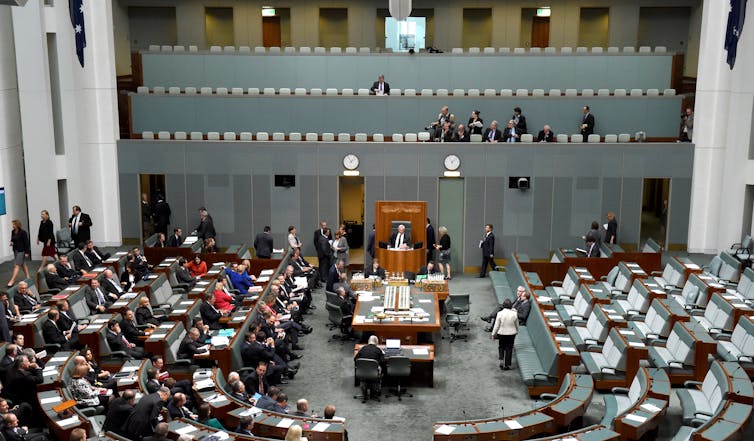 The data retention bill, forcing telecommunications providers to keep records of phone and internet use for two years, passed parliament in 2015.
Mick Tsikas/AAP
The data retention bill, forcing telecommunications providers to keep records of phone and internet use for two years, passed parliament in 2015.
Mick Tsikas/AAP
On average, it took around two and half days in the House of Representatives and two days in the Senate for each law to be approved[8]. Those are very generous figures — they count the days bills were introduced into parliament, even if they weren’t debated. The speed was fastest under the Howard government, when a new counter-terrorism law was passed on average every 6.7 weeks[9]. But the trend has continued.
At the end of last month, two laws[10] containing extensive and highly controversial surveillance powers sailed through federal parliament[11] with minimal scrutiny.
A ‘pre-crime’ approach
Counter-terrorism laws in Australia and elsewhere have reoriented the criminal justice system. Under wide-ranging offences, people can be imprisoned for harms they may cause in the future, rather than harms they have caused in the past.
This has been called a “pre-crime[12]” approach to criminal justice. As Justice Anthony Whealy said[13] when sentencing five terrorist offenders in 2010:
The legislation is designed to bite early, long before the preparatory acts mature into circumstances of deadly or dangerous consequence for the community.
The offence of preparing or planning[14] a terrorist act is the clearest example. An equivalent of this offence will now be introduced in New Zealand[15] following the recent terror attack in Auckland.
This offence and many others trigger criminal responsibility much earlier than the ordinary criminal law (for example, it has never been a crime to prepare a murder or robbery).
A person convicted of a terrorism offence can even be kept in prison[16] beyond their original sentence, possibly indefinitely, based on the risk they still pose[17] to the community.
Even tougher than our allies
Australia looked closely to the United Kingdom when designing our first counter-terrorism laws. On top of our close legal and political ties, this was because the UK had already enacted counter-terrorism laws[18]—based on previous emergency powers for Northern Ireland — before 9/11.
Read more: Australia doesn't need more anti-terror laws that aren't necessary – or even used[19]
In the years since, our laws have become more extreme, setting us apart from the UK and the rest of our “Five Eyes[20]” partners, the United States, Canada, and New Zealand. Not only have “tough on terror” policies played well with voters[21] here, Australia does not have a bill of rights. This means the government has been able to enact counter-terrorism laws that would not be possible elsewhere.
One example of this is the mandatory retention of all Australians’ telecommunications metadata for two years[22]. The European Court of Human Rights held[23] that blanket retention for that time period infringed the basic right to privacy.
Other powers, such as preventative detention orders, would simply not be possible in countries with constitutional protection for human rights. The Council of Australian Governments’ (COAG) 2013 review of counter-terrorism legislation[24] reported preventative detention orders were more likely to be seen in “discredited totalitarian regimes”.
‘The world’s most secretive democracy’
Following the 2019 federal police raid[25] on ABC headquarters, The New York Times suggested[26]: “Australia may well be the world’s most secretive democracy”.
Australia’s counter-terrorism laws enable and entrench these high levels of secrecy. It is a crime to mention basic details about the use of many counter-terrorism powers — or even the mere fact they were used[27].
 Human rights advocates have raised concerns about law enforcement’s surveillance powers in Australia, including the ability to takeover accounts.
www.shutterstock.com
Human rights advocates have raised concerns about law enforcement’s surveillance powers in Australia, including the ability to takeover accounts.
www.shutterstock.com
Sweeping espionage laws, overhauled in 2018[28], make it a crime to possess or receive national security information where the information would be made available to a foreign government or company (including through publication in the media). The definition of “national security” is exceptionally broad, extending to anything about Australia’s political and economic relations with other countries.
These offences pose a serious risk to journalists[29] and whistleblowers who act in the public interest. Criminal trials for these offences can be also held in secret[30], undermining open justice and the right to a fair trial.
Are we any safer?
Undoubtedly, some counter-terrorism laws have enhanced Australia’s national security. But others have little, or no, proven effectiveness, despite their impact on fundamental rights.
For example, in 2012, former Independent National Security Legislation Monitor, Bret Walker SC, found[31] control orders were
not effective, not appropriate and not necessary.
This finding was based on classified submissions by police and security agencies. Despite this, in response to Islamic State, the federal government expanded the grounds[32] for issuing control orders, and allowed them to be imposed on children as young as 14[33].
Both the independent monitor and the 2013 COAG review[34] recommended the repeal of preventative detention orders. Police had not used them and said normal arrest powers would be more useful[35].
Undermining cohesion
These controversial powers might even harm our security over the long-term.
Australia’s Muslim communities have felt targeted by “aggressive” counter-terrorism powers[36]. This leads to lower levels of trust[37] and makes communities less likely to cooperate with police. It also undermines the community cohesion that countering violent extremism programs[38] are trying to build.
Read more: Remaining and expanding: what the Taliban's return will mean for jihadi terrorism[39]
Undermining human rights to prevent terrorism can also fuel the grievances[40] that lead to radicalisation and recruitment. Back in 2004, a United Nations panel reported[41] terrorist recruitment thrives when human rights and democracy are lacking.
Ultimately, to reduce terrorism over the long-term, governments need to support greater investments and research into countering violent extremism[42] and deradicalisation[43] programs. This is equally true for Islamist and right-wing terrorism[44].
Security, but at what cost?
Over the past two decades, evolving terror threats have exposed gaps in our laws that needed to be filled. But many of the laws we ended up with go beyond what is needed[45] to prevent terrorism effectively. They also undermine core values and principles such as the rights to liberty, freedom of speech and freedom of the press.
These values must not be lost in the pursuit of national security. Indeed, upholding them is an essential part[46] of any counter-terrorism strategy.
These lessons have been known for a long time. As then UN secretary-general Kofi Annan[47] said in 2005, when remembering victims of terrorism since 9/11:
compromising human rights cannot serve the struggle against terrorism. On the contrary, it facilitates achievement of the terrorist’s objective.
References
- ^ 92 of them (cdn.getup.org.au)
- ^ control orders (www.ag.gov.au)
- ^ preventative detention orders (www.ag.gov.au)
- ^ without a warrant (classic.austlii.edu.au)
- ^ strip (www8.austlii.edu.au)
- ^ wartime powers (cdn.getup.org.au)
- ^ hyper-legislation (www.cambridge.org)
- ^ each law to be approved (cdn.getup.org.au)
- ^ every 6.7 weeks (classic.austlii.edu.au)
- ^ two laws (www.theguardian.com)
- ^ sailed through federal parliament (www.smh.com.au)
- ^ pre-crime (classic.austlii.edu.au)
- ^ said (www.austlii.edu.au)
- ^ preparing or planning (www5.austlii.edu.au)
- ^ offence will now be introduced in New Zealand (www.abc.net.au)
- ^ kept in prison (legislation.nsw.gov.au)
- ^ risk they still pose (www.abc.net.au)
- ^ counter-terrorism laws (www.legislation.gov.uk)
- ^ Australia doesn't need more anti-terror laws that aren't necessary – or even used (theconversation.com)
- ^ Five Eyes (www.lawfareblog.com)
- ^ played well with voters (journals.sagepub.com)
- ^ two years (classic.austlii.edu.au)
- ^ held (eur-lex.europa.eu)
- ^ review of counter-terrorism legislation (www.ag.gov.au)
- ^ raid (www.abc.net.au)
- ^ The New York Times suggested (www.nytimes.com)
- ^ mere fact they were used (www8.austlii.edu.au)
- ^ overhauled in 2018 (www.aph.gov.au)
- ^ serious risk to journalists (law.uq.edu.au)
- ^ held in secret (theconversation.com)
- ^ found (www.inslm.gov.au)
- ^ expanded the grounds (www.aph.gov.au)
- ^ as young as 14 (www.hrw.org)
- ^ COAG review (www.ag.gov.au)
- ^ more useful (www.ag.gov.au)
- ^ “aggressive” counter-terrorism powers (journals.sagepub.com)
- ^ lower levels of trust (journals.sagepub.com)
- ^ countering violent extremism programs (www.livingsafetogether.gov.au)
- ^ Remaining and expanding: what the Taliban's return will mean for jihadi terrorism (theconversation.com)
- ^ fuel the grievances (www.abc.net.au)
- ^ reported (www.un.org)
- ^ countering violent extremism (icct.nl)
- ^ deradicalisation (www.tandfonline.com)
- ^ right-wing terrorism (www.canberratimes.com.au)
- ^ go beyond what is needed (theconversation.com)
- ^ essential part (www.ohchr.org)
- ^ Kofi Annan (www.un.org)