



We studied 50 years of royal commissions — here's how they make a difference
- Written by: Michael Mintrom, Professor, Monash University
On Monday, Scott Morrison announced[1] a royal commission into veteran suicides — the fourth royal commission set up under his prime ministership.
But while Morrison says he hopes this will be a “healing process[2]” and it comes after sustained community lobbying, we know royal commissions don’t always fix problems.
Only last week, we marked 30 years[3] since the 1991 Royal Commission into Aboriginal Deaths in Custody. Far from a celebration, much of the commentary about the anniversary has emphasised the lack of progress[4] since the commission’s final report.
We have a long tradition of royal commissions in Australia — dating back before federation. And their powers and capabilities for scrutinising evidence mean they can have an impact for decades to come. But royal commissions can also fail to generate policy change.
In a recent study[5], we reviewed royal commissions from January 1970 to December 2019 to identify the factors that can increase policy influence.
We found royal commissions that had major influence used three key strategies: a clear and useful definition of the problem, working together with advocates, and making recommendations that can work in the real world.
Framing the problem
Policy problems — such as the quality of aged care or responses to disasters — are often extremely complex, with many different attributes. So framing exactly what the problem is and how the royal commission looks at it is important.
Another component here is the royal commission also needs to develop a compelling narrative around how to address the problem.
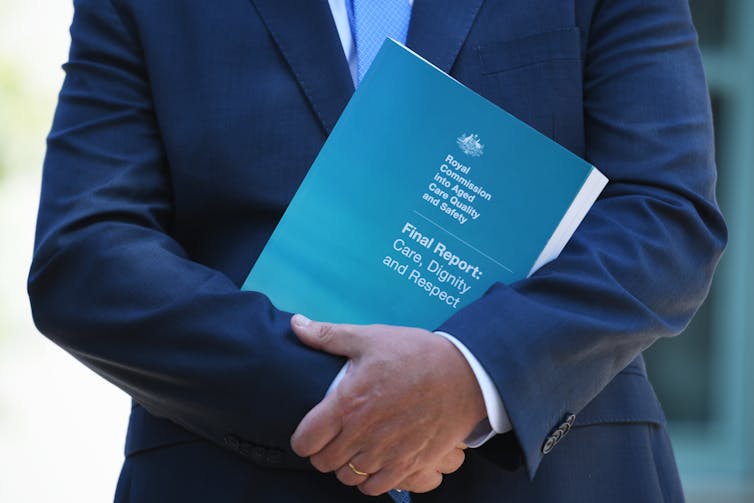 Royal commissions need to tell a story, both in terms of the problem it is addressing and how to fix it.
Dean Lewins/AAP
Royal commissions need to tell a story, both in terms of the problem it is addressing and how to fix it.
Dean Lewins/AAP
For example, the Aboriginal Land Rights Commission was established by the Whitlam government in 1973. In the final report[6], commissioner Edward Woodward framed his land rights recommendations as the natural progression of an earlier commitment that needed to be honoured by Australia — rather than a radical break from existing policy. The historic Aboriginal Land Rights (NT) Bill 1976[7] followed on from these recommendations.
Here, Woodward successfully defined a potentially political problem as a practical issue with a natural fix.
Building a support base
Although members of royal commissions cannot be expected to establish or lead social movements, they do have opportunities to engage with stakeholders, advocates and policymakers. If they do this well, they will have a ready-made coalition of experts and interested parties to support the implementation of the report recommendations.
This also makes it much harder for governments to ignore important recommendations.
Read more: Next month’s federal budget is the time to stop talking about aged care and start fixing it[8]
An example is provided by the 2009 Victorian Bushfires Royal Commission[9]. Here, the royal commission kept the affected communities and broader public engaged and involved, holding 26 community consultations and 55 days of hearings that were live-streamed and open to the public and media. It then developed its recommendations reflecting the theme of ongoing shared responsibility. Among the commissioners, there was similar importance[10] placed on cohesion.
As a result, the government of Victoria accepted all but one of the recommendations and committed more than A$900 million[11] to implement them.
Looking ahead to implementation
Policy change needs recommendations that are feasible and politically acceptable.
The final report of the child abuse royal commission[12] made 409 recommendations in 2017. These recommendations were directed at Commonwealth and state governments, but also at institutions such as churches, schools, local governments, and the criminal justice system.
Since then, the commission has been regarded as having a strong and ongoing impact — for example, the National Redress Scheme is securing compensation[13] for victim-survivors. The federal government also reports annually[14] on progress.
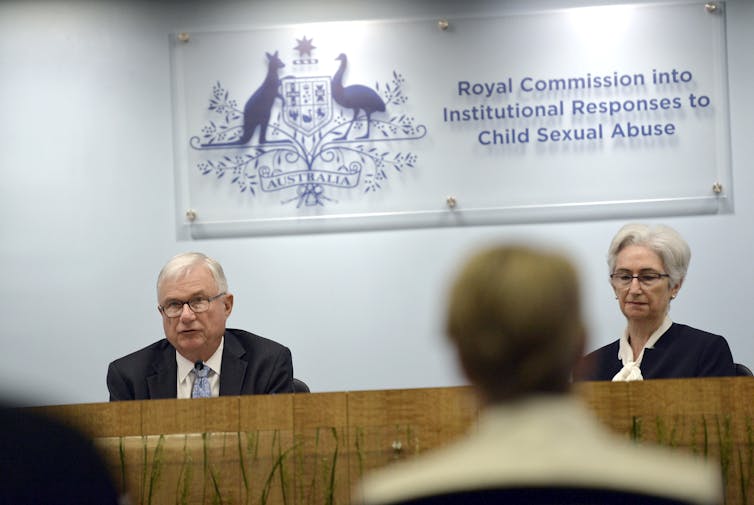 Australia has seen more than 130 royal commissions since 1970.
Royal commission/ AAP
Australia has seen more than 130 royal commissions since 1970.
Royal commission/ AAP
This can be attributed to the commissioners’ careful planning and their efforts to strike a balance between what needed to be done and what was politically feasible. For example, they held a series of review hearings that followed up with institutions to assess what, if any, measures had been taken since the initial hearings. This allowed them to avoid duplicating recommendations and provided a chance to reflect on previous suggestions.
In an example of what to avoid, the aged care royal commission[15] made 148 wide-ranging recommendations for the fundamental reform of the aged care system. However, the commissioners disagreed on a number of recommendations and this undermines their influence. It also gives governments far more leeway to adopt policies that suit them, and ignore those that don’t.
No guarantees
As the federal government moves to set up a new royal commission, our research shows royal commissions can have significant policy influence. But this is not guaranteed.
Royal commissions have long served as vital contributors to policy-making and continue to serve a significant role. So it is extremely important those who lead them and those who observe them appreciate the strategies they can use to raise the odds they will leave enduring legacies of public value.
Read more: One veteran on average dies by suicide every 2 weeks. This is what a royal commission needs to look at[16]
References
- ^ announced (www.9news.com.au)
- ^ healing process (www.abc.net.au)
- ^ 30 years (www.abc.net.au)
- ^ lack of progress (theconversation.com)
- ^ recent study (onlinelibrary.wiley.com)
- ^ final report (apo.org.au)
- ^ Aboriginal Land Rights (NT) Bill 1976 (www.nma.gov.au)
- ^ Next month’s federal budget is the time to stop talking about aged care and start fixing it (theconversation.com)
- ^ Victorian Bushfires Royal Commission (royalcommission.vic.gov.au)
- ^ similar importance (onlinelibrary.wiley.com)
- ^ A$900 million (www.cfa.vic.gov.au)
- ^ child abuse royal commission (www.childabuseroyalcommission.gov.au)
- ^ securing compensation (www.nationalredress.gov.au)
- ^ reports annually (www.childabuseroyalcommissionresponse.gov.au)
- ^ aged care royal commission (agedcare.royalcommission.gov.au)
- ^ One veteran on average dies by suicide every 2 weeks. This is what a royal commission needs to look at (theconversation.com)










