
Are the US and Iran headed for a military showdown before Trump leaves office?
- Written by: Clive Williams, Campus visitor, ANU Centre for Military and Security Law, Australian National University
Tensions are running high in the Middle East in the waning days of the Trump administration.
Over the weekend, Iran’s foreign minister, Mohammad Javad Zarif, claimed Israeli agents were planning to attack US forces in Iraq[1] to provide US President Donald Trump with a pretext for striking Iran.
Just ahead of the one-year anniversary of the US assassination of Iran’s charismatic General Qassem Soleimani[2], the head of Iran’s Revolutionary Guards also warned his country would respond forcefully to any provocations[3].
Today, we have no problem, concern or apprehension toward encountering any powers. We will give our final words to our enemies on the battlefield.
Israeli military leaders are likewise preparing for potential Iranian retaliation[4] over the November assassination of senior Iranian nuclear scientist Mohsen Fakhrizadeh — an act Tehran blames on the Jewish state.
Both the US and Israel have reportedly deployed submarines[5] to the Persian Gulf in recent days, while the US has flown nuclear-capable B-52 bombers[6] to the region in a show of force.
And in another worrying sign, the acting US defence secretary, Christopher Miller, announced over the weekend the US would not withdraw the aircraft carrier USS Nimitz[7] and its strike group from the Middle East — a swift reversal from the Pentagon’s earlier decision to send the ship home.
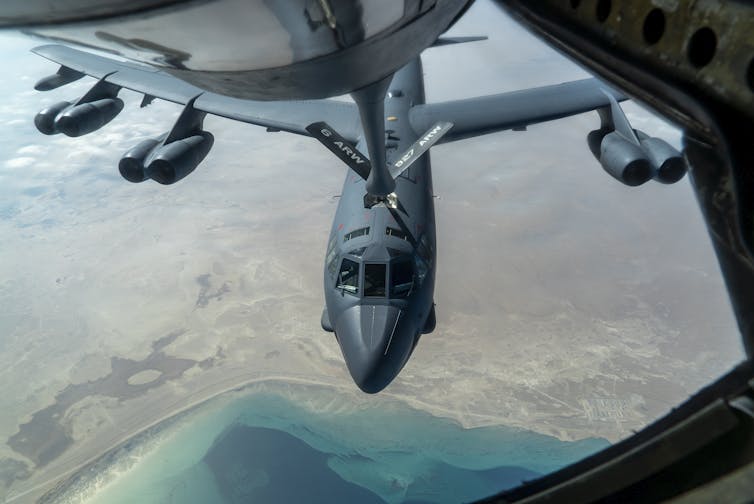 The United States flew strategic bombers over the Persian Gulf twice in December in a show of force.
U.S. Air Force/AP
The United States flew strategic bombers over the Persian Gulf twice in December in a show of force.
U.S. Air Force/AP
Israel’s priorities under a new US administration
Israeli Prime Minister Benjamin Netanyahu would like nothing more than action by Iran that would draw in US forces before Trump leaves office this month and President-elect Joe Biden takes over. It would not only give him the opportunity to become a tough wartime leader, but also help to distract the media from his corruption charges.
Any American military response against Iran would also make it much more difficult for Biden to establish a working relationship with Iran and potentially resurrect the 2015 Iran nuclear deal[8].
It’s likely in any case the Biden administration will have less interest in getting much involved in the Middle East — this is not high on the list of priorities for the incoming administration. However, a restoration of the Iranian nuclear agreement in return for the lifting of US sanctions would be welcomed by Washington’s European allies.
Read more: Joe Biden's approach to the Middle East will be very different from Trump's, especially on Iran[9]
This suggests Israel could be left to run its own agenda in the Middle East during the Biden administration.
Israel sees Iran as its major ongoing security threat because of its support for Hezbollah in Lebanon[10] and Palestinian militants in Gaza[11].
One of Israel’s key strategic policies is also to prevent Iran from ever becoming a nuclear weapon state. Israel is the only nuclear weapon power in the Middle East and is determined to keep it that way.
While Iran claims its nuclear program is only intended for peaceful purposes, Tehran probably believes realistically (like North Korea) that its national security can only be safeguarded by possession of a nuclear weapon.
In recent days, Tehran announced it would begin enriching uranium to 20%[12] as quickly as possible, exceeding the limits agreed to in the 2015 nuclear deal.
This is a significant step and could prompt an Israeli strike on Iran’s underground Fordo nuclear facility. Jerusalem contemplated doing so nearly a decade ago[13] when Iran previously began enriching uranium to 20%.
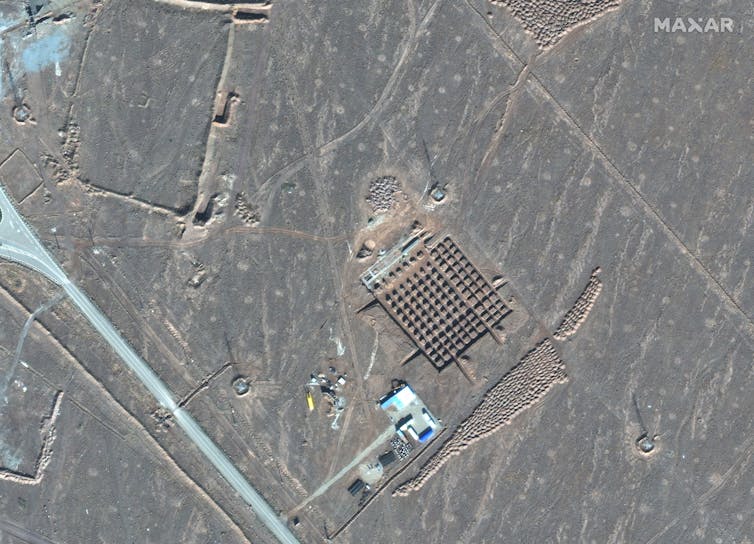 A satellite photo shows construction at Iran’s Fordo nuclear facility.
Maxar Technologies/AP
A satellite photo shows construction at Iran’s Fordo nuclear facility.
Maxar Technologies/AP
How the Iran nuclear deal fell apart
Iran’s nuclear program began in the 1950s[14], ironically with US assistance as part of the “Atoms for Peace” program[15]. Western cooperation continued until the 1979 Iranian Revolution toppled the pro-Western shah of Iran. International nuclear cooperation with Iran was then suspended, but the Iranian program resumed in the 1980s.
After years of negotiations, the Joint Comprehensive Plan of Action (JCPOA) was signed in 2015[16] by Iran and the five permanent members of the UN Security Council and Germany (known as the P5+1), together with the European Union.
The JCPOA tightly restricted Iran’s nuclear activities in return for the lifting of sanctions. However, this breakthrough soon fell apart with Trump’s election.
Read more: Iran's nuclear program breaches limits for uranium enrichment: 4 key questions answered[17]
In April 2018, Netanyahu revealed Iranian nuclear program documents[18] obtained by Mossad, claiming Iran had been maintaining a covert weapons program. The following month, Trump announced the US withdrawal[19] from the JCPOA and a re-imposition of American sanctions.
Iran initially said it would continue to abide by the nuclear deal, but after the Soleimani assassination last January, Tehran abandoned its commitments[20], including any restrictions on uranium enrichment.
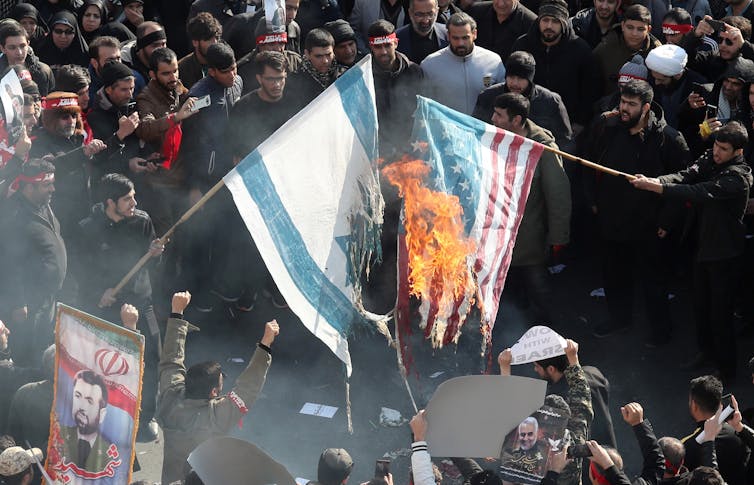 Iranians burn US and Israel flags during a funeral ceremony for Qassem Soleimani last year.
Abedin Taherkenareh/EPA
Iranians burn US and Israel flags during a funeral ceremony for Qassem Soleimani last year.
Abedin Taherkenareh/EPA
Israel’s history of preventive strikes
Israel, meanwhile, has long sought to disrupt its adversaries’ nuclear programs through its “preventative strike” policy, also known as the “Begin Doctrine[21]”.
In 1981, Israeli aircraft struck and destroyed[22] Iraq’s atomic reactor at Osirak, believing it was being constructed for nuclear weapons purposes. And in 2007, Israeli aircraft struck the al-Kibar nuclear facility[23] in Syria for the same reason.
Starting in 2007, Mossad also apparently conducted an assassination program[24] to impede Iranian nuclear research. Between January 2010 and January 2012, Mossad is believed to have organised[25] the assassinations of four nuclear scientists in Iran. Another scientist was wounded in an attempted killing.
Israel has neither confirmed nor denied its involvement in the killings.
Iran is suspected to have responded to the assassinations with an unsuccessful bomb attack against Israeli diplomats in Bangkok[26] in February 2012. The three Iranians convicted for that attack were the ones recently exchanged[27] for the release of Australian academic Kylie Moore-Gilbert from an Iranian prison.
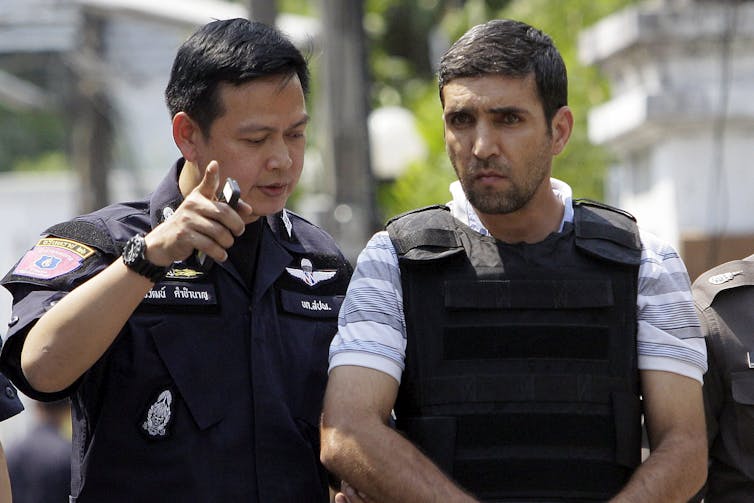 Bomb suspect Mohammad Kharzei, one of the men released by Thailand in November in exchange for Kylie Moore-Gilbert.
Sakchai Lalit/AP
Bomb suspect Mohammad Kharzei, one of the men released by Thailand in November in exchange for Kylie Moore-Gilbert.
Sakchai Lalit/AP
The Mossad assassination program was reportedly suspended under pressure from the Obama administration[28] to facilitate the Iran nuclear deal. But there seems little doubt the assassination of Fakhrizadeh was organised by Mossad[29] as part of its ongoing efforts to undermine the Iranian nuclear program.
Fakhrizadeh is believed to have been the driving force behind covert elements of Iran’s nuclear program for many decades.
The timing of his killing was perfect from an Israeli perspective. It put the Iranian regime under domestic pressure to retaliate. If it did, however, it risked a military strike by the truculent outgoing Trump administration.
It’s fortunate Moore-Gilbert was whisked out of Iran just before the killing, as there’s little likelihood Iran would have released a prisoner accused of spying for Israel (even if such charges were baseless[30]) after such a blatant assassination had taken place in Iran.
Read more: Kylie Moore-Gilbert has been released. But will a prisoner swap with Australia encourage more hostage-taking by Iran?[31]
What’s likely to happen next?
Where does all this leave us now? Much will depend on Iran’s response to what it sees (with some justification) as Israeli and US provocation.
The best outcome would be for no obvious Iranian retaliation or military action despite strong domestic pressure for the leadership to act forcefully. This would leave the door open for Biden to resume the nuclear deal, with US sanctions lifted under strict safeguards to ensure Iran is not able to maintain a covert weapons program.
References
- ^ planning to attack US forces in Iraq (www.reuters.com)
- ^ US assassination of Iran’s charismatic General Qassem Soleimani (theconversation.com)
- ^ respond forcefully to any provocations (www.washingtonpost.com)
- ^ preparing for potential Iranian retaliation (www.timesofisrael.com)
- ^ reportedly deployed submarines (www.washingtonpost.com)
- ^ flown nuclear-capable B-52 bombers (edition.cnn.com)
- ^ US would not withdraw the aircraft carrier USS Nimitz (www.military.com)
- ^ potentially resurrect the 2015 Iran nuclear deal (foreignpolicy.com)
- ^ Joe Biden's approach to the Middle East will be very different from Trump's, especially on Iran (theconversation.com)
- ^ support for Hezbollah in Lebanon (www.cfr.org)
- ^ Palestinian militants in Gaza (www.reuters.com)
- ^ announced it would begin enriching uranium to 20% (apnews.com)
- ^ contemplated doing so nearly a decade ago (www.axios.com)
- ^ Iran’s nuclear program began in the 1950s (www.france24.com)
- ^ “Atoms for Peace” program (www.brookings.edu)
- ^ was signed in 2015 (www.bbc.com)
- ^ Iran's nuclear program breaches limits for uranium enrichment: 4 key questions answered (theconversation.com)
- ^ Netanyahu revealed Iranian nuclear program documents (www.abc.net.au)
- ^ announced the US withdrawal (www.nytimes.com)
- ^ abandoned its commitments (www.npr.org)
- ^ Begin Doctrine (yale.universitypressscholarship.com)
- ^ struck and destroyed (www.nytimes.com)
- ^ Israeli aircraft struck the al-Kibar nuclear facility (www.bbc.com)
- ^ assassination program (www.voanews.com)
- ^ believed to have organised (www.nytimes.com)
- ^ bomb attack against Israeli diplomats in Bangkok (www.theguardian.com)
- ^ recently exchanged (www.smh.com.au)
- ^ pressure from the Obama administration (www.haaretz.com)
- ^ the assassination of Fakhrizadeh was organised by Mossad (www.thetimes.co.uk)
- ^ even if such charges were baseless (www.smh.com.au)
- ^ Kylie Moore-Gilbert has been released. But will a prisoner swap with Australia encourage more hostage-taking by Iran? (theconversation.com)