NZ's budget used a 'gender lens' for the first time – the result was a win for women
- Written by: Jennifer Curtin, Professor of Politics and Policy, University of Auckland
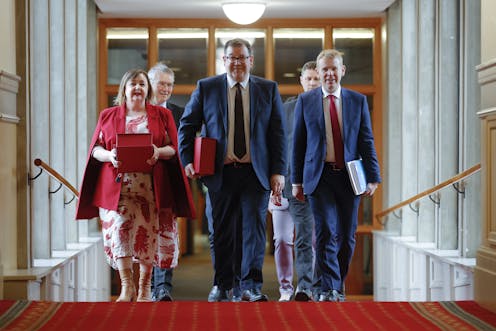
All the pre-budget talk of “bread and butter”, “no frills”, targeting and reprioritisation came with a sense of foreboding. History and research tell us that budgets in general – but particularly those hyper-focused on fiscal prudence – have different, often unequal impacts[1] on women compared to men.
For those of us who have long advocated for applying a gender lens[2] to the budget, however, those fears were misplaced. That’s because Budget 2023[3] included a gender budgeting “snapshot”[4] – the first New Zealand budget to do so.
This is an important addition to the budget process. The aim is to secure the wellbeing of diverse groups of women, underline structural inequalities, and avoid unintended negative consequences of investment decisions.
Although gender budgeting is new for Aotearoa New Zealand, it has a long history elsewhere, including in Australia[5]. More than 80 countries have trialled some form of gender budgeting, including over 20 OECD member states[6].
Indeed, the OECD, the United Nations, the World Bank and the International Monetary Fund view gender budgeting as critical to correcting[7] resource disparities, closing gender gaps in pay and the labour market, and enhancing economic, fiscal and social outcomes.
Valuable first steps
There are many gender budgeting models. But best-practice examples[8] apply a data-based gender perspective to all stages of the budget process, from design and analysis to implementation and evaluation.
The New Zealand government’s expanded pilot is not at that stage yet. But we witnessed some valuable first steps towards building a more inclusive budget system.
Treasury guidelines asked government agencies to analyse how budget proposals would enhance the wellbeing of Māori and Pacific people, children, the environment – and, explicitly for the first time, women and girls.
Fifteen agencies, supported by the Ministry for Women, used a gender budgeting toolkit to undertake this work. As a result, the budget contained specific initiatives for diverse groups of women. Investments often assumed to be “gender neutral” were assessed through this gender lens.
Read more: For a no-frills New Zealand budget it was ‘surprisingly frilly’: 5 experts on Labour’s big pre-election calls[9]
Balancing the books
Our analysis of previous “wellbeing” budgets has highlighted how the gender-segregated nature of the labour market, including unpaid care work, has meant the benefits of government investments often bypass women.
Women are underrepresented in the construction and technology sectors, for instance. They also rely heavily on affordable childcare to support their return to work after parental leave. They often have different transport needs to men, and may be affected differently by pandemics and natural disasters.
Without a gender perspective, new spending on transport and climate change mitigation is unlikely to be evenly shared.
Bringing gender into Budget 2023 overcame some of these inefficiencies. For example, gender analysis resulted in the digital technology package including NZ$26.6 million to help businesses address digital skills gaps, and increase women’s participation in the sector from 27% to 50% by 2030.
New funding for internships and cadetships as part of the Pacific Employment Action Plan[10] will benefit women and is a valuable step towards addressing the Pacific gender pay gap[11].
Closing the gaps
Expanding the 20 hours early childhood education (ECE) subsidy to cover two-year-olds (it previously covered those aged three to five) was another win for women. This $1.2 billion investment reduces by 18 months the period between parental leave payments ending and government support for childcare starting.
Reduced fees and cost-of-living support for parents with children already enrolled in ECE are also signalled. This may expand women’s labour force participation and increase productivity.
The government also began to address the gender gap in retirement savings by matching KiwiSaver employer contributions for paid parental leave recipients. This contribution is conditional on a co-contribution by employees, so may be less accessible to the lowest income earners.
Read more: NZ is finally making progress on child poverty – but a ‘no frills’ budget puts that at risk[12]
However, it represents an investment in, and acknowledgement of, the unpaid care work predominantly done by women. And it is an important step towards reducing one component of the “motherhood penalty[13]”.
The gender analysis completed by transport agencies revealed women are more likely than men to rely on public transport, use it in off-peak hours and make multiple short journeys. Women, particularly Māori and Pacific women, are also less likely than men to have a driver’s licence, making them more dependent on public transport.
So the promise of free fares for under-13-year-olds and reduced prices for under-25s is valuable. But it doesn’t cover the full cost for high school students, or help address the safety concerns associated with using public transport at night.
Read more: Want to support companies that support women? Look at your investments through a ‘gender lens’ – here’s how[14]
A political dividend?
Gender analysis also matters for climate change and disaster recovery initiatives. For example, the University of Auckland’s 2021 International Social Survey Programme[15] found more women than men reported experiencing extreme weather events in the past 12 months.
While the gender gap is not significant, this nevertheless reinforces the need to analyse the impact of climate disasters on diverse groups within regions.
Family violence and harm also increase[16] during and following such events. The additional funding dedicated to eliminating family and sexual violence in the budget is welcome. But making gender analysis the norm across recovery packages will be essential for resilience plans[17] as the impacts of climate change increase.
It’s possible this year’s gender budgeting snapshot will be read by naysayers as a “frill” or a “nice to have”. But in reality it will make New Zealand’s system of budgeting more effective, efficient and equitable. Ultimately, it makes good economic sense.
It might also help Labour, the Greens and Te Pati Māori retain enough of the women’s vote to swing this year’s general election in their favour come October.
The authors thank Eva Mountfort for her research assistance.
References
- ^ unequal impacts (wbg.org.uk)
- ^ gender lens (www.grab-nz.ac.nz)
- ^ Budget 2023 (budget.govt.nz)
- ^ gender budgeting “snapshot” (budget.govt.nz)
- ^ including in Australia (apo.org.au)
- ^ 20 OECD member states (www.treasury.govt.nz)
- ^ critical to correcting (read.oecd-ilibrary.org)
- ^ best-practice examples (read.oecd-ilibrary.org)
- ^ For a no-frills New Zealand budget it was ‘surprisingly frilly’: 5 experts on Labour’s big pre-election calls (theconversation.com)
- ^ Pacific Employment Action Plan (www.mpp.govt.nz)
- ^ Pacific gender pay gap (www.mpp.govt.nz)
- ^ NZ is finally making progress on child poverty – but a ‘no frills’ budget puts that at risk (theconversation.com)
- ^ motherhood penalty (globalwomen.org.nz)
- ^ Want to support companies that support women? Look at your investments through a ‘gender lens’ – here’s how (theconversation.com)
- ^ International Social Survey Programme (auckland.figshare.com)
- ^ increase (www.newshub.co.nz)
- ^ essential for resilience plans (unfccc.int)
Authors: Jennifer Curtin, Professor of Politics and Policy, University of Auckland