Give Customers an Update Time When the Job Time Is Uncertain
A customer has kept the afternoon free for a service visit. The business is still waiting to find out whether the previous job will finish on time. Sending an arrival estimate would be a guess, so nobody sends anything. By lunchtime, the customer is asking whether the visit is happening at all.
This is an illustrative situation, but it presents a useful writing problem. What can a small service business say when the answer the customer wants is not available yet?
It can explain what is being checked and give a time for the next update. The business may not control when a part arrives or whether rain interrupts outdoor work. It can choose when to contact the customer again. That distinction is useful throughout a booking, from the first enquiry to a question raised after the visit.
Give an enquiry a clear next step
An acknowledgement such as 'Thanks, we have received your enquiry' confirms receipt. It leaves the customer to guess whether someone will call, send a quote or ask for more information.
Consider this alternative for an Australian garden maintenance business: 'Thanks for your enquiry about the rear garden. We need to check the access before we can offer a visit. Please send a photo of the side entrance, or let us know if a call would be easier. We will review your reply by 3 pm on Thursday.'
The wording tells the customer why the question matters and what their reply will enable. The review time should be one the business can actually meet. If replies are checked only at the end of the day, promising a response within an hour creates a second problem.
For an automatic acknowledgement, explain when a person will review the request. Keep receipt separate from acceptance: a message arriving in the inbox does not mean a visit has been booked.
Make the next update a commitment you can keep
For a booking that depends on a supplier or another job, choose a sensible point to check progress. Tell the customer when they will hear from you, including if the situation remains unresolved.
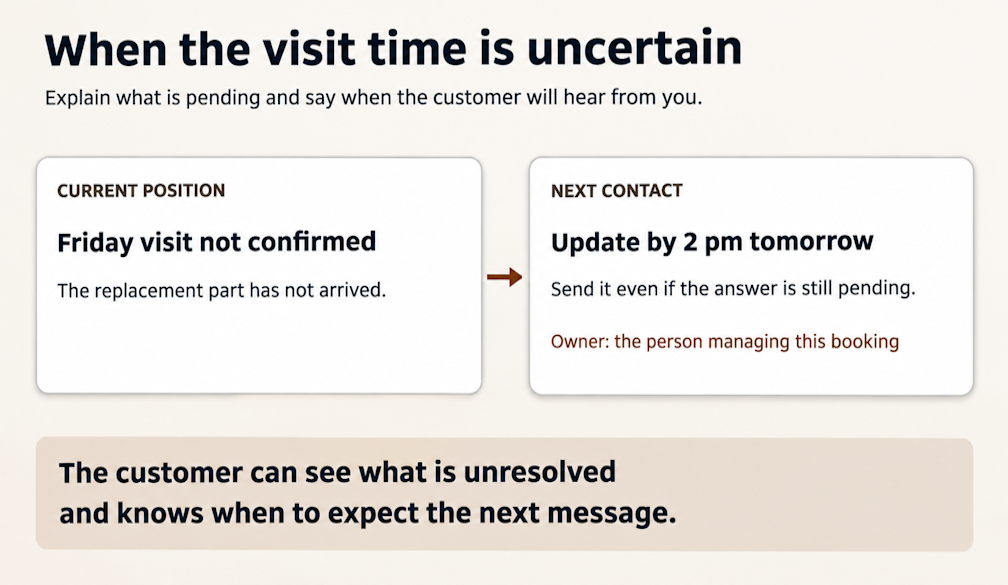
For example: 'We are checking whether the replacement part will arrive in time for Friday. Your visit is not confirmed yet. We will update you by 2 pm tomorrow, even if the supplier has not replied.'
Before sending that message, assign the update to someone and put it in the diary. Otherwise, the customer has been given a deadline that exists only in an email. A sole operator can use the same appointment calendar they already check. A team needs an owner who knows what to do if the answer is still missing.
Keep the update short when nothing has changed. Say what remains unresolved and give the next realistic contact time. If the customer needs to decide whether to keep waiting, explain the available options rather than extending the uncertainty indefinitely.
Explain the effect of a delay
An arrival update should help someone plan around the visit. A message saying 'Running late' does not tell them whether to stay home, change access arrangements or call the business.
A more useful example is: 'The previous visit is taking longer than expected. We cannot meet the agreed 1 pm to 3 pm arrival window. We are checking the revised schedule and will call by 12.30 pm to discuss whether a later visit works for you.'
Only send this wording when those facts are true. If you know the new arrival window, offer it directly. If you do not, explain when you will call. Avoid announcing a replacement appointment as settled before the customer has had a chance to respond.
Choose the contact method with the situation in mind. A time-sensitive change may need a call rather than an email that the customer may not see. If the change affects access, confirm that the relevant person has received it.
Keep a delay separate from a request for approval
Sometimes the business is waiting for the customer, rather than the other way round. Make the question easy to answer and explain what will happen while the decision is outstanding.
For instance: 'You asked whether we could include the garage. That is outside the work currently agreed for Tuesday. Would you like us to quote for it separately? Tuesday's booking still covers the original rooms.'
This gives the customer a choice without quietly changing the existing booking. If a response is needed before any work can proceed, say that instead. State the actual dependency, not a general request to 'get back to us as soon as possible'.
Australia's business.gov.au guidance recommends clarifying what customers mean and repeating it back where useful. That is a helpful discipline here: before asking for a decision, make sure the message describes the request the customer actually made.
Close the outstanding question after the visit
A completion message should explain any exception that still needs attention. 'All done' is unhelpful if one area was inaccessible or a separate request is awaiting a response.
An illustrative close-out might read: 'The agreed visit is complete. We could not access the locked store room, so that area was not serviced. We will call tomorrow before noon to discuss the next step.' Adapt the message to the work actually completed and the agreement with the customer.
If the customer raises a concern afterwards, acknowledge the specific issue and explain when someone will review it. Do not promise an outcome before the person responsible has checked the details.
Test the message while reading only the first screen
The Australian Government Style Manual advises putting the most important information first and using familiar words. For a service update, start with the booking or question affected. Move background detail below the action the customer needs to take.
Then read the message as a customer checking a phone between other tasks. Can you tell whether the visit is confirmed? Is a reply needed? When will the business make contact again? If one answer is missing, revise that sentence before adding more explanation.
Try this on the next booking that becomes uncertain. Record the promised update and send it at the agreed time, even if the answer is still pending. Afterwards, check whether the customer could make their next decision without having to chase you. That gives you a concrete way to judge whether the message helped.
Sources
business.gov.au | Communicate with customers
Australian Government Style Manual | Quick guide to plain language
About the author
Clientory Studio creates editable business documents for small service businesses, including cleaning, landscaping and property services. Its resources cover client communication and the practical information needed around a service visit. Clientory Studio