The election’s first debate was disaster-free but passion-free too
- Written by: Michelle Grattan, Professorial Fellow, University of Canberra
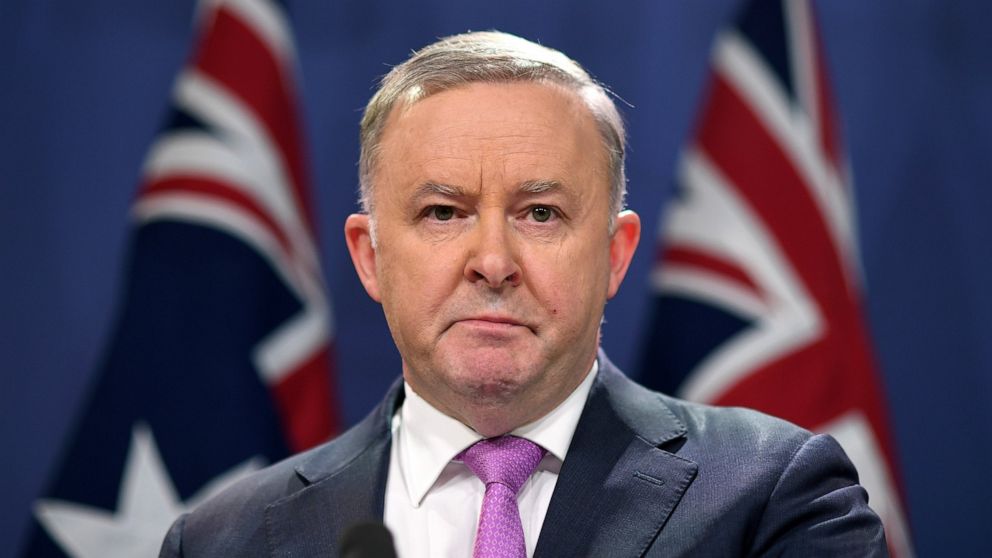
The election’s first debate, on Sky News on Tuesday night, was disappointingly dull. Viewers who’d been following the campaign would have learned little. There was minimal spontaneity.
Among the 100 undecided voters in the room, 44 said Anthony Albanese won, 35 thought Peter Dutton came out ahead and 21 were undecided.
Both camps will be satisfied, because each leader’s main aim was to avoid disaster. A bad mistake, an undisciplined moment, can sour the following day.
The Liberals will be especially relieved. After difficult days for Dutton, with Trump wading into the campaign and the fiasco over the work-from-home policy, the opposition leader needed to perform creditably. He did that, with commentators scoring the result variously (in some cases in line with the scorer’s political leaning).
Dutton was under added pressure – just before the two men faced off he learned his father Bruce had been taken to hospital.
Both leaders were well prepared, and carefully polite. Questions canvassed the “Trump pandemic”, education, health, cost of living, immigration, Albanese’s tax cuts, Dutton’s fuel excise promise, and Gaza.
When moderator Kieran Gilbert asked audience members to raise their hands if they were “doing it pretty tough” about half did so.
Albanese seemed to have more material to work with, and made sure he homed in on Dutton’s nuclear policy and his time as health minister.
Naturally, we saw Albanese’s well-worn Medicare card again.
The PM dodged an awkward reference to NSW premier Chris Minns’ returning public servants to the office, pivoting to Dutton’s dumping his working from home policy. “Peter hasn’t been able to stand up for his own policy, so I don’t know how he can stand up for Australia.”
Albanese had a good zinger countering Dutton’s spiel on gas: “The only gas policy that the Coalition have is the gaslighting of the Australia public.”
Dutton had a cut-through point on the PM’s promise to subsidise solar batteries. “He’s asking you to provide a subsidy or to support a subsidy for people on higher incomes like me to buy a battery at a subsidised price and I don’t believe that’s fair.”
Rather bizarrely, the Coalition used the cover of the debate to release its delayed modelling for its gas reservation policy, sending it out just as the debate started, embargoed until its finish.
“Modelling conducted by Frontier Economics has concluded that the Coalition’s National Gas Plan will see a 23% reduction in wholesale gas prices,” the statement said. This would “progressively mean
- 15% reduction in retail gas bills for industrial customers
- 7% reduction in retail gas bills for residential customers
- 8% reduction in wholesale electricity prices
- 3% reduction in residential electricity prices.”
And do the debates matter anyway?
Australian election debates are punctuation points in the campaign. They don’t necessarily carry much weight, although they can affect a candidate’s immediate momentum.
Ian McAllister, director of the ANU’s Australian Election Study, says fewer and fewer people are watching these debates. In 1993, about seven in ten voters watched; in 2022 only a third did.
McAllister also says our debates are low grade compared to some overseas. For example, in France, the two candidates sit across from each other, with two moderators and “go for it”. In Australia, debates are “stylised” and the candidates rely heavily on prepared answers.
Winning or losing the debates is not necessarily a guide to the election result. As the table shows John Howard performed better in elections than in debates.
NSW Premier Minns defends a back-to-the-office policy
Peter Dutton took a serious fall over his now-abandoned plan to force Canberra public servants back to the office. But Chris Minns already has many state bureaucrats back at their desks, and on Tuesday declared firmly he won’t be for turning.
The Minns policy, announced last year, admittedly has had a bumpy start, including problems with the unions. But Minns’ “sell” is very different from the Coalition’s unsuccessful attempt.
The federal opposition, which often seems obsessed with Canberra public servants, left the impression these bureaucrats working from home were ripping off the system and needed to be brought into line.
Contrast the positive spin from Minns on Tuesday. After noting most NSW public servants can’t work from home – they’re on the front line – for the rest: “We believe it’s the only way of mentoring the next generation of people, to come through offices and ensure that they’ve got good modelled behaviour, a sense of shared mission and an idea of where they’re going collectively together.
"In order for us to fulfil the mission of government and public service, it means that you’ve got to build a team culture. And that can really only be done in the workplace.
"I think our policy is different to Peter Dutton’s, but I just don’t want to mince words. We’ve got to be clear and consistent and we’re not changing our policy.
"I don’t want any ambiguity about our position. We made that call last year. It was the right decision. And in terms of the mentoring role that a senior person plays in a workplace, whether they’re a manager or not, if they’ve got years under their belt and they’ve got experience, it’s amazing the positive impact they will have on a junior recruit that we’ve just got into the public service and that doesn’t happen on zoom and it doesn’t happen on YouTube and it doesn’t happen over the phone.”
Minns has consistently proved himself a strong communicator. He often ran rings around Anthony Albanese in responding to the antisemitism crisis.
Jim Chalmers does the rounds on the tariff crisis
Treasurer Jim Chalmers is making the most of incumbency in the wake of the Trump tariff upheaval, undertaking an intense round of official activity.
Chalmers will convene a meeting on Wednesday of the Council of Financial Regulators to discuss the impact globally and locally. Those attending will include the heads of the Reserve Bank, the Australian Securities and Investments Commission, the Australian Prudential Regulation Authority, Treasury and the Australian Competition and Consumer Commission.
He will also meet the heads of the Future Fund and the ASX. On Thursday, he will have talks with major employers.
Chalmers has already convened and attended a Treasury briefing for the prime minister. He has talked with Reserve Bank Governor Michele Bullock, and been in touch with the CEOs of the major banks and superannuation funds representatives.
Chalmers is due to debate shadow treasurer Angus Taylor on Wednesday evening.