Trump isn’t the first US politician to pick a fight with the Smithsonian. But this time could be different
- Written by: Kylie Message, Professor of Public Humanities and Director of the ANU Humanities Research Centre, Australian National University
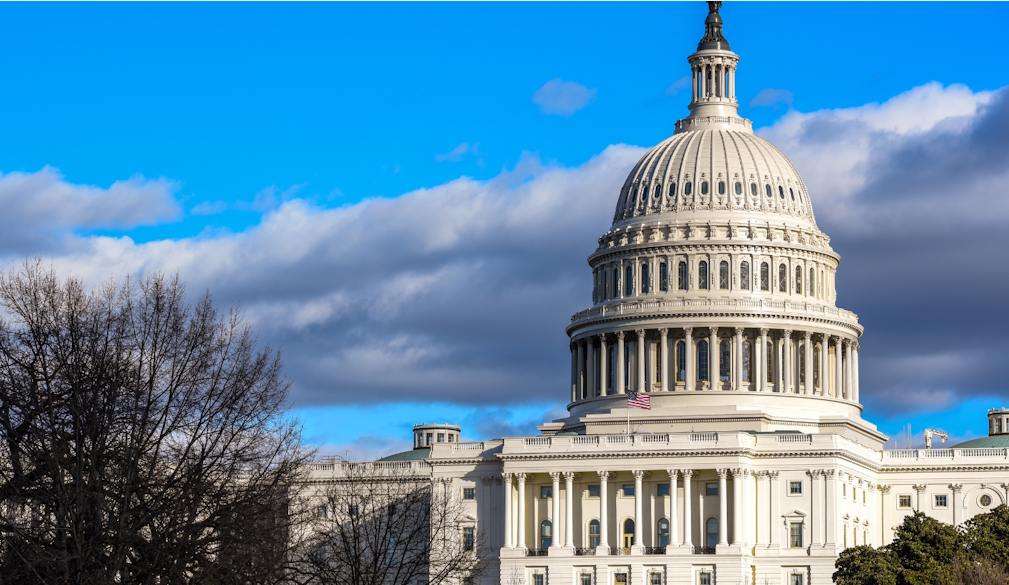
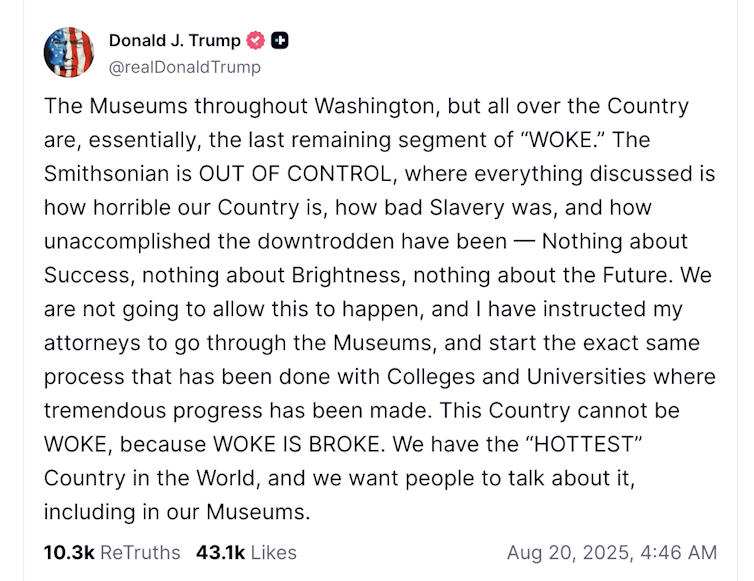
United States President Donald Trump first signalled his intention to target the Smithsonian Institution in March, when he signed an executive order[1] titled Restoring Truth and Sanity to American History.
This executive order – one of several targeting the cultural sector[2] – vowed to remove “improper, divisive or anti-American ideology”.
It was quickly followed by an article[3] from the White House titled President Trump is Right about the Smithsonian, with more than 20 examples of how the Smithsonian had embraced so-called “woke[4]” ideology.

To put this all in context, the Smithsonian[5] is the world’s largest museum, education and research complex. It was founded in 1846 as an entity independent from the US government. Today, most of its funding[6] comes through federal appropriations. Its governing board[7] includes the US vice president and supreme court chief justice.
It is custodian for more than 157 million items, 21 museums, 21 libraries, 14 education and research centres, a zoo, and several historical and architectural landmarks.
Trump has long been a participant in the culture wars, including when he denounced “cancel culture”[8] at a 2020 fourth of July event at Mt Rushmore. However, there is something different about his current interest in the Smithsonian. And that’s because next year is the US “semiquincentennial”[9]: the 250th anniversary of the Declaration of Independence.
Looking through history, it’s clear Trump’s attacks on the Smithsonian can’t be separated from the semiquincentennial. We’re also reminded of how the Smithsonian has both thwarted and endured political interference in the past.
2026: a politically important year
Trump’s heightened interest in the Smithsonian was explained in a recent letter[10] from the White House to Smithsonian Secretary Lonnie Bunch III:
As we prepare to celebrate the 250th anniversary of our Nation’s founding, it is more important than ever that our national museums reflect the unity, progress, and enduring values that define the American story.
In parallel, a presidential action[11] was released in celebration of the major anniversary.
This action established Task Force 250[12], which would be chaired by the president and housed in the Department of Defence. The task force’s key priorities include the development of a “national garden of American heroes[13]” (proposed in Trump’s first term), and the protection of monuments from vandalism.
While the presidential action identifies no specific role for the Smithsonian, taken together the statements lead to questions about political influence over the Smithsonian’s operations.
Decades of political grievance
Many of the Smithsonian exhibits that attracted historical censorship and controversy are now themselves approaching significant anniversaries.
One example is the 1972 exhibition[14], The Right to Vote, held at the Museum of History and Technology (now the National Museum of American History) to celebrate the 1965 Voting Rights Act[15].

The exhibition had been scheduled as a venue for President Richard Nixon’s inauguration ball. But upon inspection, Nixon’s team decided it was too controversial and had it walled off[18] for their events.
Further political grievances were aimed at the 1991 National Museum of American Art exhibition The West as America: Reinterpreting Images of the Frontier, 1820-1920[19]. It encouraged visitors[20] to understand how historical paintings represent a mythical view of the past that has been used to justify the West’s expansion and development.
 One of the works displayed was John Gast’s American Progress (1872), which depicts ‘Manifest Destiny’, a notion (popular in the 19th century) that the US had a providential right to expand its territory. Wikimedia[21]
The exhibition led to immediate outrage from former Librarian of Congress Daniel Boorstin[22]. Boorstin wrote[23] in the visitor’s book that it was: “A perverse, historically inaccurate destructive exhibit! No credit to the Smithsonian!”
Other politicians became energised by Boorstin’s view that the exhibition was a disrespectful attempt to dismantle and shame the history and legacy of the American frontier.
The exhibition became the subject of heated debate in the Senate Committee on Appropriations hearings from 1990 to 1992. At issue was how American nationalism should be represented in museums. A group of senators, led by Ted Stevens, threatened to reduce the Smithsonian’s funding if it failed to present “accountability” for its use of federal funds.
The Smithsonian’s then-secretary Robert McCormick Adams insisted it was precisely because the Smithsonian was dependent on tax resources that it had a responsibility to “exemplify the nation’s pluralism”.
In reporting the brouhaha, New York Times columnist Michael Kimmelman used language that wouldn’t be out of place today. He said[24] the controversy “raises questions about government involvement in the arts […] Is it now the job of Congress to police its constituents’ thinking about the art in those museums?”
Cancelled by Congress
Another instance of political interference came in the mid 1990s, in relation to a Smithsonian exhibition representing the 50th anniversary of America’s atomic bombing of Japan in WWII.
The National Air and Space Museum designed a display[25] that included the restored B-29 bomber, a plane called the Enola Gay[26], that dropped the first atomic bomb on Hiroshima on August 6, 1945.
The exhibition was supposed to open in 1995. However, people who consulted on its early plans criticised it for supposedly presenting a politically correct and revisionist interpretation of the events. They claimed it overplayed the horrors of the bombings, and portrayed Japanese victims without sufficient context surrounding the preceding Japanese aggression.
Members of Congress soon became aware of the concerns, adding their own threats of hearings and budget reductions. They called for the curator’s resignation, and contributed to the exhibition’s eventual cancellation.
 With the original exhibition scrapped, the Enola Gay was exhibited at the National Air and Space Museum in a rather bare-bones display in June, 1995. Smithsonian Institution Archives[27]
History repeats
Trump’s attacks on the Smithsonian are part of a long political playbook in which culture has been targeted for representing an inclusive view of the American union.
The Smithsonian has weathered political attacks on its exhibitions in the past. However, there is now more attention to its institutional remit than ever before.
The recent threats from Trump, and lessons from history, highlight the importance of protecting the Smithsonian as an independent authority that withstands political interference at all costs.
References
- ^ executive order (www.whitehouse.gov)
- ^ cultural sector (www.museumsassociation.org)
- ^ article (www.whitehouse.gov)
- ^ woke (truthsocial.com)
- ^ Smithsonian (www.si.edu)
- ^ most of its funding (www.theguardian.com)
- ^ governing board (www.si.edu)
- ^ denounced “cancel culture” (www.bbc.com)
- ^ the US “semiquincentennial” (america250.org)
- ^ letter (www.whitehouse.gov)
- ^ presidential action (www.whitehouse.gov)
- ^ Task Force 250 (www.whitehouse.gov)
- ^ national garden of American heroes (www.neh.gov)
- ^ 1972 exhibition (siarchives.si.edu)
- ^ 1965 Voting Rights Act (www.theguardian.com)
- ^ Flickr (www.flickr.com)
- ^ CC BY-SA (creativecommons.org)
- ^ had it walled off (www.routledge.com)
- ^ The West as America: Reinterpreting Images of the Frontier, 1820-1920 (en.wikipedia.org)
- ^ encouraged visitors (academic.oup.com)
- ^ Wikimedia (en.wikipedia.org)
- ^ Daniel Boorstin (www.theguardian.com)
- ^ wrote (www.routledge.com)
- ^ He said (www.nytimes.com)
- ^ designed a display (siarchives.si.edu)
- ^ Enola Gay (www.britannica.com)
- ^ Smithsonian Institution Archives (siarchives.si.edu)