How the Matildas won over a nation
- Written by: Fiona Crawford, Adjunct Lecturer at the Centre for Justice, Queensland University of Technology
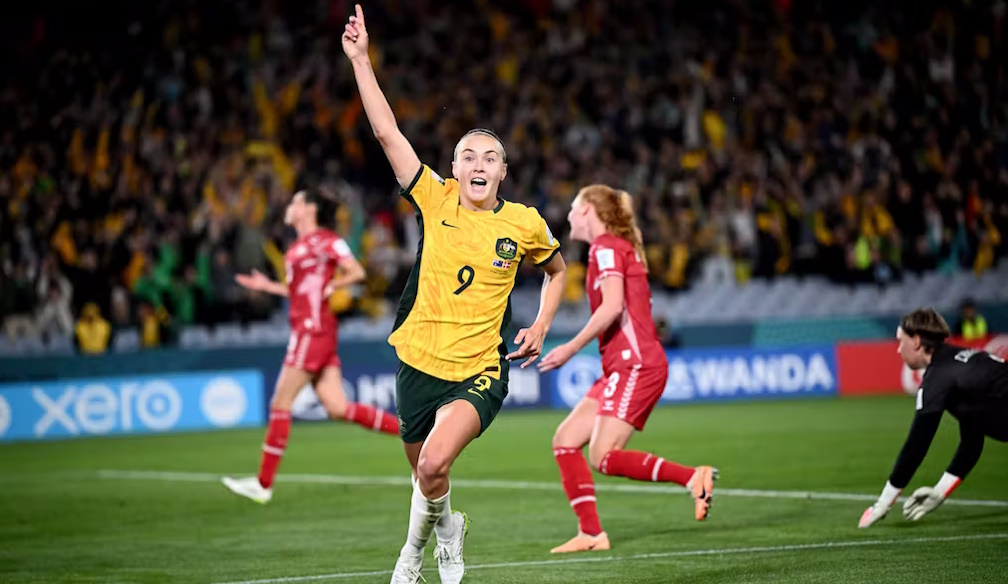
As the Matildas prepare for their 2023 FIFA Women’s World Cup sudden-death quarter final against France, they have become the hottest sporting property in the country. For example, formerly uninterested major media just days ago hired a helicopter[1] to spy on one of the team’s training sessions.
The expensive, paparazzi-style move was designed to gather exclusive footage of the team, particularly of injured Matildas captain Sam Kerr.
That conservative media was going to such lengths to gain footage of the team speaks volumes of the starkly different landscape the current Matildas are operating in, and the evolution of a team that’s gone from few resources and relatively anonymity to equal pay and national treasure status.
No longer an afterthought
More people watched the Matildas’ Round of 16 match against Denmark[2] on Channel Seven, the highest rating show of the year to date, than watched the men’s NRL and AFL grand finals last year.
Channel Seven is also delaying Saturday’s news bulletin[3] to broadcast the Matildas’ quarter final, while the AFL will be broadcasting the match in the stadium before the men’s West Coast Eagles versus Fremantle derby.
This is all particularly interesting given FIFA had to castigate broadcasters for undervaluing the broadcast rights[4] in the tournament lead-up.
What’s more, Matildas jerseys are outselling the Socceroos’ jerseys by two to one[5]. It’s worth remembering they were unavailable to buy until recent years because manufacturers didn’t deem there to be a market for them.
Read more: Fans are finding out just how disappointing merchandise for women's football is[6]
More than 1.7 million tickets have been sold, exceeding FIFA’s stretch target of 1.5 million. And the total crowd figure record of 1,353,506 set in 2015 had been surpassed[7] with 12 games to spare.
That’s a far cry from the Matildas’ early years, when players had to produce and hand out flyers to try to attract people to watch their games, or phone television stations and beg them to broadcast matches. When the team travelled to the 2003 world cup, not a single journalist turned up to the airport press conference.
It’s also quite the contrast from the traditional media coverage approach that relegates women’s sport to an afterthought. A 30-year study[8] of women’s sports coverage, published in 2021, determined major media generally adopt a “one and done” approach: a box-ticking exercise, providing a token women’s sports story before a succession of in-depth men’s sports stories.
So, how did we get here?
It was 1988 when the intrepid Matildas ventured out to their inaugural “world cup” – a pilot tournament FIFA only staged after concerted pressure[9] from other organising bodies and women footballers themselves.
There were some significant changes considered or implemented – ones that would not have been tabled for the men’s game. Matches were truncated from 90 to 80 minutes; there was some patronising discussion of whether women would play with a smaller ball[10]; and with the tournament absent any true FIFA badging, the players had to pay $850 each for the privilege of participating. They pulled that fee together by fundraising through lamington drives, car washes, and casino nights.
Still, the Australian team quickly made history by defeating Brazil[11] in an upset victory in the tournament’s first match, setting the tone for an upwards trajectory.
However, the 1995, 1999, and 2003 tournaments were not, by the Matildas’ own standards, considered breakout successes. A harsh red card for Sonia Gegenhuber in the team’s first group-stage match against Denmark in 1995 cruelled the team’s chances from the outset. And 1999 saw Alicia Ferguson awarded the fastest red card in history[12] for an ill-timed tackle two minutes into the game against China.
The Matildas’ sustained upward course arguably began in 2007. The World Cup that year was the first womens’ tournament for which SBS broadcast all the games. It also became the first time the Matildas progressed to the knockout rounds[13].
Although laundry and internet costs weren’t yet covered, that era also marked the beginning of the players receiving (albeit nominal) daily allowances and playing contracts of up to approximately A$10,000. Administrators were able to leverage that 2007 success into the establishment of the W-League (now renamed the A-League Women’s), the domestic semi-professional football league that helped the Matildas become the first Australian team (women’s or men’s) to win the Asian Cup[14]. It’s also a development pathway for the current Matildas.
2011 marked the emergence of the Matildas’ “golden generation”, with then-youthful players Caitlin Foord and Sam Kerr attending their first Women’s World Cup.
All the focus has been on Kerr in recent years, but at the time, Foord was tipped to be the player to watch, and was named the tournament’s best young player.
Read more: FIFA Women’s World Cup: Professional women athletes are still fighting for equitable sponsorship[15]
Striking for pay parity
To understand the groundbreaking success the Matildas are now experiencing, we must look at the lonely stand they took across the road from governing body Football Federation Australia’s office in 2015.
They were off contract, unpaid, and without medical insurance. Now lapsed, they had been on contracts of around A$22,000 a year: in the ballpark of Australia’s poverty line.
So the Matildas went on strike for two months to draw attention to the imperiled nature of their footballing careers, which demanded full-time, elite-athlete commitment and results, but with part-time, amateur pay.
The headlines that followed encapsulated the exasperation many felt (and still feel) at the inequity women athletes experience. This included the Junkee headline[16]
The Matildas Have Gone on Strike Because, Oh My God Can We Just Pay Them Properly?
The Matildas achieved pay parity[17] with the Socceroos in 2019, but the groundwork for that achievement was laid with that 2015 strike.
The year 2017 also marked an important moment in the team’s evolution. It was when the team sold out Penrith Stadium[18] with a then-record crowd of about 17,000.
The crowd figure signalled there was an engaged audience and market there – it had just been under-catered for.
Read more: FIFA Women's World Cup: Gender equity in sports remains an issue despite the major strides being made[19]
Fast forward to 2019. Off-pitch distractions imperilled the Matildas’ group-stage world cup results. The team was steered through the tournament by temporarily installed coach Ante Milicic, after incumbent coach Alen Stajcic had been sacked for reasons still not entirely clear.
With the rise of European nations that had invested heavily in women’s football, Australian football had stood still. The Matildas’ opening loss against debutantes Italy put the team under pressure. However, the players then produced the “Miracle of Montpellier”, winning 3-2 against superstars Brazil to salvage their tournament – before being bundled out by Norway on penalties in the round of 16.
This year, the media’s initial focus was on Kerr’s troublesome calf and then late substitution decisions by coach Tony Gustavsson. Under pressure following a shock loss to minnows Nigeria, the Matildas recorded a resounding 4–0 victory over reigning Olympic champions Canada.
Now, in a few pressure-filled hours, Australia’s most successful football team have the potential to make history: to progress to the semi finals for the first time ever.
A win would see Matildas’ media coverage and fandom enter uncharted, euphoric territory. But with record crowds, viewership, and merchandise sales, and with several of their players now household names, in many ways the Matildas will already have won before they even set foot on the pitch.
References
- ^ hired a helicopter (sport.optus.com.au)
- ^ Matildas’ Round of 16 match against Denmark (7news.com.au)
- ^ delaying Saturday’s news bulletin (www.news.com.au)
- ^ FIFA had to castigate broadcasters for undervaluing the broadcast rights (www.abc.net.au)
- ^ outselling the Socceroos’ jerseys by two to one (www.footballaustralia.com.au)
- ^ Fans are finding out just how disappointing merchandise for women's football is (theconversation.com)
- ^ had been surpassed (www.reuters.com)
- ^ 30-year study (news.usc.edu)
- ^ concerted pressure (www.france24.com)
- ^ smaller ball (www.booktopia.com.au)
- ^ defeating Brazil (www.facebook.com)
- ^ Alicia Ferguson awarded the fastest red card in history (www.abc.net.au)
- ^ progressed to the knockout rounds (www.matildas.com.au)
- ^ to win the Asian Cup (www.matildas.com.au)
- ^ FIFA Women’s World Cup: Professional women athletes are still fighting for equitable sponsorship (theconversation.com)
- ^ Junkee headline (junkee.com)
- ^ pay parity (www.matildas.com.au)
- ^ sold out Penrith Stadium (www.theguardian.com)
- ^ FIFA Women's World Cup: Gender equity in sports remains an issue despite the major strides being made (theconversation.com)