NASA is launching a major mission to look for habitable spots on Jupiter’s moon Europa
- Written by: James Lloyd, Research Fellow, ARC CoE Plants for Space, School of Molecular Sciences, The University of Western Australia
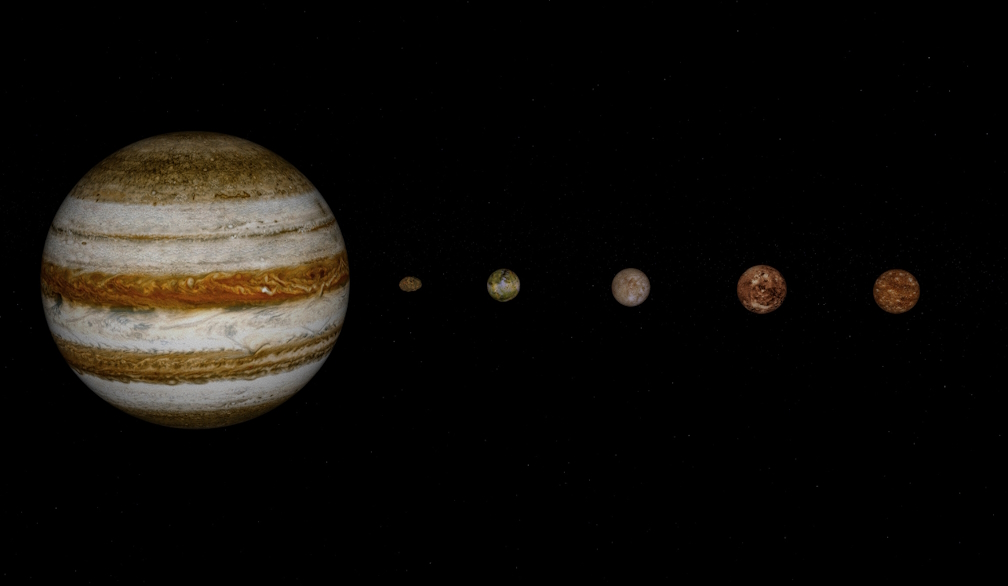
On October 10, NASA is launching a hotly anticipated new mission to Jupiter’s fourth-largest moon, Europa.
Called Europa Clipper[1], the spacecraft will conduct a detailed study of the moon, looking for potential places where Europa might host alien life.
It’s the largest planetary exploration spacecraft NASA has ever made: as wide as a basketball court when its solar sails are unfolded. It has a mass of about 6,000 kilograms – the weight of a large African elephant.
But why are we sending a hulking spacecraft all the way to Europa?
Looking for life away from Earth
The search for life in places other than Earth usually focuses on our neighbour Mars, a planet that’s technically in the “habitable zone” of our Solar System. But Mars is not an attractive place to live[2], due to its lack of atmosphere and high levels of radiation. However, it’s close to Earth, making it relatively easy to send missions to explore it.
But there are other places in the Solar System that could support life – some of the moons of Jupiter and Saturn. Why? They have liquid water.
Here on Earth, water is the solvent of life: water dissolves salts and sugars, and facilitates the chemical reactions needed for life on Earth to proceed. It’s possible life forms exist elsewhere that rely on liquid methane or carbon dioxide or something else, but life as we know it uses water.
The reason there’s liquid water so far out in the Solar System is because Jupiter and Saturn, the gas giants, wield immense gravitational power over their moons[3].
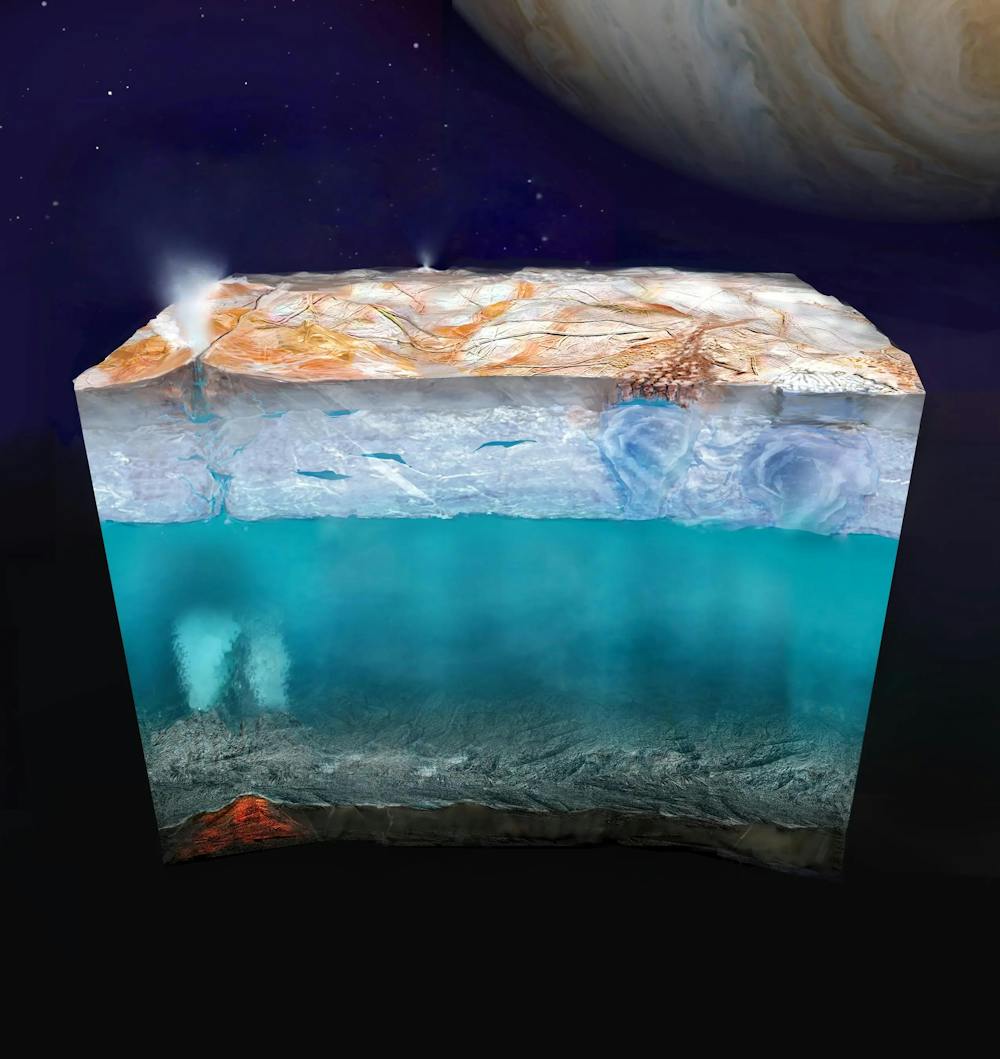
Saturn’s moons, Titan and Enceladus, are stretched and compressed by gravity as they go around their host planet. This movement results in vast underground oceans with a surface of solid ice, with plumes of water vapour[4] exploding 9,600 kilometres from the surface.
It is strongly suspected that Europa is the same. While we know a lot about Europa from more than four centuries of observation[5], we have not confirmed it has an under-ice liquid ocean like Titan and Enceladus.
But all clues point to yes. Europa has a smooth surface despite being hit by many meteors[6], suggesting the surface is young, recently replaced. Ice volcanoes raining down water over the surface would make sense.
It also has a magnetic field[7], suggesting that like Earth, Europa has a liquid layer inside (on Earth, this liquid is molten rock).
What will Europa Clipper do?
At the surface, Europa is bombarded by high levels of space radiation[9], concentrated by Jupiter. But deeper down, the thick ice sheet could be protecting life in the liquid subsurface ocean.
This means it would be difficult for us to find concrete evidence for life without drilling down deep. But where to look? Through flybys of the icy moon, Europa Clipper will be looking at areas where life could be dwelling under the icy shell.
To achieve this, Europa Clipper has nine scientific instruments. These include a wide-angle camera to study geologic activity and a thermal imaging system to measure surface texture and detect warmer regions on the surface.
There’s also a spectrometer for looking at the chemical composition of the gases and surface of Europa, and for any explosive plumes of water from the surface. The mission also has tools for mapping the moon’s surface.
Other instruments will measure the depth and salt levels of the moon’s ocean and the thickness of its ice shell, and also how Europa flexes within the strong gravitational pull of Jupiter.
Excitingly, a mass spectrometer will analyse the gases of the moon’s faint atmosphere and potential plumes of water. By examining the material ejected from the plumes, we can understand what is hidden within the under-ice oceans of Europa.
A dust analyser will also look at matter that has been ejected from Europa’s surface by tiny meteorites or released from the plumes.
Unfortunately, we will have to wait a while for any discoveries. Europa Clipper will take more than five years to reach Jupiter. And the mission is only equipped to look for the potential of life, not life itself. If we see evidence that might point towards life, we will need future missions to return and explore Europa in depth.
So we must be patient. But this is an exciting opportunity for humanity to get one step closer to find life beyond our own home planet.
References
- ^ Europa Clipper (europa.nasa.gov)
- ^ not an attractive place to live (theconversation.com)
- ^ wield immense gravitational power over their moons (spaceplace.nasa.gov)
- ^ plumes of water vapour (www.nasa.gov)
- ^ more than four centuries of observation (phys.org)
- ^ smooth surface despite being hit by many meteors (science.nasa.gov)
- ^ magnetic field (science.nasa.gov)
- ^ NASA/JPL-Caltech (science.nasa.gov)
- ^ high levels of space radiation (europa.nasa.gov)