Why do cats knead with their paws?
- Written by: Julia Albright, Associate Professor of Veterinary Medicine, University of Tennessee
 Curious Kids[1] is a series for children of all ages. If you have a question you’d like an expert to answer, send it to curiouskidsus@theconversation.com[2].
Why do cats like to pat their paws on a soft blanket? – Anonymous
Do you ever see your cat shifting his front paws back and forth just before settling down for a nap? Have you heard some cat lovers talk about their feline friends “making biscuits” or “kneading dough”?
Scientists who study cat behavior call this distinctive paw action “kneading” and believe it to be a sign of a relaxed cat. My own cats knead before taking a nap near me. While they are kneading, they purr – one of them gets so relaxed, he sometimes drools. Kneading usually occurs near a favorite person[3].
As a veterinarian[4], I think it’s important to recognize the little moments your cat is telling you she’s happy to be near you.
Kneading in kittens
If you’re ever around newborn kittens, you will see kneading pretty quickly after birth. A kitten kneads on his mother’s abdomen[5] as a way of telling her he is hungry and ready for her milk.
Kneading and purring.At the same time, the kitten usually purrs, which is a sound created by rapid vibrations of certain throat muscles. Purring is a signal for attention[6].
Using these two behaviors, kittens are asking their moms, also known as queens, to remain still so they can continue suckling. Young kittens usually fall asleep while suckling.
Kittens stop drinking their mother’s milk by about two months of age. So why do cats continue to knead as adults?
Ready to relax
Kneading seems to be more common in some cats than others. If your cat doesn’t knead, it could mean he is a little stressed – or it could just be that your cat doesn’t display relaxation or affection in that manner.
But many cats do continue kneading into adulthood. It’s pretty safe to assume a cat who is kneading is feeling calm, content and ready to settle down, just like a kitten settling in to suckle and sleep.
Curious Kids[1] is a series for children of all ages. If you have a question you’d like an expert to answer, send it to curiouskidsus@theconversation.com[2].
Why do cats like to pat their paws on a soft blanket? – Anonymous
Do you ever see your cat shifting his front paws back and forth just before settling down for a nap? Have you heard some cat lovers talk about their feline friends “making biscuits” or “kneading dough”?
Scientists who study cat behavior call this distinctive paw action “kneading” and believe it to be a sign of a relaxed cat. My own cats knead before taking a nap near me. While they are kneading, they purr – one of them gets so relaxed, he sometimes drools. Kneading usually occurs near a favorite person[3].
As a veterinarian[4], I think it’s important to recognize the little moments your cat is telling you she’s happy to be near you.
Kneading in kittens
If you’re ever around newborn kittens, you will see kneading pretty quickly after birth. A kitten kneads on his mother’s abdomen[5] as a way of telling her he is hungry and ready for her milk.
Kneading and purring.At the same time, the kitten usually purrs, which is a sound created by rapid vibrations of certain throat muscles. Purring is a signal for attention[6].
Using these two behaviors, kittens are asking their moms, also known as queens, to remain still so they can continue suckling. Young kittens usually fall asleep while suckling.
Kittens stop drinking their mother’s milk by about two months of age. So why do cats continue to knead as adults?
Ready to relax
Kneading seems to be more common in some cats than others. If your cat doesn’t knead, it could mean he is a little stressed – or it could just be that your cat doesn’t display relaxation or affection in that manner.
But many cats do continue kneading into adulthood. It’s pretty safe to assume a cat who is kneading is feeling calm, content and ready to settle down, just like a kitten settling in to suckle and sleep.
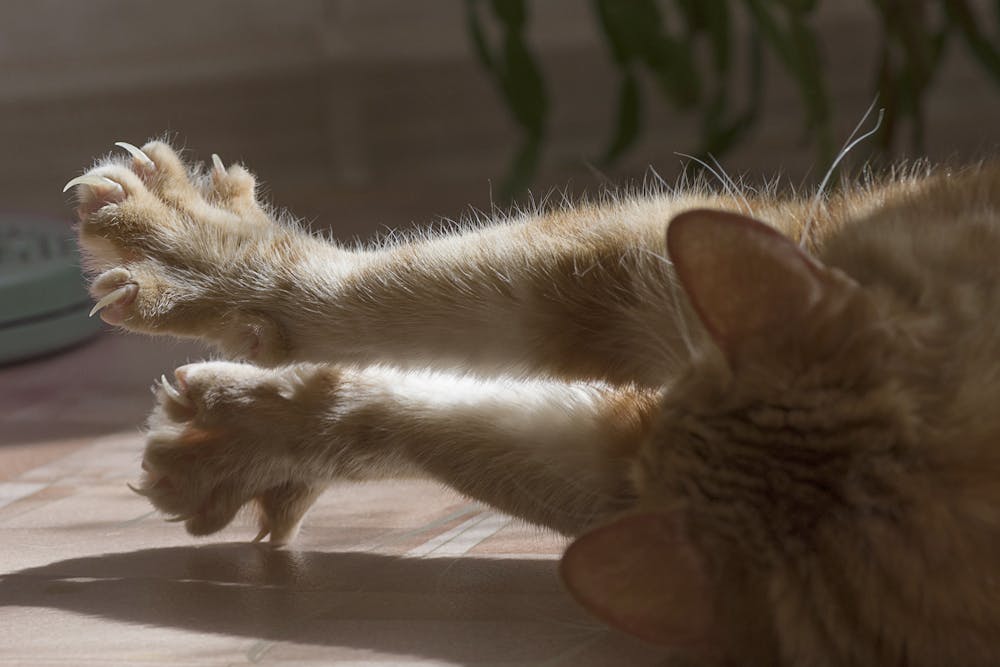 Cats can mark areas with scent glands in their feet.
vizland/iStock via Getty Images Plus[7]
You may already know that when your cat bunts[8], or butts his head and rubs his cheek, head and body against your leg or an object near you, he is putting his scent in these locations. Cats also have scent glands between their toes, prompting some people to suggest that cats are also putting a familiar, comforting scent on their sleeping area when they knead.
Don’t bother to look for these glands on your own cat. They are not easily visible.
Subtle signals
Kneading may also be a form of communication between cats and their people.
If you’ve been around dogs, you know most are quite obvious in letting humans know they want something or like someone. For thousands of years, people have purposely bred dogs[9] to be fun companions, as well as to have useful behaviors such as herding, tracking or guarding.
Cats and people have also lived together for thousands of years[10] – and humans have appreciated their amazing natural mousing skills. Only recently have people tried to breed cats[11], but mostly for their appearance, not for specific behaviors.
The result is that cats are a little more subtle than dogs in their ways of telling a person, “I like you.” Kneading is one of those clues.
Hello, curious kids! Do you have a question you’d like an expert to answer? Ask an adult to send your question to CuriousKidsUS@theconversation.com[12]. Please tell us your name, age and the city where you live.
And since curiosity has no age limit – adults, let us know what you’re wondering, too. We won’t be able to answer every question, but we will do our best.
Cats can mark areas with scent glands in their feet.
vizland/iStock via Getty Images Plus[7]
You may already know that when your cat bunts[8], or butts his head and rubs his cheek, head and body against your leg or an object near you, he is putting his scent in these locations. Cats also have scent glands between their toes, prompting some people to suggest that cats are also putting a familiar, comforting scent on their sleeping area when they knead.
Don’t bother to look for these glands on your own cat. They are not easily visible.
Subtle signals
Kneading may also be a form of communication between cats and their people.
If you’ve been around dogs, you know most are quite obvious in letting humans know they want something or like someone. For thousands of years, people have purposely bred dogs[9] to be fun companions, as well as to have useful behaviors such as herding, tracking or guarding.
Cats and people have also lived together for thousands of years[10] – and humans have appreciated their amazing natural mousing skills. Only recently have people tried to breed cats[11], but mostly for their appearance, not for specific behaviors.
The result is that cats are a little more subtle than dogs in their ways of telling a person, “I like you.” Kneading is one of those clues.
Hello, curious kids! Do you have a question you’d like an expert to answer? Ask an adult to send your question to CuriousKidsUS@theconversation.com[12]. Please tell us your name, age and the city where you live.
And since curiosity has no age limit – adults, let us know what you’re wondering, too. We won’t be able to answer every question, but we will do our best.
References
- ^ Curious Kids (theconversation.com)
- ^ curiouskidsus@theconversation.com (theconversation.com)
- ^ Kneading usually occurs near a favorite person (www.petmd.com)
- ^ As a veterinarian (scholar.google.com)
- ^ kitten kneads on his mother’s abdomen (doi.org)
- ^ Purring is a signal for attention (www.loc.gov)
- ^ vizland/iStock via Getty Images Plus (www.gettyimages.com)
- ^ cat bunts (www.thesprucepets.com)
- ^ For thousands of years, people have purposely bred dogs (www.morrisanimalfoundation.org)
- ^ lived together for thousands of years (www.smithsonianmag.com)
- ^ Only recently have people tried to breed cats (cat-world.com)
- ^ CuriousKidsUS@theconversation.com (theconversation.com)
Read more https://theconversation.com/why-do-cats-knead-with-their-paws-156254