How did Australian laws change in 2025? Here are 6 you need to know
- Written by: Rick Sarre, Emeritus Professor in Law and Criminal Justice, University of South Australia
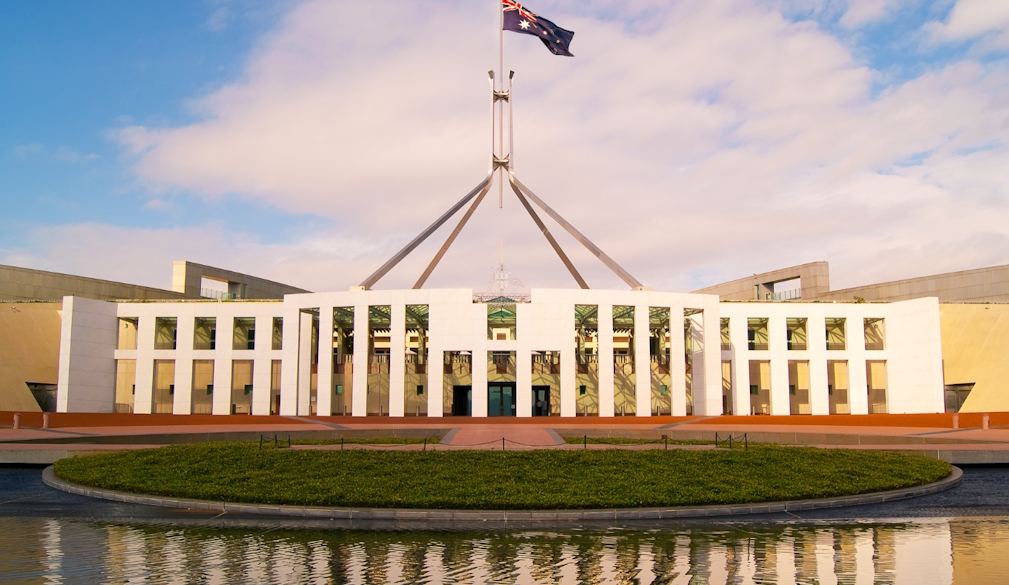
Some people take heart in the idea that the law is resistant to change, arguing that this reinforces its stability. Others delight in its ability to adapt to change, as that reflects its flexibility. In our eyes, the latter view is rapidly gaining ascendancy.
So what changed in Australian law in 2025? Let’s look at six important examples.
1. Fixing the unfair ‘account deactivation’ of digital food deliverers
In 2025, workers in digital platforms[1] such as Uber, UberEATS, DiDi and DoorDash finally got a reprieve. Before February 26, a rider or driver could open their app and find their account gone[2], often with little warning, limited explanation, and no right of review.
Today, if workers have been active on a platform for at least six months, they can now take an “unfair deactivation[3]” claim to the Fair Work Commission. The Commission can order reinstatement or compensation[4].
It doesn’t change everything, but it opens a door that used to be locked shut by putting a limit on what platforms can and can’t do. Digital food deliverers and drivers no longer have to live with the constant fear that an app can simply “switch them off” for no good reason.
2. Pets and family law separation
Under the Family Law Act, pets, also referred to as “companion animals”, used to be lumped in with all other property (such as cars, furniture and air fryers) following the breakdown of a marriage[5] or de facto relationship[6].
In June 2025, the act was amended to deal with the ongoing ownership and care of pets. Now, the court must consider a range of issues when deciding whether the pet should be owned by one party, transferred, or sold. These include how the furry friend was acquired, who provided its care (and future care), who paid vet bills, and the level of attachment of each family member.
The consideration now includes whether there has been past cruelty to the pet, and even whether there has been family violence in the home. The new laws don’t allow for shared care of a pet, although parties are free to agree this without court orders.

3. Sovereign citizens take a hit
This year the simmering social phenomenon of “pseudolaw[7]” – when people construct legal arguments that suit their own purposes but are in fact wrong – grabbed the headlines.
The antics of this movement[8] initially gained attention during the COVID pandemic. “Sovereign citizens” waved red ensigns[9] at protests, and “Bunnings Karen[10]” cited the Universal Declaration on Human Rights[11] to avoid a mask mandate.
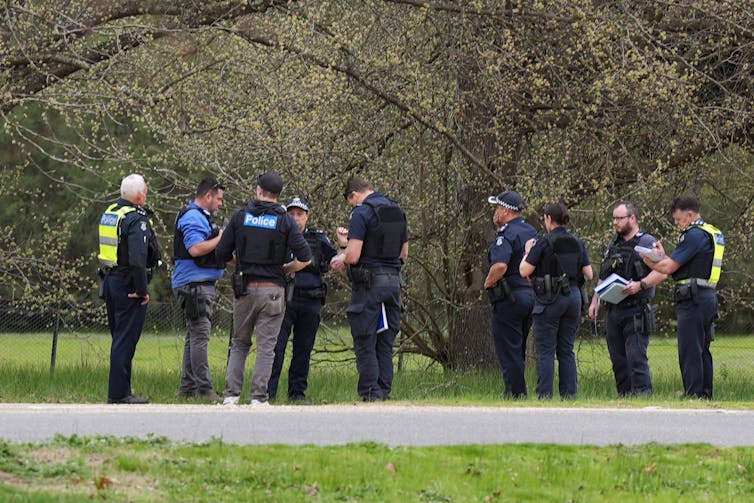
The phenomenon increasingly clogged up the courts but largely remained invisible and somewhat harmless. That changed in August, with the tragic Porepunkah[12] police shootings allegedly carried out by self-proclaimed sovereign citizen[13] Dezi Bird Freeman, who has now disappeared.
Moreover, in the civil courts, former South Australian sports star and broadcaster Warren Tredrea tried to offset his $149,000 debt to the Nine Network by claiming a handwritten IOU (purporting to erase his liability by virtue of his interpretation[14] of pseudolaw) had legal status.
In early September, the Federal Court ruled against[15] his “incomprehensible and legally meaningless” bid, calling his purported IOU “a waste of time”.
The civil courts have therefore spoken. We may hope pseudo-legalistic nonsense is in terminal decline. But there are indications the movement remains a threat to society[16], and that threat should not be ignored.
4. Australian recognition of Palestine
Australia’s decision on September 21 2025 to formally recognise the independent State of Palestine[17] was one of the year’s most significant legal developments.
In international law, a state has certain defining features[18]: a permanent population, a relatively determinate territory, an effective government, and the capacity to enter into relations with other states.
Functionally, the last of these is the most important, and it manifests as recognition. Recognition creates a legal relationship, triggering the reciprocal rights and obligations that flow between states.
Recognition also strengthens Palestine’s standing in international forums and reinforces the Palestinian people’s right of self-determination[19].
While Australia has long endorsed a two-state solution, it had previously recognised only Israel. Making the announcement at the 80th session of the United Nations General Assembly, Australia joined other Western countries[20] such as the United Kingdom, France and Canada in overturning years of diplomatic equivocation.
5. Tougher penalties for breaching environmental law
Reforms to the Environment Protection and Biodiversity Conservation Act were passed on November 28[21]. Significantly, the act increased the civil penalties for offences by changing the method of calculation.
For example, if a corporation does something that significantly affects a “protected matter[22]” (such as a threatened species or ecological community) without approval, it can be fined three times the total value of any benefit derived (or any detriment avoided) from the contravention, or 10% of its annual turnover (up to $825 million), or $16.5 million, whichever is the higher.
The maximum penalty for individuals will be whichever is higher: three times the value of benefits or detriments avoided, or $1.65 million. It is clear corporations and individuals who flout the environmental rules now do so at very great financial risk.
6. Under-16s social media bans
Finally, we cannot forget the new law banning social media accounts for anyone under 16. The Online Safety Amendment[23] (Social Media Minimum Age) Act 2024, passed in November 2024[24], officially came into effect on December 10 2025[25]. Platforms on the “naughty” list[26] now have to verify the age of the user and could face fines of up to $49.5 million[27] if they don’t comply.
The government says it’s about protecting kids from harmful content and predators, but critics argue[28] it’s heavy-handed and might not work[29].
A teenager has already launched a High Court challenge[30], claiming the ban breaches the implied constitutional freedom[31] of political communication.
Meanwhile, young people are divided[32]: some welcome the safety net; others say it ignores deeper issues[33] such as bullying and threats to mental health, and also removes some of the benefits of social media. Love it or hate it, this law will reshape how we connect online.
References
- ^ digital platforms (www.fairwork.gov.au)
- ^ account gone (www.mullinslawyers.com.au)
- ^ unfair deactivation (www.fwc.gov.au)
- ^ compensation (www.abc.net.au)
- ^ breakdown of a marriage (classic.austlii.edu.au)
- ^ de facto relationship (classic.austlii.edu.au)
- ^ pseudolaw (theconversation.com)
- ^ this movement (classic.austlii.edu.au)
- ^ red ensigns (theconversation.com)
- ^ Bunnings Karen (www.abc.net.au)
- ^ Universal Declaration on Human Rights (www.un.org)
- ^ Porepunkah (www.abc.net.au)
- ^ sovereign citizen (www.abc.net.au)
- ^ his interpretation (www.news.com.au)
- ^ Federal Court ruled against (www.abc.net.au)
- ^ a threat to society (www.sbs.com.au)
- ^ formally recognise the independent State of Palestine (www.foreignminister.gov.au)
- ^ defining features (opil.ouplaw.com)
- ^ right of self-determination (www.ag.gov.au)
- ^ joined other Western countries (www.aljazeera.com)
- ^ passed on November 28 (www.dcceew.gov.au)
- ^ protected matter (www.dcceew.gov.au)
- ^ Online Safety Amendment (parlinfo.aph.gov.au)
- ^ passed in November 2024 (www.aph.gov.au)
- ^ December 10 2025 (www.abc.net.au)
- ^ “naughty” list (www.esafety.gov.au)
- ^ up to $49.5 million (www.aph.gov.au)
- ^ critics argue (www.afr.com)
- ^ might not work (theconversation.com)
- ^ High Court challenge (www.abc.net.au)
- ^ implied constitutional freedom (www.austlii.edu.au)
- ^ divided (switzer.com.au)
- ^ ignores deeper issues (www.nature.com)