We mapped the entire bilby genome – and now we can use poo to save Australia’s ‘Easter bunny’ from extinction
- Written by: Carolyn Hogg, Deputy Director, Sydney Environment Institute; Co-Lead Australasian Wildlife Genomics Group, University of Sydney
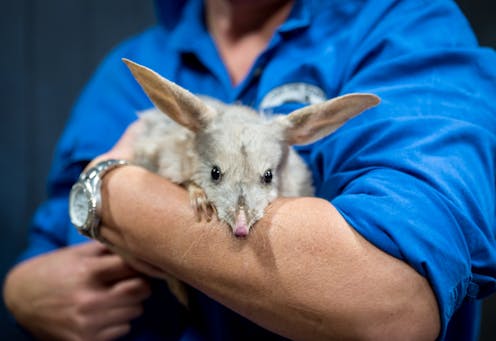
Commonly known as Australia’s “Easter bunny” due to its large ears and hopping movement, the greater bilby[1] (Macrotis lagotis) is the last of its kind. Today we published its reference genome – all 3.66 billion pieces of it.
Published in the journal Nature Ecology and Evolution[2], it is the largest marsupial genome to date. Not only is it bigger than the koala genome, it’s even bigger than that of humans.
A genome is the entire set of DNA – the building blocks of life – holding the genetic code for what makes a species what it is. So, what is a reference genome and why is it useful?
A reference genome is the reference point for investigating the biology of a species. It’s like the lid of a puzzle box: without it, you can figure out where the pieces go with time and patience. With it, the puzzle comes together quickly as you know what each piece is and where it goes.
The new reference genome can tell us more about bilby biology and evolution, like what genes are involved in their keen sense of smell, or how they have a slow metabolism to live in arid areas.
Importantly, the genome has allowed us to build new conservation tools to help managers and rangers save this unique Australian species.
A culturally important species
Bilbies are more than their unique biology. They are culturally important to Indigenous Australians, and have many Indigenous names across the country. We call the greater bilby Ninu – the name used by Western Australia’s Gibson Desert Kiwirrkurra Community[3] we worked with. Sadly, Ninu only now exist in 20% of their former range.
Historically, Ninu occurred across temperate and arid regions, while the Yallara (lesser bilby, Macrotis leucura) were only found in the sandy deserts. Both species declined sharply when Europeans arrived. They were predated on by foxes and cats, had to compete with rabbits, and experienced changes in cultural fire regimes.
The Yallara were well known to the Indigenous peoples of the central deserts but went extinct in the 1960s. Critical as “ecosystem engineers” thanks to their digging nature, today Ninu persist in small, fragmented populations mostly in the central deserts of Western Australia and the Northern Territory.
Indigenous knowledge, bilby ceremonies, stories and songlines still exist across the country linking sites and people, even where the animals are locally extinct.

The importance of genes
The more genetic variation (variation across the genome) a species has, the greater its ability to adapt to a changing world. Due to the extinction of the Yallara, and rapid declines of Ninu, a Ninu captive breeding program was established in 1979.
Originally housed in zoos, in 1997 Ninu were released onto islands and into fenced sanctuaries, to establish what’s known as a “metapopulation[4]”. To ensure their persistence, the National Bilby Recovery Team[5] sought to increase the number of fenced sanctuaries between 2016 and 2021.
Using our reference genome in combination with 363 Ninu samples from different sites, we were able to determine the genetic diversity of each site, and how different these sites were from one another.
We used this genetic data to select individuals to release into sanctuaries. Through this approach, we produced genetically diverse offspring, supporting the long-term survival of the species.
We can learn a lot from poo
Even though there are around 6,000 Ninu in the metapopulation, very little is known about Ninu in the wild. The Kiwirrkurra Community Indigenous Rangers have been working with the WA Department of Conservation, Biodiversity and Attractions for several years.
Using our reference genome and working with our team, department scientists developed a new scat (animal droppings) analysis tool. Using their cultural knowledge, Indigenous Rangers already knew where Ninu lived, what they ate, and how to track them.
 Indigenous ranger Scott West from the Kiwirrkurra Indigenous Protected Area in Western Australia, holding a bilby poo sample.
Kiwirrkurra Indigenous Protected Area
Indigenous ranger Scott West from the Kiwirrkurra Indigenous Protected Area in Western Australia, holding a bilby poo sample.
Kiwirrkurra Indigenous Protected Area
Now, by picking up their poo, they can tell them apart and know what sex they are, providing the Rangers with information to manage their Ninu populations.
Kiwirrkurra Indigenous Ranger Scott West notes:
Using old-ways and new-ways together helps us get good information about Ninu and how to look after them. This is what two-way science is.
Starting in 2024, with the support of the Save the Bilby Fund and Deadly Science, we are working with Indigenous communities across Australia to pick up poo so we can understand the genetic diversity of bilbies across their range and compare this to the metapopulation.
References
- ^ the greater bilby (australian.museum)
- ^ journal Nature Ecology and Evolution (doi.org)
- ^ Kiwirrkurra Community (www.ngaanyatjarra.org.au)
- ^ metapopulation (www.britannica.com)
- ^ National Bilby Recovery Team (www.dcceew.gov.au)