fresh, funny and completely joyous
- Written by: Huw Griffiths, Associate Professor of English Literature, University of Sydney
It is easy to forget that when Oscar Wilde’s The Importance of Being Earnest was first written and performed in February 1895, Ibsen’s A Doll’s House[1] was already 16 years old. Both plays, in different ways, expose the foundations of society (marriage; class; money; property) to searching critique.
Ibsen’s proto-modernism looks forward to a new century of realist scrutiny, as Nora slams the door on convention at the end of his play. But Wilde’s play looks backwards to older comedies of manners and aims for a similar effect by blowing their old, moral assumptions wide apart.
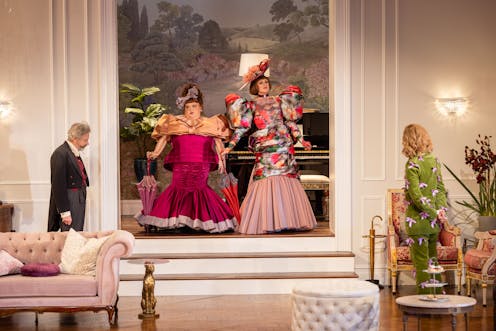
The Importance of Being Earnest is no less radical than A Doll’s House, but it is much more difficult to translate onto the 21st century stage without preserving it in aspic. Director Sarah Giles pulls the trick off with this new Sydney Theatre Company production.
It is fresh, funny and completely joyous. Wilde’s extraordinary script is delivered with sharp wit by an extraordinary cast and placed within a production that exploits the dialogue for its viciously comic potential.
The price of privilege
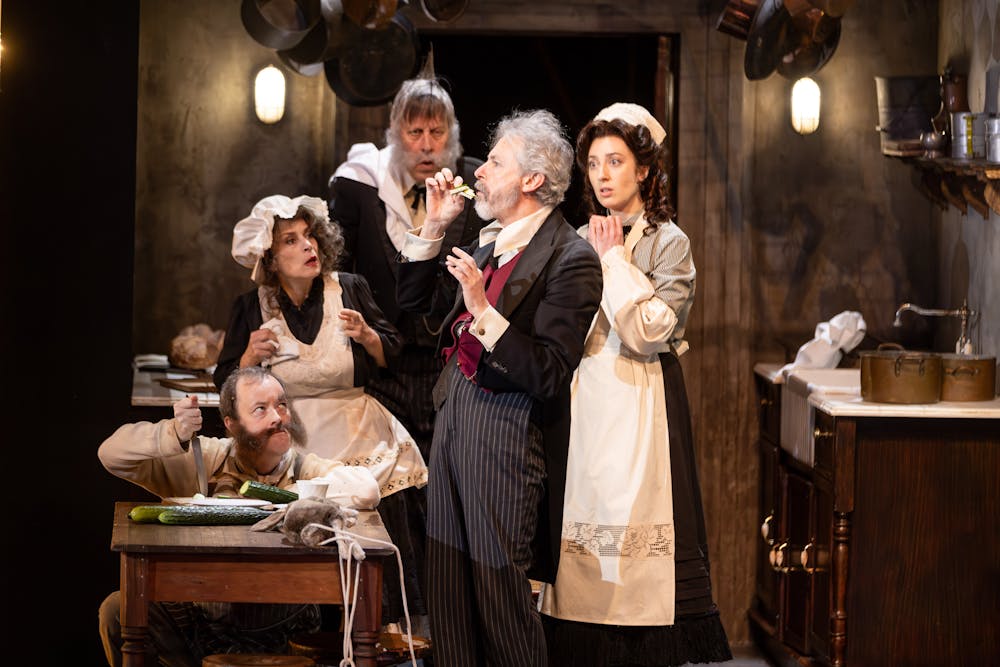
In one of very few changes, Giles has slightly expanded the roles of the servants in the play. In doing so, she has afforded us the pleasure of some beautifully comic moments from Sean O'Shea as Algie’s butler, Lane, and Gareth Davies as Merriman, servant to Jack.
More than this, however, the main action of the play now sits a little more uneasily alongside our awareness of the price of privilege. We are now conscious of the labour that has gone into the cucumber sandwiches and muffins, elsewhere launched as social weapons in the “Morning Rooms” and manicured gardens.
Helen Thomson’s Lady Bracknell is as brilliant as you’d expect from the phrase, “Helen Thomson’s Lady Bracknell”: imperious, monstrous, and utterly hilarious.
Some genuinely scene-stealing performances come from Megan Wilding as an exceptionally funny Gwendolen and Brandon McClelland as an exuberantly bumbling Jack. Charles Wu manifests Algie, the closest thing to Wilde’s voice in the play, with an elegantly light touch. Melissa Kahraman contributes an energetic and animated Cecily.
This latter performance, together with Wilding’s as Gwendolen, ensure the central act of the play is just as much a hire-wire act as the opening and closing. The middle part of the play focuses mainly on the female characters. When there is not enough attention paid to the casting and performance of Gwendolen and Cecily, it can drag a little. Not here, where their conversation over tea and cake becomes a battleground of wit and barely concealed violence.
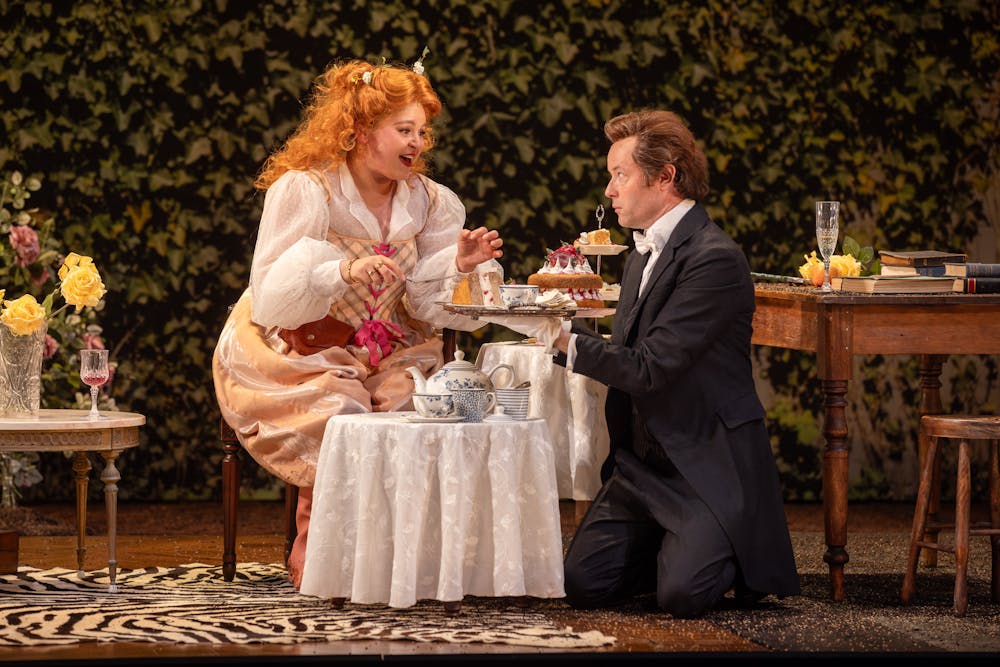 Melissa Kahraman contributes an energetic and animated Cecily.
Daniel Boud/Sydney Theatre Company
Melissa Kahraman contributes an energetic and animated Cecily.
Daniel Boud/Sydney Theatre Company
The fascinating liar
At the centre of Wilde’s play is, famously, “a handbag”.
Previous comedies of manners, such as Sheridan’s The School for Scandal[2], and even Wilde’s own earlier play, A Woman of No Importance[3], always had secrets at the heart of them. Revealing those secrets confirmed society’s moral codes. The School for Scandal even has an adulterous woman hiding behind a screen for much of the action of the play. Her discovery leads to confessions of guilt, repentance and reconciliation.
Wilde’s genius lies in completely overturning the assumptions behind this comic structure while still using its recognisable format. In place of sin, we have a momentary lapse of concentration from a nanny and a misplaced piece of luggage.
Wilde is looking backwards and taking aim at the traditions that have produced his own society as hypocritical.
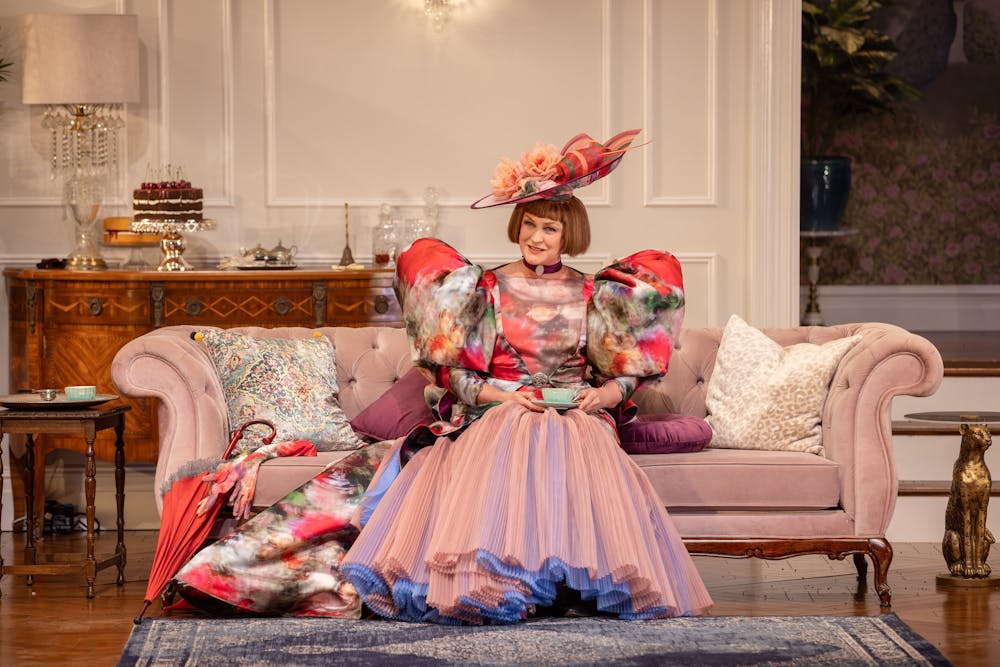 Helen Thomson’s Lady Bracknell is as brilliant as you’d expect.
Daniel Boud/Sydney Theatre Company
Helen Thomson’s Lady Bracknell is as brilliant as you’d expect.
Daniel Boud/Sydney Theatre Company
In some of his other writing, he explained how this overturning of “truth-telling” could bring about a social and artistic revolution. His brilliant essay, The Decay of Lying[4], written four years before Earnest, lays out an improbable plan for the future:
Bored by the tedious and improving conversation of those who have neither the wit to exaggerate nor the genius to romance […] Society sooner or later must return to its lost leader, the cultured and fascinating liar.
As with society, so with Art which:
breaking from the prison-house of realism, will run to greet him, and will kiss his false, beautiful lips, knowing that he alone is in possession of the great secret of all her manifestations, the secret that Truth is entirely and absolutely a matter of style.
Read more: Friday essay: in defence of beauty in art[5]
Absurd fragility
In making us slightly more aware of the social “truths” behind Victorian leisure, this production might have run the risk of undermining Wilde’s revolutionary celebration of the cultured and beautiful lie. What it pulls off, instead, is the Wildean effect of revelling in the pleasures of life’s surfaces while still being uncomfortably aware of their absurd fragility.
When the play made its way into print in 1899, four years after a triumphant London run, it did not have Wilde’s name attached to it. Wilde was in exile in Paris, his health destroyed by the two years of penal servitude he was sentenced[6] to for having sex with men.
This high-profile court case heralded a wave of legal homophobia that echoed through the 20th century. He died in 1900, with his (and our) futures crushed by a society over-keen on telling its own “truths”.
Go to this production and stay for its final moments in which one utterly charming piece of stage business hardly redresses the balance of the century of paranoid homophobia following Wilde’s arrest and imprisonment. But it does a very good job of laughing in its face.
The Importance of Being Earnest is at the Sydney Theatre Company until October 14.
Read more: On sexuality, the law still caters to the norms of public disgust[7]
References
- ^ A Doll’s House (en.wikipedia.org)
- ^ The School for Scandal (en.wikipedia.org)
- ^ A Woman of No Importance (en.wikipedia.org)
- ^ The Decay of Lying (virgil.org)
- ^ Friday essay: in defence of beauty in art (theconversation.com)
- ^ sentenced (www.history.com)
- ^ On sexuality, the law still caters to the norms of public disgust (theconversation.com)